

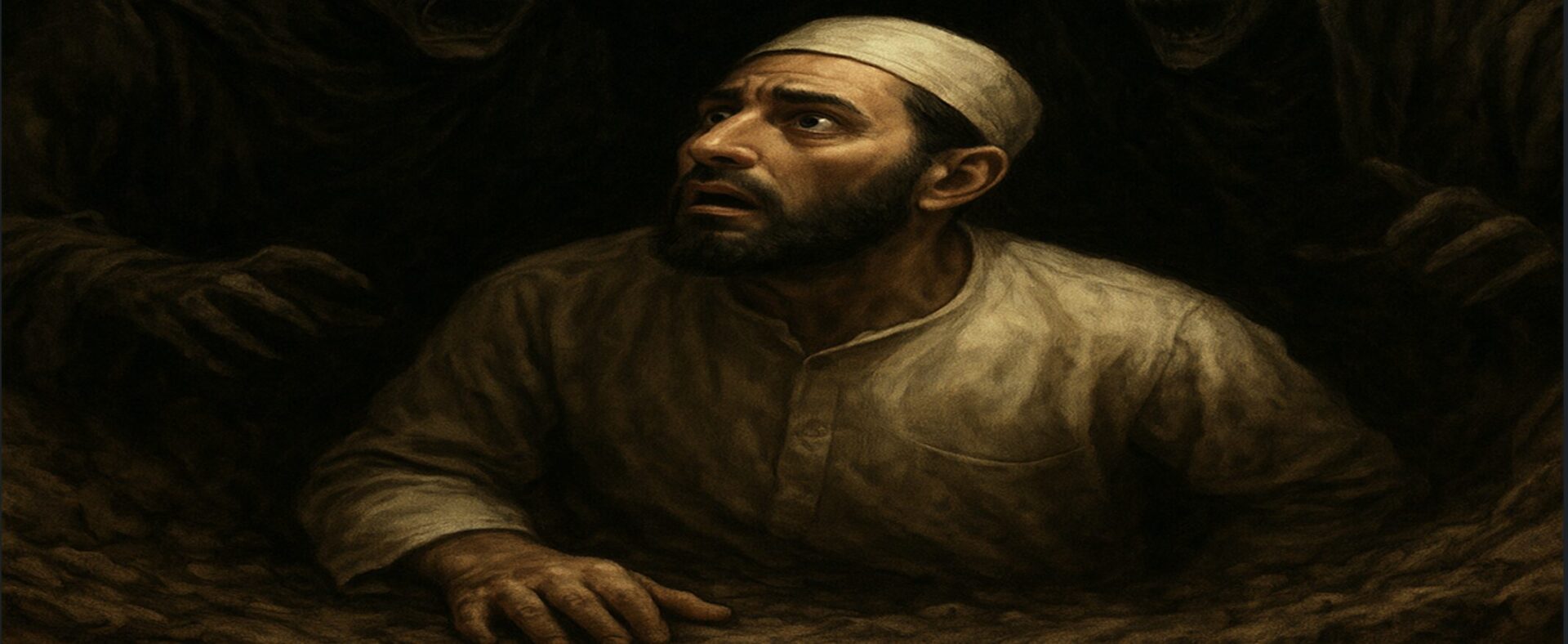
A Reflection on the Grave, Not a Transcript of the Unseen
The opening scene below should be read as a reflection, not as a word for word account of what every person will experience. Authentic hadith tell us about questioning in the grave. They do not give us permission to invent extra dialogue and present it as revelation.
The soil is still fresh.
The cries of the family have faded.
Silence.
Darkness.
Then, the sound of shoveling stops… and he wakes up.
Authentic reports describe two angels called Munkar and Nakir who question the deceased. Tirmidhi 1071 records the questioning and is graded sahih by Darussalam. We should not add dramatic descriptions that come from weak reports or our imagination.
They ask the question every soul must answer:
“Who is your Lord?”
His voice trembles, “Allah…”
“What is your religion?”
“Islam…”
“Who is your Prophet?”
“Muhammad ﷺ…”
The answers are correct. A glimmer of hope flickers.
The authentic grave questioning concerns the person’s Lord, religion and the Messenger ﷺ. The question “What did you prepare for this day?” is a useful reflective question for the living, but it should not be placed in the mouths of the angels as though it were part of the hadith.
Now his throat dries. His mind races. He blurts out:
“I prayed, I fasted. I gave my family everything they needed. I made sure to divide my wealth properly. I gave my children what they deserved. I was a fair man.”
The angels say nothing.
Islam teaches that deeds are recorded and that people will be accountable before ALLAH. The exact scene of a scroll being opened in the grave with this particular list is not established here, so it is better to keep the warning general rather than invent details of Barzakh.
He panics.
“But I did some good! I gave money to my siblings. I let my children enjoy my wealth. I left behind property, cars, accounts…”
The angels respond:
“Let us show you what came of it.”
A vision appears before him.
What heirs later choose to do with lawfully inherited wealth is normally their own responsibility. A deceased parent is not automatically punished because an adult child later travels, spends on luxury or even commits a sin. Responsibility depends on what the deceased actually taught, enabled, commanded or knowingly facilitated.
He weeps.
“But I meant well. I gave them freedom. I thought they would use it wisely…”
At this point the story becomes imaginative. There is no authentic report in which the angels question a deceased person about whether he built a well, sponsored an orphan or funded a masjid in these words.
Those are excellent forms of charity, but a fictional scene should not be presented as a revealed conversation.
He is silent.
Then, in a voice that sounds like judgment itself:
“These coins have no value here. The only currency in this grave is what you sent ahead—sincerely, for the sake of Allah.”
His chest tightens.
Authentic reports describe constriction and punishment in the grave for some people. We cannot assign that punishment to this imagined person’s spending choices or declare that owning property rather than funding a masjid caused his ribs to be crushed.
His screams echo—but no one hears.
Because in the grave, you are alone with your deeds.
A Ray of Mercy in the Darkness
Just as the torment begins, the pressure unbearable, a soft light appears in the grave.
It grows—slowly at first—then surrounds him like a shield. The angels pause. The crushing walls hold back.
He blinks, confused. “What… is this?”
A beautiful figure, radiant and peaceful, stands before him. Calm. Comforting. Familiar.
“Who are you?” he asks.
The figure replies:
There is authentic support for a more general idea. In the long hadith of Al Bara ibn Azib, a beautiful man appears to the believer and identifies himself as the person’s righteous deeds. The hadith does not identify that figure specifically as a well, Quran copies, a masjid or an orphan project.
Read the narration of Al Bara ibn Azib
Tears of gratitude stream down his face. He had forgotten those deeds—small gestures done quietly, for Allah alone.
The angels step aside.
A window to Paradise opens. A breeze scented with musk flows in. His grave expands, wide and green, like a garden from Jannah.
He lies down, relieved.
Not because of his name.
Not because of his wealth.
But because he remembered to send something forward.
What Will Defend You?
This is a reflection built around real Islamic teachings about death and Barzakh. The invented parts are not a preview of anyone’s exact experience.
The grave is not fiction—it is your next address. And everything you own today, everything you chase, will be stripped away at the moment of death. Only your intentional good deeds—done for the pleasure of Allah—will rise with you.
So before your bank account is frozen,
Before your name becomes a memory,
Before your phone stops ringing forever—
Ask yourself:
What have I truly sent ahead?
Because the grave doesn’t accept credit cards. Only credit with Allah.
What Authentic Reports Say About the Grave
The well known wording “the grave is either a garden from the gardens of Paradise or a pit from the pits of Hell” appears in Tirmidhi 2460, but that chain is graded weak by Darussalam. The broader reality of reward and punishment in Barzakh is supported by stronger reports, including Tirmidhi 1071 and the hadith of Al Bara ibn Azib.
Read Tirmidhi 2460 and its grading
We live as if we will never die. We spend, decorate, build, and flaunt as though this world is eternal. But the ground beneath our feet is not just for walking—it’s waiting to consume us. And what happens after the funeral, after the body is lowered, and after the final handful of soil falls?
That’s where the real reckoning begins.
The Torment That Begins Before Judgment Day
The punishment of the grave (ʿadhāb al-qabr) is not a metaphor. It is a reality—explicitly mentioned in the Qur’an and Hadith.
“The Fire; they are exposed to it morning and evening. And on the Day the Hour will be established [it will be said], ‘Make the people of Pharaoh enter the severest punishment.'”
(Qur’an, 40:46)
This verse speaks of the torment of the grave, a prelude to Hell for those who neglected Allah’s commands.
According to authentic Hadith:
“When a believer is placed in his grave, two angels will come to him… But if he was a hypocrite, he will say, ‘I heard people saying something, so I said the same.’ He will be struck with an iron hammer, and he will scream so loud that everything near him hears it—except humans and jinn.”
(Bukhari & Muslim)
The Illusion of Material Wealth
Many Muslims today live with a dangerous delusion: “I provided for my family, I left behind wealth. Surely that counts for something?”
But here’s a question—did you invest in the Afterlife?
You bought property, but did you build a masjid?
You gave to your children, but did you sponsor an orphan?
You paid for their education, but did you leave behind any sadaqah jariyah (any act that continues to benefit humanity even after the death) that now protects you?
A Haunting Scenario in the Grave
Imagine a Muslim man, average by every standard. He prayed, fasted, even performed Hajj once. He assumed he’d done “just enough.”
In the grave, the angels ask:
“What have you prepared for this day?”
He lists his deeds. But then, a scroll of his sins is brought out—secret ones, forgotten ones, minor ones that piled up. There’s no more salah to offer, no more time to make amends.
He pleads:
“But I gave money to my siblings. I told my children to divide the inheritance fairly.”
A scene plays before him.
🎞️ His siblings spent the money gambling and on alcohol.
🎞️ His children traveled the world, buying luxury cars, indulging in vanity.
🎞️ Fights over property caused deep family rifts.
The way heirs use inherited wealth does not automatically increase the deceased person’s punishment. The deceased remains accountable for his own conduct, including any wrongdoing he taught, encouraged or knowingly enabled.
The angels ask:
“Did you leave behind a well for the poor to drink from?
Did a single orphan make duʿā for you?
Is there a Qur’an school or masjid you helped build?
Did anyone remember you in their prayers?”
Silence.
He is told:
“What you buried with your body is not your wealth, but your deeds. And only they can defend you now.”
What We’re Getting Wrong
We think we’re safe just because we lived as “good Muslims” by cultural standards. But we:
- Skip prayers because we’re “tired.”
- Delay Hajj until it’s “more convenient.” or even more dangerous, “I am not ready”
- Spend more on oneself than we do on orphans.
- Think a yearly zakat check is our ticket to Jannah.
Meanwhile, our graves are being dug by our own hands.
What Should You Do?
Here’s how Islamic references suggests us to prepare for the moment your body touches the soil:
1. Prioritize Sadaqah Jariyah
- Build a masjid, a well, a school.
- Sponsor Islamic education.
- Distribute Qur’ans.
“When a person dies, their deeds end except for three: a continuing charity, knowledge that is benefited from, or a righteous child who prays for them.” (Muslim)
2. Create a Legacy of Duʿā
- Be the person whom others want to pray for after you’re gone.
- Support causes that deeply impact real lives—orphans, widows, da’wah.
3. Document an Islamic Will
- Ensure your wealth serves your Akhirah.
- If making a wasiyyah for charity or other non heirs, remember that the ordinary limit is up to one third of the estate after debts and funeral expenses, unless the eligible heirs consent to more. Faraid shares and Singapore estate administration rules still need to be respected.
4. Live With Accountability
- Repent regularly for sins—especially secret ones.
- Keep your heart detached from the dunya.
The Grave is Not a Mystery. It’s a Mirror.
The Prophet ﷺ said:
“Every one of you is shown his place in the morning and evening, either in Paradise or Hell, and it is said: ‘This is your place until Allah resurrects you on the Day of Judgment.’” (Bukhari)
Ask yourself now: What will your grave show you?
Will it be lit by the Qur’an you recited, the masjid you helped build, the orphan who prays for you?
Or will it echo with screams, regret, and the weight of wealth used wrongly?
Don’t Just Leave Money—Leave Meaning
This world is a market. You’re either buying your Jannah or selling your soul.
The bank accounts you fill, the assets you hoard, the family members you spoil—none of them can stop the soil from closing in.
But your intentional deeds, your eternal investments, and your pure repentance?
They can light up your grave before your eyes even close.
Final Reflection
Wealth is not evil. But when it becomes your comfort blanket in this world and your coffin in the next—you’ve made it your god.
So prepare. Because no matter how luxurious your mattress today, your true bed is being dug six feet deep.

2 Comments
🤔 topic.
… you think you’re just gonna shuffle off and that’s it? What if your first passenger in the afterlife is your own bad habits?
evr stopped to wonder what sort of baggage your daily routine is dragging into the grave with you?
3your grave gets comfy for good deeds but squeezes you for the bad… which one do you think it’s preparing for
Btw, I m not a Muslim, but I don’t despise them. Just curious on the topic
Hi Avery
Honestly, that’s such a real question. Most of us don’t think twice about the ‘baggage’ we’re piling up in our day-to-day. But in Islam, the grave isn’t just a resting place—it reacts to what you bring with you. Like, if your days were full of good—kindness, prayer, even small stuff done sincerely—it opens up like a cozy space. But if it’s mostly bad… let’s just say it gets real tight.
And hey, totally respect where you’re coming from. Being curious without being judgmental is a rare combo these days, and it actually reflects a kind of humility Islam values a lot.
The Learning Guy