


Spiritual wellness is often reduced to feeling calm or connected. In Islam, the picture is broader. Faith, worship, repentance, character, relationships and responsibility before ALLAH all shape a person’s spiritual life. Modern research can explore links between religion and wellbeing, but it does not define Islamic spirituality. Revelation and recognised scholarship do that.
Table of Contents
- Defining spiritual wellness in Islam
- Core pillars: Tazkiyah, iḥsān, and intentional practice
- Faith, practice, and well-being: The research perspective
- Islamic spiritual wellness vs. secular mindfulness
- Practical steps to nurture your spiritual wellness as a young Muslim professional
- Why spiritual wellness in Islam is misunderstood—and why it matters now
- Continue your spiritual journey with Rethinking Islam
- Frequently asked questions
Key Takeaways
| Point | Details |
|---|---|
| Holistic approach | Islamic spiritual wellness unites faith, ethics, and personal development into a single, actionable framework. |
| Core practices matter | Tazkiyah, iḥsān, and intentional action are the foundation of Islamic spiritual wellness—not just beliefs or feelings. |
| Practical impact | Integrating these principles can promote emotional resilience and purpose for young Muslim professionals. |
| Islamic vs. secular | Islamic spiritual wellness differs from generic mindfulness by emphasizing God-consciousness and accountability. |
| Continuous journey | Spiritual wellness in Islam is an ongoing path of striving for growth, not a state of perfection. |
Defining spiritual wellness in Islam
Most people borrow the word “spiritual” from Western wellness culture, where it often means vague feelings of peace or connection to something bigger. Islam offers something far more concrete. Spiritual wellness here is grounded in īmān (faith), consistent worship, and akhlāq (moral character). It is not a passive state you stumble into. It is an active orientation toward Allah that shapes how you think, act, and relate to the world.
A foundational concept in this framework is tazkiyah, which means purification of the soul. This is not just about avoiding sin. It is about actively cultivating sincerity, gratitude, patience, and God-consciousness in every dimension of life. The Islamic views on wellness tradition has always held that physical, emotional, social, and spiritual health are deeply interconnected. You cannot compartmentalize your spiritual life from your work stress, your relationships, or your mental state.
A central Islamic framework for spiritual wellness is tazkiyah, which links inner purification with tawhid-based worship and produces taqwa (God-consciousness) and ikhlāṣ (sincerity). This is not abstract theology. It is a practical roadmap.
Tazkiyah is best understood as an ongoing effort to purify the inner life and improve conduct. It includes repentance, sincerity, self examination and the cultivation of qualities such as patience, gratitude and humility.
Here is a quick breakdown of the core dimensions of Islamic spiritual wellness:
| Dimension | Islamic concept | Practical expression |
|---|---|---|
| Inner purification | Tazkiyah | Regular self-reflection, repentance |
| God-consciousness | Taqwa | Ethical decision-making, mindfulness of Allah |
| Sincerity | Ikhlāṣ | Intentional worship and action |
| Moral conduct | Akhlāq | Honest dealings, compassion, fairness |
| Social wellness | Haqq al-nās | Fulfilling obligations to others |
Understanding this table changes how you approach personal growth. Spiritual wellness is not just one column. It is the whole table working together. And as mental health in the Sunnah scholarship shows, the Prophet Muhammad (peace be upon him) modeled this integration in every aspect of his life.
Core pillars: Tazkiyah, iḥsān, and intentional practice
Once you understand the holistic nature of spiritual wellness, the next question is: how does it actually work? The Islamic tradition gives us a clear methodology built around three interlocking pillars.
Tazkiyah is the process of purifying the soul from harmful traits like arrogance, envy, and heedlessness, and cultivating virtues like humility, gratitude, and reliance on Allah. Think of it as ongoing maintenance for your inner life. You would not let your physical health deteriorate without intervention. The same logic applies here.
Iḥsān takes things further. It is often translated as spiritual excellence or the highest level of worship. The Prophet (peace be upon him) defined it as worshipping Allah as though you see Him, and knowing that even if you do not see Him, He sees you. Islamic spiritual excellence functions as a core mechanics layer for spiritual wellness: worship and conduct with deep God-consciousness. This is not reserved for scholars or saints. It is a standard every Muslim is invited to aspire toward.
Muraqabah means self-accountability. It is the practice of regularly checking in with yourself: your intentions, your actions, your patterns. Where are you falling short? Where are you growing? This is not self-criticism for its own sake. It is a tool for course correction and continuous improvement.
The structured practice of tazkiyah, muraqabah, dhikr, and ṣalāh forms the methodology of Islamic spiritual wellness, not just a feeling but a repeatable, daily system.
Here is how these pillars translate into daily life:
- Set your niyyah (intention) before every action. Before you start your workday, before a meeting, before eating. This one habit rewires how you experience ordinary moments.
- Perform ṣalāh on time. Not as a checkbox, but as five daily resets that return you to God-consciousness.
- Practice dhikr (remembrance of Allah) consistently. Even ten minutes of morning and evening adhkar builds a baseline of spiritual awareness.
- Make duʿāʾ (supplication) personal and honest. Talk to Allah about your actual life, not just recited phrases.
- End your day with muraqabah. A brief self-review: what did I do today that aligned with my values? What did not?
Before a presentation, difficult email or negotiation, pause and clarify your intention. In Islam, niyyah matters because actions are judged in relation to intention. A lawful everyday action can also carry spiritual value when it is connected to a sincere purpose.
For deeper reading on Islamic approaches to spiritual growth, the tradition is rich and surprisingly practical for modern contexts.
Faith, practice, and well-being: The research perspective
Modern research has examined relationships between religion, spiritual practice, coping, community support and psychological wellbeing. The findings can be useful, but they should be read carefully. Many studies are observational, methods vary and an association does not prove that a religious practice will produce the same psychological or physical effect in every person.
Islamic spirituality practices are discussed in peer-reviewed literature as potentially associated with psychological and spiritual well-being, though research gaps remain and effects depend on how spirituality is operationalized. In plain terms: the research is promising, and the methodology matters.
For believers, practices such as salah, dua, dhikr, sabr and tawakkul can provide meaning, structure and a way to respond to difficulty. Family and community can also provide valuable support. These benefits should not be turned into medical promises.
Prayer does not guarantee a lower cortisol level. Dhikr is not a substitute for treatment of an anxiety disorder. Tawakkul does not mean ignoring trauma, depression or persistent distress. Spiritual practice and professional healthcare can work alongside each other.
Some studies report positive associations between Muslim religious practice and wellbeing, while the strength and quality of evidence varies. Religious practice may support coping and meaning, but persistent mental health symptoms deserve proper assessment rather than being interpreted as a simple shortage of faith.
If you are navigating stress at work or dealing with anxiety, the Islamic approach to managing anxiety draws directly from these practices. And as technology reshapes Muslim well-being, there are new ways to integrate these practices into modern life without losing their depth.

Islamic spiritual wellness vs. secular mindfulness
The wellness industry loves the word “mindfulness.” Meditation apps, corporate retreats, and therapy programs have all adopted it. And while mindfulness has real benefits, it is worth being clear about what makes the Islamic framework different and, for Muslims, more complete.
Mindfulness programmes vary. Many teach attention to present experience and reduced automatic reactivity, and some are used in clinical settings. They are not the same thing as salah, dhikr, dua or muraqabah, because Islamic worship has its own religious meaning, intention and relationship with ALLAH.
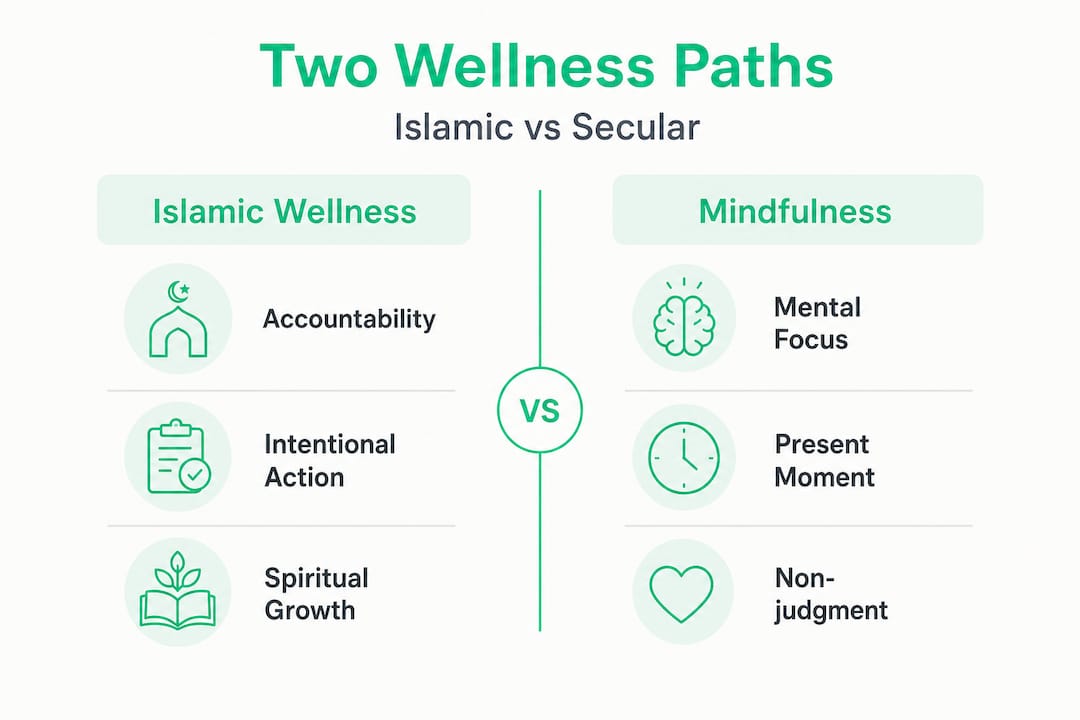
Islamic spiritual wellness is structured differently. Islamic practices like muraqabah, ṣalāh, dhikr, and niyyah are conceptually distinct from secular mindfulness because they emphasize transcendental accountability, not just mental focus. You are not just observing your thoughts. You are measuring them against divine guidance and actively working to align your inner life with your Creator.
Here are the key distinctions:
- Islamic worship: Salah, dhikr and dua are acts directed toward ALLAH and shaped by revelation.
- Mindfulness programmes: Their aims differ depending on whether they are clinical, educational, religious or secular.
- Possible overlap: Both may involve attention and reduced impulsive reaction, but overlap does not make them the same practice.
- For Muslims: Useful psychological techniques can be considered without replacing the religious meaning of worship.
“The Islamic tradition does not separate inner calm from moral accountability. Genuine spiritual wellness is always oriented toward Allah and expressed through ethical action in the world.”
This distinction matters because Muslims do not need to rename worship as a wellness technique before taking it seriously. At the same time, beneficial psychological tools do not become religiously suspect merely because they were developed outside an Islamic setting.
Practical steps to nurture your spiritual wellness as a young Muslim professional
Theory is only useful if it changes how you live. Here is a practical, step-by-step approach to building Islamic spiritual wellness into a busy professional life. These steps are not idealistic. They are designed for someone juggling deadlines, relationships, and the constant noise of modern life.
Spiritual wellness is realized through structured practice including tazkiyah, intention, accountability, and faith-driven action. That structure is what makes it sustainable.
- Start with niyyah every morning. Before you check your phone, take sixty seconds to set your intention for the day. What kind of person do you want to be today? What are you doing this for?
- Protect your five daily prayers. Even in the busiest schedules, ṣalāh on time is non-negotiable. Use it as a transition ritual between work blocks, not an interruption.
- Build a dhikr habit. Morning and evening adhkar take under ten minutes. Pair them with an existing habit like your morning coffee or commute.
- Schedule weekly self-reflection. Friday evenings are a natural reset point. Spend fifteen minutes reviewing your week through the lens of your values and intentions.
- Bring your values into your professional conduct. Honesty in reporting, fairness in team dynamics, and compassion in leadership are all expressions of Islamic spiritual wellness in action.
- Engage with a learning community. Regular engagement with Islamic knowledge, whether through podcasts, articles, or study circles, keeps your spiritual framework sharp and relevant.
Pro Tip: Treat your spiritual development the same way you treat professional development. Schedule it, track it, and invest in it. The professionals who grow fastest are the ones who are intentional about both. If you are planning spiritual travel for soul nourishment, that same intentionality transforms a trip into a genuine renewal.
Why spiritual wellness in Islam is misunderstood—and why it matters now
Here is an uncomfortable truth: most Muslims who talk about spiritual wellness are actually describing spiritual comfort. They mean the feeling of peace after a good prayer, or the warmth of Ramadan. Those feelings are real and valuable. But they are outcomes, not the practice itself. And when the feeling fades, which it always does, people assume something is wrong with them or their faith.
The real misunderstanding is treating spiritual wellness as a mood rather than a methodology. Islam never promised that faith would feel good all the time. It promised that structured practice, honest accountability, and sincere orientation toward Allah would produce thabāt (steadfastness) and tuma’nīnah (inner tranquility) over time. That is a very different value proposition.
For young Muslim professionals, pressure to perform, conform or compartmentalise faith can be real. A spiritual life built only around pleasant feelings may become fragile when those feelings disappear. Tazkiyah, ihsan, prayer and self examination can provide a steadier reference point, although no practice makes a person immune to stress or mental illness.
The other misunderstanding is that spiritual wellness is private. Islam is clear that your inner state is expressed through your conduct. How you treat your colleagues, how you handle failure, how you respond to success. These are not separate from your spiritual life. They are its most visible expression.
For modern Muslims, the useful goal is not to reduce faith to rituals, moods or productivity tools. Spiritual growth should affect worship, character, relationships, work and responsibility while leaving room for ordinary human vulnerability.
Continue your spiritual journey with Rethinking Islam
If this article sparked something in you, that is exactly the point. Understanding spiritual wellness in Islam is the beginning, not the destination.

At Rethinking Islam, we build content specifically for Muslims who want to go deeper without losing their modern footing. Whether you want to explore Islamic thinking for modern minds, boost your Islamic literacy, or explore the full landscape of Islamic healing and wellness, you will find resources here that take your intelligence and your faith seriously. This is a space built for Muslims who refuse to choose between being fully Muslim and fully present in the modern world.
Frequently asked questions
Is spiritual wellness in Islam only about religious rituals?
No, it includes inner purification, ethical living, and holistic wellness alongside faith and practices. Tazkiyah links inner purification with worship, moral conduct, and social responsibility as an integrated whole.
How is Islamic spiritual wellness different from secular mindfulness?
Islamic spiritual wellness is rooted in accountability to Allah and intentional action, not just mental focus or emotional regulation. Islamic practices like muraqabah are conceptually distinct from secular mindfulness by emphasizing transcendental accountability.
Can practicing spiritual wellness improve mental health?
Some research finds associations between religious practice and psychological wellbeing, but results vary and do not prove that spiritual practice is a treatment for a mental health condition. Religious support can complement qualified healthcare when needed.
Do I need to be “perfect” in practice to experience spiritual wellness?
No, spiritual wellness is a journey of continuous growth and striving for sincerity, not perfection. The tradition emphasizes istimrār (consistency) and honest effort far above flawless performance.
What’s a good place to start for nurturing spiritual wellness as a busy professional?
Begin with setting intentionality in daily actions and establishing a regular practice of dhikr, ṣalāh, and personal reflection. Structured practice through tazkiyah and intention is where sustainable spiritual wellness begins.
Recommended
- Healing the Body and Soul – Islamic Views on Wellness – Rethinking Islam
- Do You Know the Islamic Hack to Dealing with Anxiety? – Rethinking Islam
- Mental Health in the Sunnah – A Forgotten Topic – Rethinking Islam
- She’s Not Lost—She’s Just Finding Her Way with Allah – Rethinking Islam
Reviewed and edited for Rethinking Islam.
