

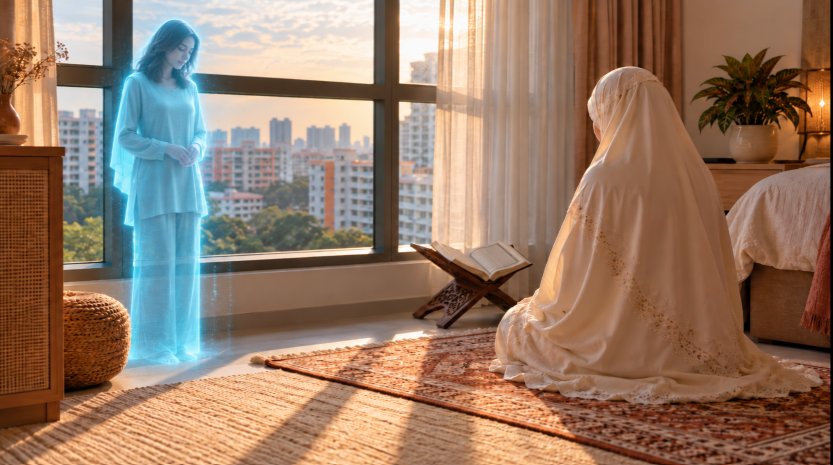
A woman is at home in her HDB bedroom. The door is locked. The curtains are closed. The family is out, the phone is on silent, and nobody can see her.
She lays out her prayer mat, puts on her telekung or prayer covering, and begins salah.
It raises a fair question.
If a woman covers mainly because men may see her, why does she still cover her hair when she is completely alone? Why do women also cover appropriately when praying together in a private room with only women present?
The short answer is this: covering in salah is not only about who may see a woman. It is part of how she prepares to stand before Allah.
That does not mean we know every wisdom behind every detail. But the religious instruction itself is clear, and scholars have offered meaningful explanations for what it teaches us about worship.
The Quran Connects Clothing With Worship
Allah says:
“O children of Adam, dress properly whenever you are at worship.”
Read Quran 7:31 and its English commentary.
The verse was revealed in a context where some people performed tawaf without proper clothing. Yet its wording is broader. It links appropriate dress with worship.
This is important. The Quran does not say in this verse, “Women must cover their hair in private prayer because of this one specific reason.” But it does show that clothing is part of approaching worship properly.
Salah is not merely a private conversation that happens in whichever state we happen to be in. It has a form. We perform wudu. We face the qiblah. We stand, bow and prostrate at appointed times. Clothing is also part of that preparation.
The Specific Instruction Comes Through the Prophet ﷺ
A hadith narrated by Aishah states:
“Allah does not accept the prayer of a woman who has reached puberty unless she wears a veil.”
Read Sunan Abi Dawud 641. The page grades it sahih according to Al Albani.
The same report appears in Jami at Tirmidhi 377, where Imam Al Tirmidhi grades it hasan and explains that the wording refers to a woman who has reached maturity. It does not mean a woman is praying while menstruating.
For Muslims, the Prophet’s teachings carry religious authority. The Quran says:
“Whoever obeys the Messenger has truly obeyed Allah.”
Read Quran 4:80.
So yes, this is understood as something Allah requires through the teaching of His Messenger ﷺ. It is not a cultural habit created much later, nor is a telekung itself the only acceptable garment. A telekung is simply a familiar way many women in Singapore and Malaysia use to meet prayer clothing requirements.
But Why Does It Still Matter When Nobody Is There?
Here is the heart of the question.
A woman may uncover her hair at home in appropriate private settings. Yet when she begins salah, the requirement changes. This shows that ordinary privacy rules and prayer rules are related, but they are not identical.
A classical explanation, quoted in this English discussion of prayer in private, puts it plainly: a woman praying alone covers during prayer what she may be allowed to leave uncovered outside prayer.
In other words, prayer clothing is not activated only by the presence of men.
The same principle applies to men. Men also have requirements about covering in salah, including when alone. Prayer has bodily manners for everyone. It is not a performance for human spectators.
That helps us reach a more complete answer. Islamic modesty does include matters of gaze, privacy and sexual ethics. But those matters cannot be the full explanation for prayer clothing, because the requirement remains even when no human being can see.
Standing Before Allah Is Not Like Being Watched by People
Allah does not need clothing to know what is hidden. Nothing is hidden from Him.
So covering during salah is not about concealing the body from Allah. It is about the worshipper entering an act of worship with the outward preparation Allah has prescribed.
Think of it this way. We do not make wudu because Allah needs to be informed that our hands are clean. We make wudu because purification is part of how salah is approached. We face the qiblah even when we are alone in a room because direction is part of the form of prayer.
In the same way, appropriate clothing becomes part of the sacred etiquette of salah.
A contemporary Salafi explanation of prayer covering describes it through dignity, modesty and obeying Allah’s instruction. That explanation should be understood carefully. The evidence establishes the instruction more directly than it reveals every wisdom behind its exact form.
Still, the meaning is not empty.
A woman putting on her prayer garment is not dressing up for people. She is stepping away from daily life and entering salah. The laundry can wait. The office messages can wait. That one notification insisting it is urgent can also wait. Allah has been receiving prayers long before WhatsApp arrived.
The Outer Preparation Can Remind Us About the Inner One
Scholars of spirituality have often reflected on the connection between outward preparation and inward preparation.
When we cover for prayer, we may also remember the state of our hearts. Are we carrying resentment? Are we distracted? Are we returning to Allah sincerely?
This does not mean a prayer garment magically produces concentration. Anyone who has tried to pray while mentally planning dinner knows the struggle is real.
But preparing the body can create a pause. It can signal to the heart: now is the time to stand before Allah.
For some women, familiar prayer clothing brings comfort and a sense of readiness. For others, it creates a helpful boundary between the rush of work, caregiving or household tasks and a few minutes of worship.
These are possible personal benefits. They are not proof that every woman feels the same way, and they are not the stated reason for the religious requirement.
What About Angels or Unseen Beings?
Some people say a woman must cover because angels, jinn or unseen beings may be watching.
We should be careful here.
There are general Islamic teachings about modesty in private. But there is no clear, sound evidence establishing that women must cover their hair during salah because angels or jinn are watching them.
This review of the evidence about uncovered hair and angels specifically says there is no clear sound text proving that angels do not attend a gathering merely because women uncover their hair.
So this should not be presented as the reason for prayer covering. We should not turn possibilities into religion. Islam already has enough evidence without adding mystery for extra flavour.
What If Someone Enters Unexpectedly?
There is a practical point worth mentioning.
In a shared home, office prayer room or family gathering, someone may accidentally enter. A door may be left unlocked. A child may appear at the worst possible moment, usually with a question that cannot wait thirty seconds.
Covering can provide a practical safeguard in such situations.
But this is an additional benefit, not the complete reason for the rule. Even if a woman is alone in a securely locked room, the prayer requirement remains. And if someone intrudes, responsibility for respecting privacy also lies with the person entering.
A More Complete Way to Understand It
A woman covers in private salah because the Prophet ﷺ taught that prayer has a clothing requirement for an adult woman.
The deeper meaning is not that she is hiding from Allah, nor that a man must always be nearby somewhere in the background. Rather, she is approaching Allah through a form of worship that includes both body and heart.
Scholars explain this through obedience, reverence, dignity and modesty before Allah. These are meaningful explanations, even though we should be honest that Allah has not revealed to us every wisdom behind every detail.
That honesty matters.
We know the command more clearly than we know its complete wisdom. Yet perhaps that is part of what salah teaches. A prayer mat in a quiet bedroom, a woman covered before no human audience, and a heart turning towards Allah remind us that worship is not only about what other people see.
Sometimes the door closes, the room becomes quiet, and faith becomes very personal indeed.
Question: Why is there a difference between men’s and women’s casual dressing requirements during salah, even when they are praying alone in complete seclusion?
Answer: Islam sets different minimum clothing requirements for men and women during salah. Men cover their awrah, while women cover more, including their hair. The sources establish this rule but do not give one complete reason for every difference. Private prayer shows that a woman’s covering is not only about men looking at her. It is also part of obedience, reverence and preparing to stand before Allah.
Further reading, with live links checked:
- Is Makeup Haram in Islam for Women? on Rethinking Islam
- Building Confidence: How Faith Enhances Self Esteem in Muslim Women on Trailblazing Muslimahs
