

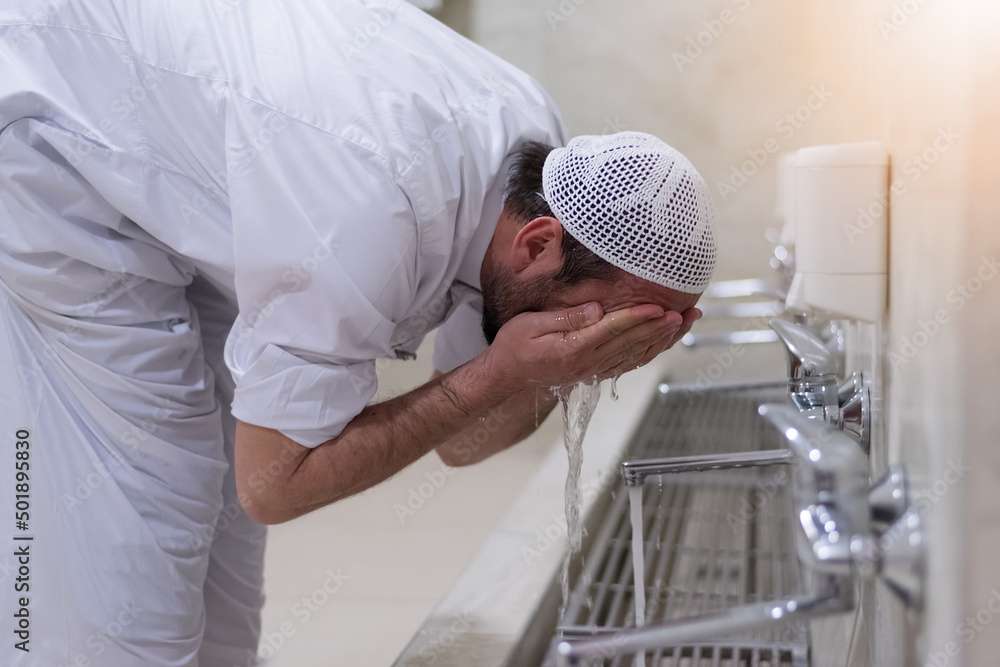
Wudu may sometimes need to be performed in a modern bathroom that also contains a toilet. This raises a practical question: should Bismillah be said aloud before beginning wudu there?
The majority of scholars regard saying Bismillah at the beginning of wudu as recommended rather than a condition for validity. Scholars then differ about verbally mentioning Allah inside a toilet area, so the issue should be presented as a fiqh disagreement rather than as a single absolute rule.
Why Bismillah Is Mentioned Before Wudu
There are hadith used by jurists when discussing saying Bismillah before wudu. Scholars differ over the strength and legal effect of those reports, which is why some regard Bismillah as recommended while others give it greater legal weight.
The bathroom question is separate. Classical etiquette generally discourages verbal remembrance of Allah in a place used for relieving oneself. Some contemporary scholars therefore recommend saying Bismillah before entering, while others permit saying it quietly when the bathroom is clean and wudu is being performed there.
Opinions of Scholars
Navigating the nuanced opinions of scholars on invoking Allah’s name during moments of purification, especially in places considered impure, poses a challenge. The differing views on saying “Bismillah” during ablution in a bathroom with an attached toilet reflect the diversity within Islamic jurisprudence.
Following a recognised school or qualified scholar does not mean a person is blindly inventing religion. Most readers are not expected to independently grade hadith and derive legal rulings. The useful goal is to understand that more than one recognised opinion exists and follow reliable guidance consistently.
One practical view is to say Bismillah before entering the bathroom. Another is to say it quietly at the point of wudu. Some scholars also mention remembering Allah in the heart without verbalising the words. These approaches reflect different attempts to combine the etiquette of wudu with respect for a toilet area.
The safest general advice is simple. If it is easy, say Bismillah before entering the bathroom and then perform wudu. If you follow a scholar who permits saying it quietly inside a clean modern bathroom, that is a recognised view. Omitting Bismillah does not invalidate wudu according to the majority of scholars.
Read a summary of the scholarly disagreement
Modern Structure of Toilets
- Modern Toilet Structure:
- Unlike traditional toilets, modern bathrooms often have a separate area for toilets and sinks, allowing individuals to perform wudu at the sink without being directly in the presence of the toilet.
- The act of wudu involves specific steps, including washing the hands, face, arms, wiping the head, and washing the feet. These steps can be completed at the sink, which is usually located separately from the toilet area in contemporary bathrooms.
- Adaptation to Practicality:
- Understanding the challenges posed by modern bathroom structures, scholars acknowledge the flexibility in performing wudu while maintaining respect for the sacred nature of the act.
- Scholars may differ in their opinions, but many agree that saying “Bismillah” at the sink during wudu is permissible. However, if an individual finds it challenging or uncomfortable, they have the option to say “Bismillah” before entering the bathroom and then proceed with wudu.
In summary, the key is to combine adherence to traditional Islamic practices with a practical understanding of modern bathroom structures. The intention, supplication, and method of performing wudu or ghusl can be adapted to accommodate the facilities available while upholding the sanctity of these acts of purification.
Addressing Common Misconceptions
A. Clarifying misconceptions about saying Bismillah in the toilet
Respect for Allah’s name is precisely why some jurists discourage verbal dhikr inside a toilet area. Modern bathrooms may be cleaner and may combine a toilet, shower and sink, but that does not erase the classical etiquette question. The difference in layout is one reason contemporary scholars may apply the rule differently.
B. Encouraging a holistic understanding of Islamic rituals
Islam is a comprehensive way of life that encompasses all aspects of a Muslim’s life. It is essential to understand that Islamic rituals are not confined to specific spaces or moments but are meant to be practiced in all settings. Saying Bismillah during Wudu in the toilet serves as a reminder that Islam is a religion that emphasizes spirituality in every aspect of life and seeking a clear understanding on many actions in life.
C. Promoting unity and respect within the Muslim community
Diverse practices within the Muslim community should be respected and embraced. While saying Bismillah during Wudu in the toilet is a practice followed by some Muslims, others may have different interpretations. It is important to promote unity and respect within the Muslim community, understanding that the core intention behind these practices is to seek Allah’s blessings and maintain a strong connection with Him.
There is no established Sunnah prescribing Surah Al Fatiha, Ayat al Kursi or other Quran recitation during an ordinary shower. A bathroom containing a toilet is also not the place to invent a new recitation routine and then describe it as spiritual purification.
The Prophet Muhammad (peace be upon him) emphasized cleanliness and purification, and this is evident in various hadiths. For instance, it is reported that he said, “Cleanliness is half of faith” (Sahih Muslim). This general emphasis on cleanliness and purification includes physical cleanliness, which involves taking regular showers.
Because there is no specific evidence for turning Quran recitation in the shower into a devotional practice, the article should not recommend it as a form of minor ruqyah. Keep Quran recitation and established adhkar in suitable settings and keep the shower focused on cleanliness or ghusl where required.
Muslims are encouraged to recite various supplications and remembrances (adhkar) after completing their ablutions or during different daily activities. While specific supplications related to showering are mentioned in the Sunnah, such as the du’a when entering and exiting the restroom, there isn’t a prescribed recitation during the actual act of showering.
In summary, the practice of reciting Surah Al-Fatiha or Surahs during a shower doesn’t have a specific basis in the hadith or Sunnah regarding the act of showering itself. However, Muslims are encouraged to maintain cleanliness and engage in acts of worship and remembrance of Allah throughout their daily routines, as long as these practices align with the broader principles of Islamic teachings.
Modern bathrooms differ from older latrine structures, and that practical difference contributes to contemporary scholarly discussion. It does not by itself prove that every form of verbal dhikr inside a bathroom is preferable.
Related Articles:
- Building an intimate relationship with Allah, the Most Merciful and Compassionate
- The Best Ablution Method in Islam
- How to perform ablution: by Muslim.Sg
