

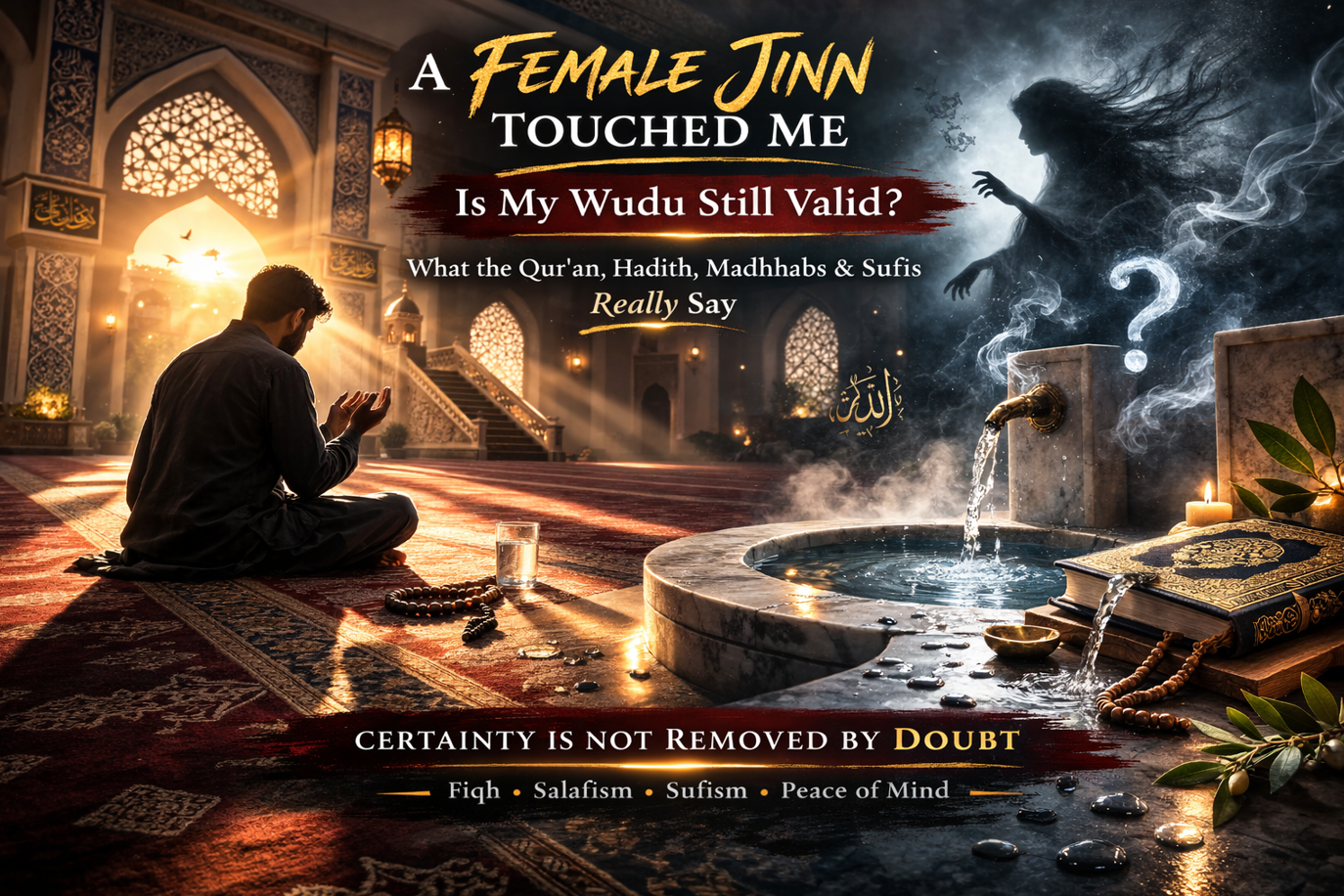
The Question That Is Quietly Disturbing Some Muslims
A Muslim brother asked me something serious.
He sometimes experiences what he believes is a jinn passing by.
Occasionally, he feels touched.
His fear is simple:
“If a female jinn touches me, does my wudu break?”
Before we answer, we need to stabilise something important.
Islam does not build law on fear.
What Actually Breaks Wudu?
Across all four Sunni madhhabs, wudu breaks due to clearly defined nullifiers.
Examples include:
• Anything exiting from the private parts
• Deep sleep or loss of consciousness
• Direct human contact between male and female according to specific school conditions
I found no established nullifier of wudu based on a person merely believing that an unseen being touched them. Islamic rulings on purification are built around known nullifiers, not unverifiable assumptions about the unseen.
The Legal Principle: Certainty Is Not Removed by Doubt
Sahih Muslim records that when a person doubts whether something has happened that breaks wudu, the person should not leave prayer merely because of uncertainty. The narration gives the example of not acting on the doubt unless there is clear evidence such as hearing a sound or perceiving a smell.
This establishes a foundational legal maxim:
Certainty is not removed by doubt.
If you had wudu, that certainty remains until a certain nullifier occurs.
A sensation is not certainty.
A thought is not certainty.
A spiritual interpretation is not certainty.
What About the Different Madhhabs?
Let us be intellectually honest.
Shafi’i School
Skin to skin contact between unrelated adult male and female invalidates wudu, even without desire.
But this refers to human contact.
The practical issue is simpler. A person does not need to determine the sex, form or legal category of an unseen being. If there is no certain, recognised nullifier of wudu, the existing state of purification remains.
Hanafi School
Mere touch does not invalidate wudu at all. Only discharge does.
Under Hanafi fiqh, even actual human touch does not break wudu without something exiting the body.
So the issue becomes irrelevant.
Maliki and Hanbali Schools
Contact invalidates wudu only if accompanied by desire.
Again, this applies to human legal interaction.
An uncertain sensation interpreted as supernatural contact does not override the established rules of purification.
Do Not Build Fiqh on an Unverifiable Experience
The useful question is not what a Salafi, Sufi or any other label might hypothetically say. The legal principle is already sufficient. If a person is certain that they had wudu, it remains valid until a recognised nullifier is known to have occurred.
A sensation interpreted as jinn contact does not by itself create a new category of nullifier.
The Pastoral Reality
Now let us be compassionate.
If someone repeatedly feels jinn presence or touch, the issue may not be fiqh.
It may be:
• Waswas
• Anxiety
• Stress manifesting physically
• Hyper awareness of bodily sensation
Islam does not deny jinn.
But Islam does not validate every internal experience as supernatural.
If repeated sensations or fears are distressing, a person may use authentic dua and ruqyah while also considering ordinary medical or mental health assessment. Religious support and healthcare do not need to compete.
Related Reading
Jinn, Devils and Muslim Faith: What the Quran Establishes
Can a Jinn Fall in Love with a Human? What Islam Actually Says
The Final Verdict
This is a minor issue legally.
Unless a recognised nullifier of wudu is actually known to have occurred, the original state of purification remains. A person should not repeatedly restart wudu because of an uncertain sensation or a supernatural interpretation of that sensation.
The aim is to protect both worship and peace of mind from unnecessary doubt.
A Bigger Reflection for Modern Muslims
We live in an age of spiritual sensationalism.
Possession stories go viral.
Jinn encounters become identity.
Purity becomes paranoia.
But the Prophetic model was stable.
Grounded.
Unshaken by invisible speculation.
Purification in Islam was designed to make prayer easier.
Not to trap believers in fear.
Read More!
- Quranic Glow Up: How to Cultivate Inner Peace and Beauty
- And for deeper reflective discussions without noise, join our community:
https://nas.io/think-again-a-muslim-thinking-lab - What If Jinn Are Not the Disturbers, But the Disturbed?
