

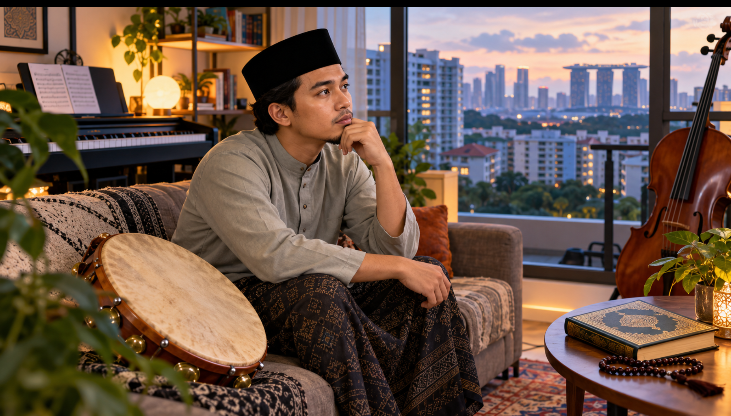
For Muslims in Singapore, music is almost impossible to avoid.
It follows us through shopping centres, Grab rides, weddings, gyms, cafes, TikTok, Instagram and probably somebody’s HDB flat at 10.47 at night.
So the question is not theoretical.
Is music actually haram in Islam?
And if some music is permissible, where exactly is the line?
I explored this question previously in The Imam’s Secret Playlist, where I looked at why Muslims themselves remain divided on the subject.
Read The Imam’s Secret Playlist
This time, I want to narrow the discussion.
Not what TikTok says.
Not what somebody’s uncle says at a wedding.
What do the strongest hadith actually say?
The Hadith That Makes The Debate Serious
The strongest evidence used by those who prohibit musical instruments is Sahih al Bukhari 5590.
The Prophet ﷺ is reported to have warned that people from his community would regard unlawful sexual relations, silk, intoxicants and maazif as lawful.
The word maazif is commonly understood to refer to musical instruments.
That hadith matters.
So it would be inaccurate to say:
There is no evidence against musical instruments.
There is.
But we also need to be precise about what the hadith actually says.
It does not mention piano.
It does not mention cello.
It does not mention violin.
It does not mention guitar.
It does not explicitly say:
Every instrument, in every place, in every circumstance, is haram.
That broader conclusion comes from how the term maazif is interpreted and applied.
That may be a valid Islamic legal interpretation.
But it is still an interpretation.
That distinction matters.
Then We Have Mother Aisha’s (r.a) Hadith
Now things become more interesting.
In Sahih al Bukhari 952, Aisha رضي الله عنها describes two young girls singing in her home during Eid.
Abu Bakr (R.A) objected strongly.
The Prophet ﷺ did not order the girls to stop.
Instead, he told Abu Bakr (R.A) to leave them because it was Eid.
A related narration appears in Sahih Muslim 892.
This does not prove that every type of music is permissible.
But it proves something important.
Singing and musical enjoyment were not automatically treated as sinful in every circumstance.
Context mattered.
Celebration mattered.
What was being performed mattered.
Then There Is The Wedding
Another important narration appears in Sahih al Bukhari 5147.
At a wedding, young girls were beating the duff and singing.
One of them said something suggesting that the Prophet ﷺ knew what would happen tomorrow.
The Prophet ﷺ corrected that statement.
But he did not tell them to stop singing.
He did not tell them to stop beating the duff.
He corrected the problematic words and allowed the performance to continue.
That distinction deserves attention.
The problem in that moment was the meaning of the words.
It was not simply the existence of rhythm.
Why Is The Duff Always Mentioned?
This is where many Muslims ask the obvious question.
Why the duff?
Was the duff the only instrument permitted?
Or was it simply the instrument being used in those particular situations?
The safest thing we can say is this:
The hadith clearly establish that the duff was permitted in certain circumstances.
What the hadith do not explicitly say is:
Every instrument other than the duff is forbidden.
That conclusion requires further legal interpretation.
There is an important difference between those two statements.
Permission for one instrument does not automatically create an explicit prohibition for every other instrument.
If the Prophet ﷺ ate dates, we do not conclude that mangoes require religious clearance.
Islamic reasoning is a little more sophisticated than that.
What About Piano, Cello And Jazz?
This is probably where many Singapore readers actually want the answer.
Suppose someone is sitting at home after work playing a peaceful piano piece.
No alcohol.
No vulgar lyrics.
No nightclub.
No neglect of prayer.
No behaviour that Islam clearly prohibits.
Is the piano itself haram?
There is no hadith that mentions a piano.
There is also an oft repeated narration saying singing produces hypocrisy in the heart, but the version in Sunan Abi Dawud 4927 is graded weak by al Albani. That means we should not lean heavily on it in your article as though it were equivalent to Bukhari or Muslim.
The modern piano did not exist in seventh century Arabia.
So anyone ruling on a piano must apply a broader principle to it.
The stricter position says that if maazif means musical instruments generally, then piano, cello, violin and similar instruments are included.
The more permissive position argues that the authenticated Sunnah itself shows musical activity being allowed in some circumstances, so content, context and consequences should also be considered.
That is where the disagreement begins.
Why Do Scholars Disagree So Much?
This is important.
The disagreement is not simply between religious Muslims and people who enjoy Spotify.
There are serious scholars on both sides.
The Stricter View
Many classical and contemporary scholars understood maazif in Sahih al Bukhari 5590 as referring broadly to musical instruments.
A prominent modern representative of this position was Sheikh Abdul Aziz ibn Baz, the former Grand Mufti of Saudi Arabia.
The reasoning is straightforward.
If the Prophet ﷺ warned against maazif, and maazif includes musical instruments generally, then modern instruments such as piano, cello and violin would fall under the same ruling even though those particular instruments did not exist during the Prophet’s lifetime.
This is a serious Islamic argument.
It should not be dismissed merely because modern Muslims may enjoy music.
The More Permissive View
Other respected scholars reached a different conclusion.
Egypt’s Dar al Ifta, one of the Muslim world’s established official fatwa institutions, describes music as an area of genuine juristic disagreement.
It records permissive positions associated with recognised scholars including Ibn Hazm and Imam al Ghazali.
Dar al Ifta argues that music cannot simply be judged through the existence of an instrument alone.
Content, circumstances, behaviour and consequences also matter.
Read Dar al Ifta on musical instruments in Islam
This does not mean anything with a beat suddenly becomes halal.
Music that contains obscene material, promotes prohibited conduct or causes a person to neglect religious duties may still become religiously problematic.
The disagreement is over whether the instrument itself creates an automatic universal prohibition.
Imam al Ghazali Gives Us Another Perspective
Imam al Ghazali is interesting because he did not automatically treat enjoyment and recreation as spiritually worthless.
His broader approach recognised that appropriate recreation can give the heart rest and help a person return to serious responsibilities with renewed energy.
At the same time, he warned against excess and entertainment connected with immoral behaviour.
That introduces a question which feels particularly relevant today.
Instead of asking only:
What instrument is this?
We may also need to ask:
What is this doing to me?
So Who Is Correct?
This article is not going to pretend that centuries of disagreement can be solved with one confident paragraph.
The stricter position has serious evidence.
The more permissive position also has recognised scholarly precedent.
Much of the disagreement comes down to interpretation.
How broadly should maazif be understood?
Are the Eid and wedding narrations narrow exceptions?
Or do they demonstrate that music itself is not automatically prohibited?
Does the instrument determine the ruling?
Or do content, context and consequences also matter?
Qualified scholars have answered those questions differently.
So Muslims should be careful with two opposite statements.
Do not say:
Every scholar agrees music is haram.
That is not accurate.
But also do not say:
There is no serious Islamic evidence against musical instruments.
That is not accurate either.
A more honest conclusion is that a genuine disagreement exists.
So What Does MUIS Say?
For Muslims in Singapore, this naturally leads to another question.
What does MUIS say?
Here we need to be extremely careful.
At the time of writing, I could not locate a current standalone MUIS fatwa in its official Fatwa or Irsyad directories that specifically declares all music permissible or all music prohibited.
That does not mean:
MUIS says music is halal.
It also does not mean:
MUIS says music is haram.
It simply means that I could not verify a published blanket MUIS ruling on music in the official directories checked.
The MUIS Fatwa page explains that the Office of the Mufti gathers relevant references and information for the Fatwa Committee, particularly when dealing with emerging issues. Experts may also be consulted when their knowledge is relevant.
MUIS also maintains an Irsyad directory covering contemporary religious questions and developments.
MUIS official Irsyad directory
What MUIS Actually Says About Context
This is where MUIS becomes particularly relevant.
In its 2024 sermon titled Fatwa: A Reflection of the Dynamics Between Law and Context, MUIS outlined three important principles.
It stated that fatwa and religious guidance should not be limited simply to quoting verses of the Quran, hadith and opinions of earlier scholars.
It also stated that fatwa should reflect the circumstances and realities of life.
And it said that sound fatwa formulation should consider relevant expert views.
Read MUIS on fatwa, law and context
MUIS has separately discussed the importance of understanding context when interpreting religious texts and applying Islamic law.
Read MUIS on context in Islamic law
This is not a MUIS ruling on music.
It should never be presented as one.
But it tells us something important about methodology.
Context matters.
Reality matters.
Consequences matter.
MUIS Gives Us Another Useful Example
MUIS also has an official advisory on kuda kepang.
Kuda kepang traditionally involves music and dance.
Interestingly, the MUIS advisory does not frame its concern simply around the existence of music.
Instead, it identifies particular objectionable elements, including trance states, invocation of spirits and dangerous behaviour.
MUIS states that those elements are against Islamic teachings and should be avoided.
Read the MUIS advisory on kuda kepang
Again, we should not transform a kuda kepang advisory into a general ruling on music.
MUIS did not do that.
MUIS holds the view that such performances are not part of Islam and have never been so. Such performances are not a religious function or practice. But the advisory provides an interesting example of examining the specific religious problems within a cultural activity instead of lazily treating everything within that activity as identical.
Singapore Changes The Practical Question
Music today is not merely somebody beating a drum during Eid.
It is everywhere.
A teenager studies with headphones.
Someone listens to jazz while driving along the PIE.
A child learns piano after school.
A Muslim wedding has background music at a hotel ballroom.
Someone listens to instrumental music while answering emails at midnight because adulthood apparently forgot that human beings require sleep.
These situations are not identical.
Neither is the content.
A quiet piano composition and a song glorifying drugs, sexual exploitation or violence are not morally identical simply because both contain melody.
That should matter.
The Bigger Modern Question Is What Music Does To Us
Even if someone follows a permissive opinion, another issue remains.
Music has psychological power.
A melody can continue inside the mind long after the headphones come off.
Most of us know the experience.
You hear a chorus in the morning.
By lunchtime, your brain has apparently granted it permanent residency.
That does not make music haram.
But it raises a spiritual question.
What occupies our inner silence?
If someone listens to music for hours every day but barely listens to Quran or engages in dhikr, it should not surprise us when song lyrics appear in memory more easily than Quranic verses.
That does not prove that music somehow blocks the Quran from entering the soul.
We should not invent theological claims.
But habits shape attention.
And attention matters spiritually.
Lyrics Matter More Than We Sometimes Admit
Muslims can spend twenty minutes debating whether a piano key is permissible while completely ignoring what the singer is saying.
That seems backwards.
A song may glorify adultery, intoxication, violence, humiliation or obsession with wealth.
The instrument may sound beautiful.
The message may still be ugly.
The wedding narration provides an interesting lesson.
When the young girl made an incorrect statement, the Prophet ﷺ corrected the words and allowed the performance to continue.
Content mattered then.
Content matters now.
Music In Modern Singapore
Singapore makes this discussion especially interesting because Muslims here live inside a multicultural society where music is part of everyday public life.
It appears during National Day celebrations, cultural festivals, weddings, school performances, shopping, restaurants and entertainment.
That does not automatically determine its Islamic ruling.
But it does mean the subject deserves more than a one sentence answer copied from somewhere else.
Rethinking Islam is ultimately interested in how Muslims live responsibly inside the world we actually inhabit.
So Is Music Haram?
Based on the strongest texts, I would be extremely cautious about making either extreme statement.
I would not say:
There is no evidence against musical instruments.
The maazif narration in Sahih al Bukhari prevents us from honestly saying that.
But I would also hesitate to say:
The Prophet ﷺ explicitly declared every instrument in every circumstance haram.
The authenticated Sunnah itself records singing and the duff being permitted in recognised circumstances.
So perhaps the more useful Islamic questions are these:
What am I listening to?
What does it encourage?
What environment surrounds it?
Does it affect my salah?
Does it push Quran and dhikr out of my daily life?
Does it strengthen something good in me?
Or does it repeatedly feed something unhealthy?
A Muslim who avoids musical instruments completely out of religious caution has a serious Islamic tradition behind that decision.
A Muslim who follows a recognised permissive interpretation while avoiding indecent content, prohibited environments, excess and neglect of religious duties also has recognised scholarly precedent.
The mistake is pretending that the disagreement does not exist.
Perhaps The Real Test Begins After The Music Stops
Islam is not only about asking whether we can squeeze something through the door marked permissible.
It is also about asking what something is doing to us.
A piano may create beauty.
A cello may move someone deeply.
Jazz may calm one person and drive another person slightly mad.
Music may bring joy.
Music may also consume attention, normalise harmful ideas or quietly become the soundtrack to every empty moment.
So perhaps the final question is not simply:
Is music haram?
Perhaps it is:
When the room becomes quiet, what has my heart learned to return to?
That question may tell us more than the playlist ever will.
Related Reading
Q&A: Is Music Forbidden In Islam? | Dr. Shabir Ally
Is Music Haram? | Q&A | Shaykh Dr. Yasir Qadhi & Imam Ibrahim Bakeer
Why Some Muslims Say Music Isn’t Haram? | Sheikh Assim Al Hakeem
Is Music Permitted in Islam? – Dr Zakir Naik
The Imam’s Secret Playlist on Rethinking Islam
Coffee, Conversations, and Hijabs on Trailblazing Muslimahs
