

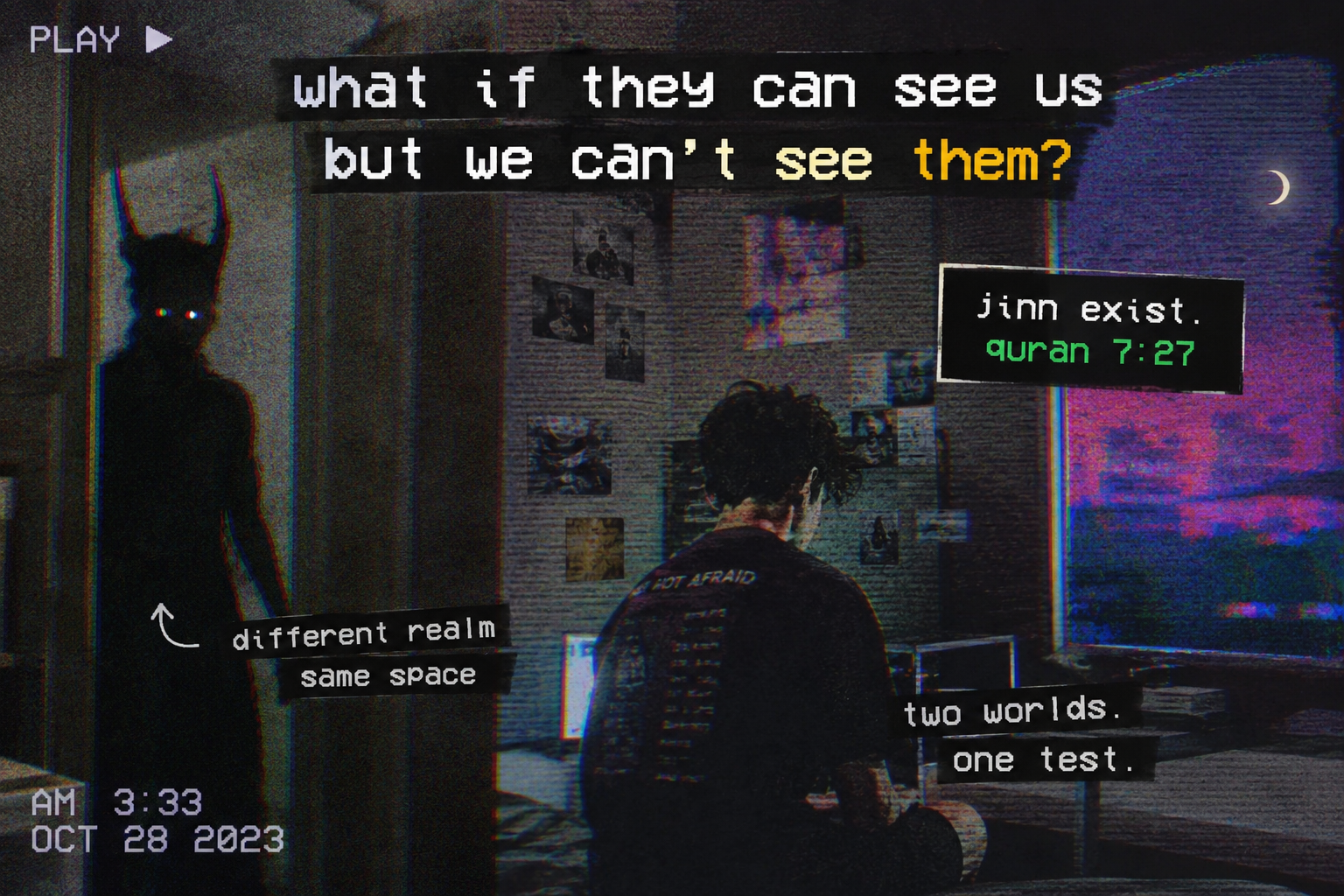
What if a jinn were standing beside you right now?
Not hiding.
Not invisible in the way we normally understand invisibility.
But present within a layer of reality that your senses simply cannot access.
For this discussion, let us skip the basics. Muslims already accept the existence of jinn and the unseen. We also know the Qur’an describes Shaytan and his kind seeing humans from where humans do not see them.
The interesting question is much deeper.
What if the separation between us and them is less like a wall and more like a boundary between dimensions or modes of existence?
And what happens when something crosses it?
Perhaps They Are Not Somewhere Else
We usually imagine the jinn world as another place.
But what if “place” is the wrong concept?
Imagine two layers of reality occupying what appears to us as the same location.
Humans normally experience one.
Jinn experience another.
Under normal circumstances, neither needs to interfere directly with the other.
You live your life.
They live theirs.
But perhaps there are occasions when those boundaries intersect.
The Qur’an does not call this another dimension. That is our modern thought experiment.
But Qur’an 7:27 gives us the intriguing starting point:
“Indeed, he sees you, he and his tribe, from where you do not see them.”
There is an imbalance of perception.
They can perceive something about our realm that we normally cannot perceive about theirs.
Why?
That is where things become interesting.
Imagine Reality Has Another Direction
Imagine a creature that lives entirely on a flat sheet.
It understands left and right.
Forward and backward.
But it cannot understand “above”.
Now place your finger onto its world.
Something suddenly appears.
Lift your finger.
It disappears.
To the creature, you have performed something supernatural.
To you, nothing supernatural happened.
You simply moved through a direction unavailable to it.
Now imagine that we are the creature on the sheet.
What if jinn can access an aspect of creation that human beings normally cannot?
Something could then appear within our perceptible world and disappear without necessarily travelling across the room in the way we understand movement.
Nothing. Something. Nothing again.
From our perspective, extraordinary.
From theirs, perhaps perfectly ordinary.
This does not prove that jinn are higher dimensional beings. Islam never makes that claim.
But it gives us an interesting model for thinking about Qur’an 7:27.
Ibn Arabi Gives Us an Even Stranger Possibility
Centuries before modern physicists started seriously discussing additional dimensions, the Sufi thinker Ibn Arabi explored something called barzakh.
A barzakh separates two realities while also connecting them.
That is important.
Think of it not simply as a brick wall between World A and World B.
Think of it as an intermediate boundary through which different orders of reality can relate without becoming identical.
Ibn Arabi also developed sophisticated ideas about khayal, the imaginal realm.
Imaginal does not simply mean imaginary.
Within his metaphysics, realities normally beyond physical perception could become perceptible through another mode of experience.
Suddenly our question changes.
Perhaps crossing between realms does not always require physically travelling somewhere.
Perhaps sometimes what changes is perception itself.
When Humans Intentionally Approach the Boundary
Most of us have no reason to go looking for that boundary.
Islam certainly does not encourage us to.
But the Qur’an describes humans deliberately seeking relationships with jinn.
Qur’an 72:6 speaks about humans seeking refuge with beings among the jinn.
Qur’an 2:102 connects occult knowledge with devils and magic.
Qur’an 6:128 speaks about humans and jinn having benefited from one another.
Whatever the precise mechanics, the Qur’an therefore does not present the two orders of creation as incapable of interaction.
This gives us a darker interpretation of occult practice.
Perhaps the magician is not “summoning something from millions of kilometres away”.
Perhaps he is deliberately trying to interfere with a boundary humans were never supposed to manipulate.
He wants something.
Knowledge.
Influence.
Power.
Control.
And Islamic tradition repeatedly warns that such relationships come at a spiritual price.
But What If the Crossing Is Accidental?
This is more difficult.
Cultures around the world contain stories of people who enter a place and suddenly experience something completely unfamiliar.
Time feels different.
The surroundings change.
Someone sees beings or structures that others cannot see.
Then everything suddenly returns to normal.
Islamically, we cannot automatically declare:
“They crossed into the jinn realm.”
Psychology gives us genuine alternative explanations.
Sleep states can intrude into waking consciousness.
Dissociation can alter our perception of time and surroundings.
The brain can create extraordinarily convincing experiences.
But that does not answer every metaphysical question either.
Perhaps some encounters are psychological.
Perhaps some are spiritual.
Perhaps some involve something we currently lack the language to describe.
We simply do not know.
And What If Jinn Cross Towards Us?
Now reverse the question.
Humans may occasionally seek interaction with their world.
Could jinn intentionally interfere with ours?
Islamic tradition certainly takes that possibility seriously.
But here our dimensional model becomes particularly interesting.
Perhaps manifestation does not mean a jinn travelled from some distant universe to Singapore.
Perhaps it means something normally inaccessible to human perception became accessible.
Almost like changing channels.
One moment your receiver cannot detect the signal.
The next moment it can.
The signal did not necessarily travel towards you.
Your relationship with it changed.
This is only an analogy, but it comes surprisingly close to the Sufi idea of unveiling, or kashf.
Something hidden becomes perceptible.
The observer may not have physically travelled anywhere.
The curtain moved.
The Throne of Sheba Makes This Even Stranger
There is one Qur’anic episode that deserves attention.
When Prophet Sulayman asked who could bring him the throne of the Queen of Sheba, an ifrit from among the jinn answered:
“I can bring it to you before you rise from your place.”
Qur’an 27:39
That is an extraordinary claim involving a physical object and extraordinary movement.
The Qur’an does not explain how.
And that is precisely why we should not pretend we know.
Was it incredible speed?
A different relationship with physical space?
Something completely beyond modern physics?
Allah does not tell us.
But the passage certainly leaves our ordinary understanding of jinn looking rather limited.
Then Modern Physics Makes Things Weird
Modern physics does not prove any of this.
Let us get that out of the way.
Scientists have not discovered a jinn dimension.
Quantum physics does not prove the unseen.
But modern theoretical physics does seriously investigate the possibility of dimensions beyond those we ordinarily experience.
Some models propose additional spatial dimensions that could remain inaccessible to everyday human observation.
That does not prove jinn occupy them.
It establishes something more modest but philosophically powerful:
Human perception does not determine the limits of reality.
Our eyes were never designed to reveal everything that exists.
Even within known physics, humans cannot naturally see radio waves, magnetic fields, ultraviolet radiation or most of the electromagnetic spectrum.
So perhaps saying:
“I cannot see it, therefore it cannot be here”
was never a particularly intelligent argument.
So What If One Is Standing Beside You?
Now return to where we started.
Suppose a jinn were beside you.
Perhaps asking “how far away is it?” would be meaningless.
Perhaps the real separation is not metres.
Perhaps it is access.
A different mode of perception.
A different layer of created reality.
Something resembling another dimension.
Or something for which humanity has not yet invented the correct scientific language.
Islam tells us that there is an unseen reality.
Sufi metaphysics gives us concepts such as barzakh and kashf for thinking about boundaries and perception.
Modern physics reminds us that reality can be considerably stranger than ordinary human intuition suggests.
But none allows us to declare exactly how the jinn world works.
And perhaps that is what makes Qur’an 7:27 so fascinating.
They see us from where we do not see them.
Maybe the mystery has never really been about invisibility.
Maybe the mystery is the word:
Where?
And perhaps one day humanity will discover that the curtain separating the seen from parts of the unseen was never about distance at all.
Allah knows best.
Important Note
The idea that jinn occupy another physical dimension is an exploratory model, not established Islamic doctrine. The Qur’an does not identify the jinn world as the fourth, fifth or sixth dimension, and modern physics has not discovered a physical dimension containing jinn. The comparison helps us think about perception and different orders of reality without claiming scientific proof.
