


You finally get the keys. Then comes the dangerous part: Pinterest, Instagram and TikTok.
Suddenly your saved folder contains hundreds of beige living rooms, curved sofas, textured walls, designer lamps and kitchens that appear to have never encountered sambal in their lives.
Welcome to renovating your first home in Singapore.
For younger homeowners, especially Gen Z couples planning a BTO or resale flat, interior design is becoming less about choosing a recognised style and more about creating a home with personality.
For Muslim homeowners, that question becomes particularly interesting.
Because a Muslim home does not have to look traditional to feel meaningful.
The Copy and Paste BTO Is Losing Its Grip
Singapore homes are not abandoning minimalism.
What appears to be changing is the idea that minimalism must mean an almost identical cream, white and light wood interior.
Younger homeowners are increasingly looking for interiors with more flexibility, personality and warmth.
Earthy colours such as terracotta, sage and caramel can introduce character without making a home visually overwhelming.

Warm Minimalism Without the Showroom Feeling
Minimalism still works brilliantly in a Singapore flat.
But warm minimalism is less interested in making the room look empty.
Cream can replace clinical white. Walnut can bring depth. Natural fabrics, textured finishes and warmer lighting can make an otherwise simple interior feel much more lived in.
For a Muslim home, this also creates a useful starting point.
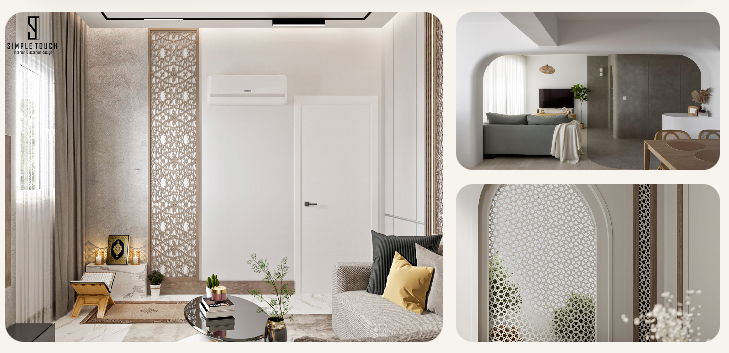
Islamic design has always involved proportion, rhythm, geometry, light and material. You do not need obvious religious decoration in every corner to create cultural character.
The Arch Is Back. Just Don't Turn the Whole House Into One.
Curves and organic forms continue to appear in contemporary Singapore interiors.
A rounded opening, recessed niche or curved foyer feature can soften the hard rectangular lines of an HDB flat.
For Muslim homeowners there is also a subtle cultural connection. Arches have appeared throughout centuries of Islamic architecture.
The clever approach is not to reproduce historical architecture literally. Take the idea and reinterpret it.

Islamic Geometry Without Building a Monument
Geometric patterns are one of the easiest ways to introduce Islamic influence into a contemporary interior.
But restraint matters.
Instead of covering an entire wall, imagine the pattern appearing within a cabinet screen, entrance divider, lighting feature or recessed panel.
The strongest examples feel integrated into the architecture rather than added afterwards because someone suddenly remembered the home was supposed to have an Islamic influence.
Islamic Influence: Too Much vs Just Right
The difference is often simply how much you use.
When the home starts feeling themed
- Arabic motifs on multiple walls
- Several decorative arches
- Competing geometric patterns
- Decor overriding practicality
When identity feels part of the architecture
- One strong geometric feature
- A discreet prayer space
- Natural textures and warm colour
- Layouts built around real routines
The Prayer Space Deserves More Than the Leftover Corner
In a Singapore flat, an entire prayer room may not be realistic.
Thoughtful planning can still create something far better than an empty space beside a cupboard.
Consider concealed prayer mat storage, a slim drawer for prayer garments, soft lighting, a clear floor zone and one meaningful visual feature.
When prayer is finished, the space remains visually connected to the rest of the home.
Privacy Can Be Beautiful Instead of Defensive
Privacy matters in many homes, especially when family members and visitors share the same space.
But that does not automatically mean building another solid wall.
A curved foyer partition can redirect sightlines. A geometric screen can introduce separation while allowing light through. Textured glass can provide partial privacy.
Even furniture orientation can prevent the front door from opening directly onto the family's main sitting area.
Beige Has Suffered Enough
Nobody is asking you to paint the entire living room emerald green.
Colour can appear through one olive cabinet, a clay coloured chair, deep blue tiles, a rust rug or artwork collected during travel.
Earthy shades such as terracotta, sage and caramel provide personality without overwhelming the room.
Inspiration can come from Southeast Asia, North Africa, Central Asia or the Middle East without reproducing any one traditional interior literally.
A Modern Muslim Gen Z Palette
Design the Home You Actually Live In
This may be the least Instagrammable renovation advice in this article.
It is also probably the most important.
Beautiful homes fail when they are designed for photographs instead of people.
What Actually Happens Inside Your Home?
Five Questions Before You Renovate
Will I still like this in five years?
Trends move quickly. Permanent carpentry does not.
Do I love this, or does my algorithm love this?
Seeing the same interior repeatedly can make a trend feel like personal taste.
Does the layout survive a family gathering?
Imagine the home during its busiest day.
Where does everything actually go?
Storage becomes interesting very quickly after moving in.
Does this home feel like us?
That may matter more than fitting neatly into a design category.
Good Design Starts With Better Questions
A good renovation conversation should go beyond asking whether you prefer Japandi, modern luxury or minimalism.
It should explore how you cook, entertain, pray, work, store things and use your home when nobody is taking photographs of it.
Our mock renovation partner represents an approach where lifestyle comes first and the visual language develops around it.
The New Muslim Home Is Not One Particular Style
Perhaps we have been asking the wrong question.
Instead of asking what an Islamic interior should look like, perhaps we should ask what a Muslim home should allow us to do.
Rest. Gather. Cook. Laugh. Host. Pray. Grow.
And occasionally collapse on the sofa while scrolling TikTok at midnight.
The interesting opportunity for a new generation is not choosing between modern interior design and Muslim identity.
It is discovering how naturally the two can belong together.
The best Gen Z home may not be the one that follows another trend. It may be the one that becomes difficult to copy because it actually feels like you.
