

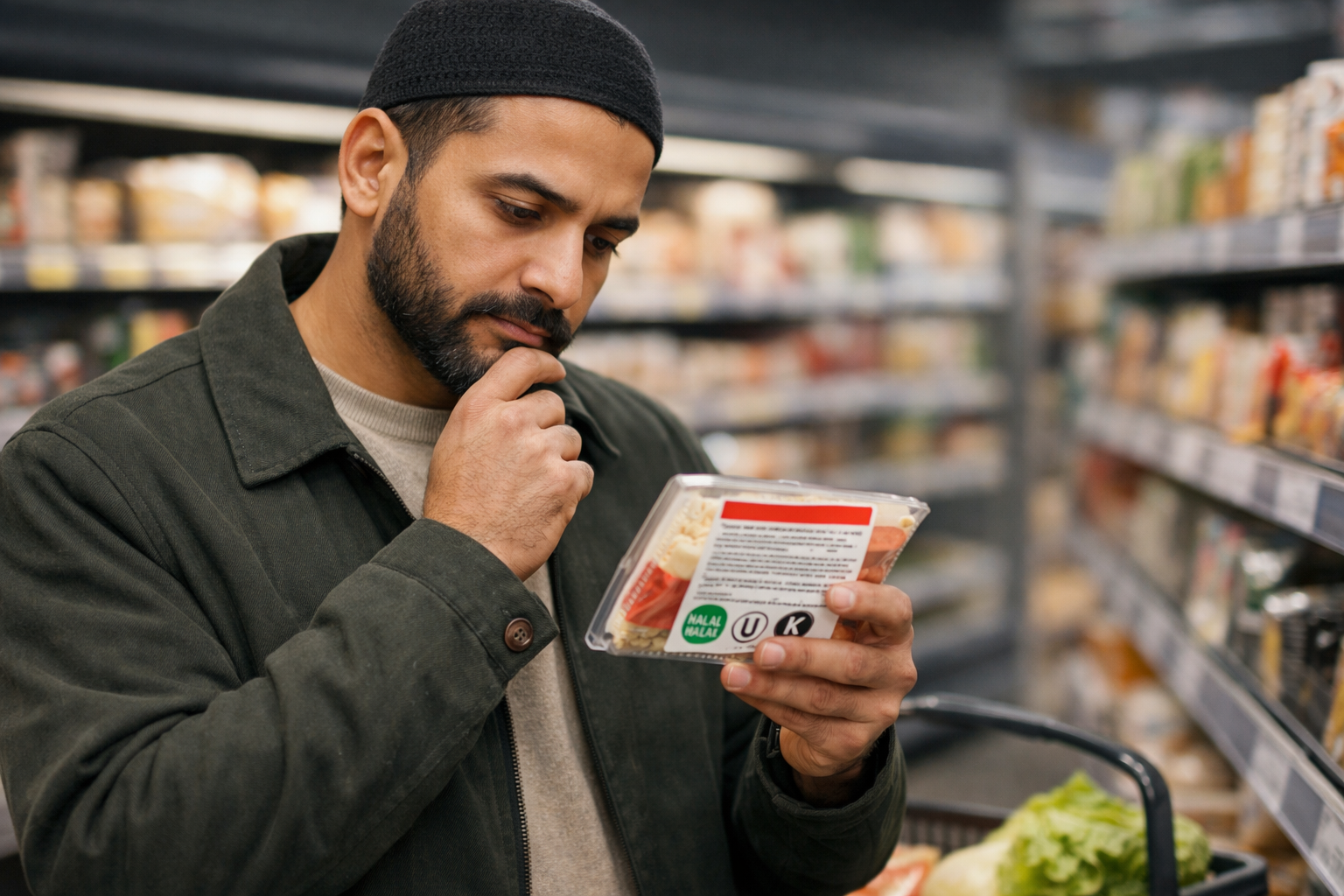
Muslims travelling outside Singapore often face a familiar question.
There is no halal meal available. A kosher option appears. Can you eat it?
The answer deserves more care than either “kosher is basically halal” or “kosher is not halal at all”. Islamic law gives the food of the People of the Book a recognised place, but modern certification and industrial food production add questions that did not exist in the same form centuries ago.
Start With the Quran
Surah Al Maidah states that the food of those who were given the Scripture is lawful for Muslims.
Muslim jurists have long discussed this verse in relation to food prepared by Jews and Christians, especially slaughtered animals.
That does not mean every product carrying a kosher symbol automatically becomes halal. The Quranic principle and a modern certification logo are related questions, but they are not identical questions.
What Kosher Certification Actually Means
Kosher certification tells Jewish consumers that a product complies with Jewish dietary law under the standards of the certifying authority.
That system can examine ingredients, equipment, meat and dairy separation, slaughter, processing and supervision.
It is a serious religious system in its own right. It is simply not designed to answer every Islamic question.
Kosher Slaughter Is Not Ordinary Industrial Slaughter
The old version of this article stated that stunning is commonly accepted in kosher slaughter. That was incorrect.
Traditional shechita requires ritual slaughter by a trained Jewish slaughterer using a specialised sharp knife. Prestunning that injures the animal is generally rejected under Orthodox kosher rules because the animal must be alive and uninjured in the required sense at the time of slaughter.
Read an explanation of stunning and shechita
This makes kosher meat closer to halal slaughter in some respects than ordinary non religious meat. But similarities do not erase every difference in Islamic legal interpretation.
Why Muslim Scholars Still Differ
Some Muslim scholars take Quran 5:5 broadly and permit meat slaughtered by Jews when the animal itself is lawful for Muslims and the slaughter is genuinely Jewish ritual slaughter.
Other scholars apply additional conditions. They may focus on how the animal was slaughtered, whether Allah’s name or another name was mentioned, whether the slaughterer truly qualifies as a person of the Scripture, and whether modern industrial practices preserve the conditions assumed by classical jurists.
This is therefore a fiqh issue with recognised disagreement.
A traveller should follow a trusted scholarly position rather than treating an internet slogan as a universal ruling.
Kosher Meat and Kosher Packaged Food Are Different Questions
A kosher biscuit and a kosher steak do not raise exactly the same Islamic questions.
For packaged foods, the main concerns may involve ingredients, flavourings, processing aids and alcohol.
For meat, the species and slaughter method become central.
That is why saying “it has a kosher symbol” is often not enough information by itself.
Alcohol Requires Separate Attention
Jewish dietary law and Islamic law do not classify every alcohol related ingredient in exactly the same way.
A kosher certified product may therefore contain an ingredient or flavouring that a Muslim scholar would want assessed separately.
This does not mean kosher certification is careless. It means the two legal systems ask different questions.
What About Pork?
Pork is prohibited under both halal and kosher dietary law, so a properly kosher certified product will not contain ordinary pork ingredients.
But Muslim consumers should still avoid assuming that every non pork kosher ingredient automatically meets Islamic requirements.
Religious certification is more detailed than one forbidden ingredient.
What Should You Do on a Flight?
If a halal meal is available, that is usually the simplest choice for a Muslim traveller.
If it is not available and the airline offers a kosher meal, the answer depends partly on what the meal contains and the scholarly view you follow.
A sealed kosher vegetarian meal may raise fewer questions than a meat meal because the slaughter issue is absent, although ingredients may still deserve attention.
For kosher meat, follow a recognised scholarly position on the meat of the People of the Book rather than assuming that every Muslim scholar gives the same answer.
What About Hospitals and Remote Travel?
Context matters.
A person who is unwell, travelling or unable to obtain ordinary halal food may face a different practical situation from someone standing in a supermarket with many alternatives.
Islamic law recognises necessity and hardship, but those principles should not be used casually when suitable food is easily available.
A Better Way to Read Food Labels
- Look for recognised halal certification first when it is available
- If relying on kosher certification, identify whether the product contains meat
- Check ingredients that may raise separate Islamic questions
- Do not assume that kosher means halal in every detail
- Do not assume that kosher means haram either
- Follow a qualified scholarly view you trust when the issue concerns meat slaughter
So Is Kosher Permissible for Muslims?
The most accurate answer is not a universal yes or no.
The Quran explicitly permits the food of the People of the Book. Muslim jurists have differed over how that principle applies to particular slaughter methods, modern industrial practices and individual ingredients.
Kosher certification can therefore provide useful information to a Muslim consumer, but it is not a substitute for halal certification and it does not answer every Islamic question.
Related Reading
Is Bottled Water Halal? What Certification Actually Means
Can Muslims Eat Festive Food in Non Muslim Homes?
Final Reflection
Food labels are supposed to make life easier.
Sometimes they create an entirely new homework assignment.
The sensible approach is neither panic nor blind trust. Understand what the certification means, know where Islamic and Jewish dietary rules overlap, recognise where they differ, and make your decision from knowledge rather than assumption.
