

Work, side hustles, and a phone that never sleeps. How can a young Singaporean Muslim balance deen and dunya and chase a good life without letting dunya quietly take over?
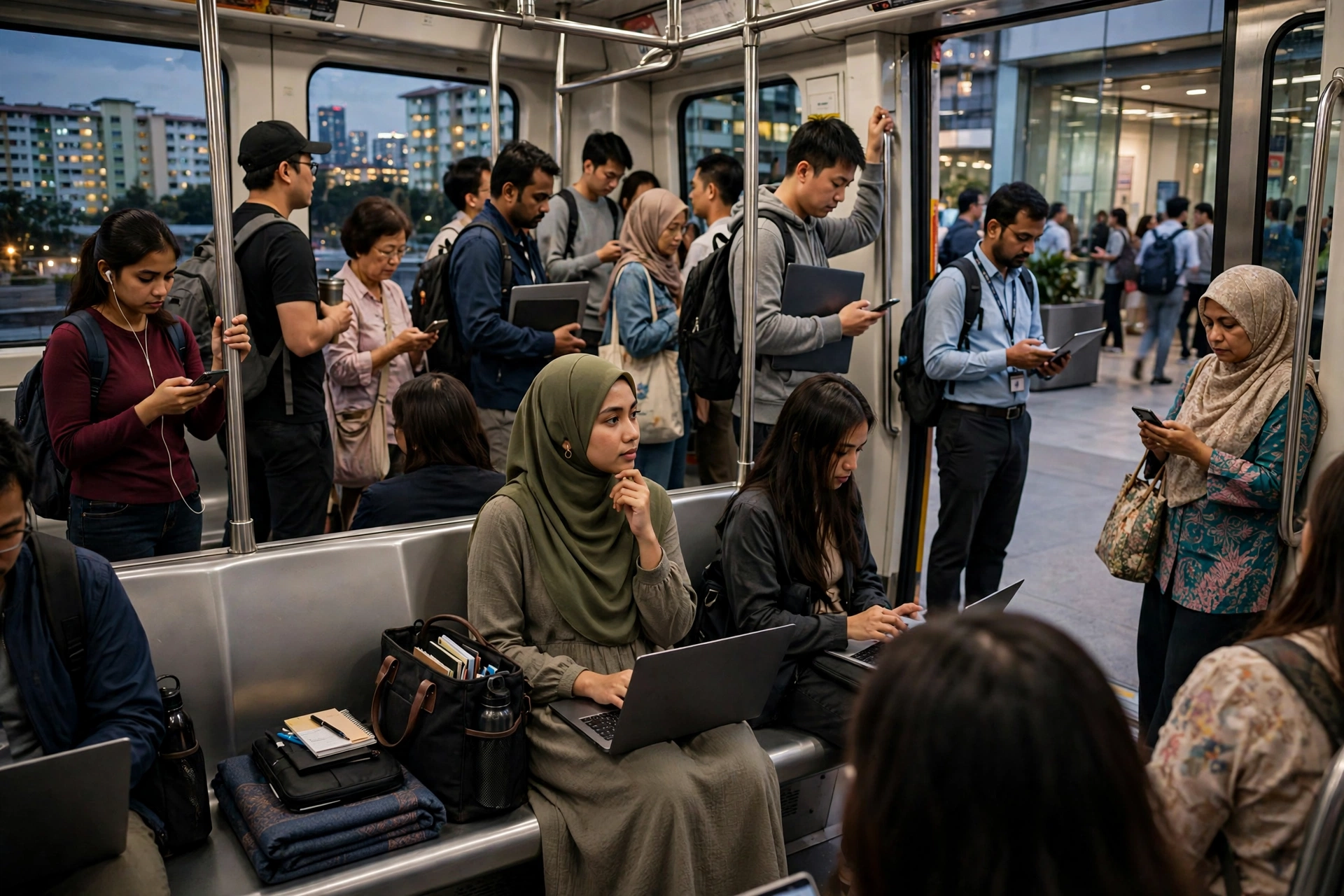
It is 6.40 pm on the MRT. The train is full. The announcements are calm. Your phone is not calm at all.
First, there is a work message. Also, there is a group chat planning dinner. Then, there is a video you meant to watch. Finally, there is a reminder you set for yourself and then ignored.
You are not doing anything wrong. Still, you are just tired in a very Singaporean way. You are busy at work. Also, you are busy after work. In fact, you are busy even in your rest.
That tiredness is where many young Muslims start asking a quiet question. The question is not whether deen or dunya matters more in theory. Instead, the question is how both are supposed to fit into one ordinary day, without one of them always losing.
The question is older than the MRT
Islam never asked believers to leave the world behind. Surah Al Qasas 28:77 says to seek the home of the Hereafter with what Allah has given you. At the same time, it says not to forget your share of this world.
Also, the well known dua in Surah Al Baqarah 2:201 asks Allah for good in this world and good in the Hereafter. Therefore, deen and dunya are not two rival teams. They are two parts of one life. The work is in the balance between them.
The problem is not ambition itself. Earning a living is part of being responsible. Doing good work is part of being responsible. Supporting parents is part of being responsible. Saving for a home is part of being responsible. Building skills is part of being responsible.
However, the problem starts when ambition stops having a boundary. For example, work expands into every evening. Rest becomes scrolling. Prayer becomes the thing squeezed in after everything else is done.
Why balance feels so hard in Singapore
Singapore rewards being switched on. Many young adults work long days. Also, many take on freelance or side work. Then, many study after hours. Finally, many stay reachable on chat apps long after office hours.
Burnout, in this sense, is not only about working too many hours. It is about living without a rhythm. When there is no pause and no clear end to the day, even good things start to feel heavy.
Social media makes this worse. Someone else always seems to be doing more. Therefore, comparison turns rest into something we feel guilty about. That guilt is a quiet pressure. It follows many young adults home.
Deen and dunya rhythm: what Islam says
One of the most helpful ideas about deen and dunya in Islam is that the day already has a rhythm built into it. The five daily prayers are not only obligations. They are also pauses.
First, they break the day into parts. Also, they remind us who we are working for. Finally, they give the body and mind a reason to stop, stand, and breathe.
Surah Al Baqarah 2:286 says that Allah does not burden a soul beyond what it can bear. Readers often read that verse as comfort in hardship. It can also warn against the burdens we place on ourselves.
For example, think of the extra project we did not need to accept. Think of the standard we copied from someone else. Think of the schedule that leaves no room for family, prayer, or sleep. Those burdens are often our own choice.
The Prophet Muhammad ﷺ taught that religion is easy, as recorded in Sahih al Bukhari 39. He also taught that actions are judged by intentions, as recorded in Sahih al Bukhari 1.
Those two teachings sit well together. Ease does not mean doing nothing. It means not turning faith into a performance. It also means not turning work into an identity.
In other words, the question is not, “How do I do everything?” Instead, the question is, “What am I doing all this for, and what can I protect first?”
Deen and dunya: requirement or preference?
This distinction can save a young adult a lot of guilt.
A requirement is something Islam asks of you. For example, the five prayers are a requirement. Honesty at work is a requirement. Fulfilling trusts is a requirement. Kindness to parents is a requirement. Staying away from what is clearly forbidden is a requirement.
A preference is something that feels urgent because of culture, career, or comparison. For example, replying instantly at 11 pm is a preference. Having the newest phone is a preference. Taking every opportunity is a preference. Keeping up with every trend is a preference.
Preferences are not always bad. Some are useful. However, they are not requirements. Therefore, do not let them push requirements out of the day.
That distinction also helps at work. A good career does not require saying yes to everything. Saying no to an extra commitment can protect rest. Also, it can protect prayer on time. In addition, it can protect time with family. That is not a lack of ambition. It can be a form of amanah. Amanah means taking care of the health, time, and relationships you have been entrusted with.
Practical deen and dunya steps that actually fit a Singapore day
Deen and dunya balance sounds nice. However, it only helps when it becomes a small, repeatable habit.
- Protect prayer before protecting the calendar. Instead of fitting prayer around work, try fitting work around prayer where you can. If you know your prayer times for the day, block them first in your mind, even if the block is short. A prayer prayed calmly is very different from a prayer prayed while already thinking about the next meeting.
- Give the phone a closing time. Choose a time in the evening when work chats and endless scrolling stop, at least for an hour. Put the phone in another room if you can. Rest is not wasted time. Rest is what makes the next day possible.
- Make one evening a week that cannot be moved. It does not have to be dramatic. Dinner with family works. A walk works too. Reading works too. Simply taking an early night works as well. If every evening is available for work, work will take every evening.
Check extra work and keep rest steady
- Audit the side hustle. Extra income can be helpful, especially in Singapore. However, ask honestly: is this side work meeting a real need, or is it feeding a comparison? Is it costing sleep, family time, or prayer? A smaller income with a steadier life is not failure.
- Rest without apologising for it, and keep one small, steady good deed. Sleep, a quiet meal, and time with loved ones are not rewards for finishing everything. They are part of living well. Likewise, a short daily reading or a simple dua before work is easier to keep than a grand plan. Keeping it matters more than starting big and stopping. Work done honestly, caring for parents, and resting so you can be kind the next day can all carry a good intention, as long as you keep obligations intact.
So, can you have deen and dunya both?
Yes, but not by doing more of everything.
You have both when prayer has a protected place in the day. Also, you have both when work has an end time. In addition, you have both when you treat rest as necessary. Finally, you have both when you check ambition against intention rather than comparison.
Burnout often arrives quietly. It does not announce itself. It arrives when every day feels the same. Sometimes it arrives when you are always behind. At other times it arrives when the things that used to give you peace start feeling like chores.
If that sounds familiar, the answer is probably not a bigger plan. Instead, it is a smaller, steadier one. Protect one prayer. Set one honest boundary at work. Keep one evening for family or rest. Renew one intention each morning.
Deen and dunya never need to be a tug of war. They can be a balance. You practise balance, like prayer itself, a little at a time, every day.
More Reads
- Scroll, Like, Pray: Islam in the Age of Instagram Piety
- Spiritual Wellness in Islam: Faith, Practice and Mental Health
- Why He Began Talking to Allah Every Day
- Partner feature from Trailblazing Muslimahs, our sister site: How to Balance Career Family and Faith as a Muslimah All Rounder
Frequently Asked Questions
Is it wrong to want a good career and a comfortable life?
No. Islam encourages earning, providing, and using what Allah has given you responsibly. The concern is when comfort becomes the only goal, or when it pushes aside prayer, honesty, family, and rest.
What if my job makes it hard to pray on time?
Speak to your employer where possible. Plan your day around prayer times. Seek practical solutions that fit your workplace. If your situation is difficult, ask a qualified local teacher for guidance for your specific circumstances, rather than assuming there is no way forward.
Does resting mean I am not ambitious enough?
No. Rest protects your health, your relationships, and your ability to work well. A sustainable pace is part of responsibility, not a sign of laziness.
Sources and References
- Surah Al Qasas 28:77
- Surah Al Baqarah 2:201
- Surah Al Baqarah 2:286
- Sahih al Bukhari 1
- Sahih al Bukhari 39
This article presents the Quranic verses and hadith cited above in summary for reflection. Readers with specific religious questions should consult qualified local asatizah.
Rethinking Islam presents this article for general education and reflection. Individual religious, legal, and financial circumstances can differ. Readers with specific questions should consult the appropriate qualified professional or local asatizah.
