

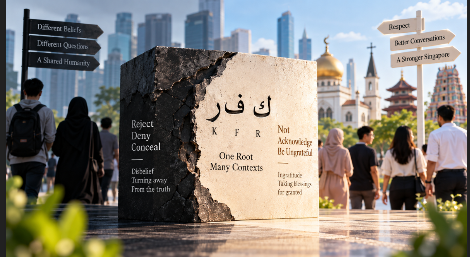
We often translate kafir as “disbeliever.” But the Arabic root behind the word tells us something deeper about disbelief, rejection and even ingratitude.
Most Muslims know the word kafir.
We hear it in religious classes. We encounter it in Quran translations. We see it in online arguments.
Sometimes it is translated simply as “disbeliever.”
Sometimes people use it as though it means nothing more than “non Muslim.”
And sometimes it is thrown at another person almost like an insult.
But what does the Quran itself actually mean by it?
To understand kafir, we first need to understand the Arabic root behind it:
ك ف ر
K F R
This root appears hundreds of times in the Quran in different grammatical forms.
And it carries two closely related ideas that are important for our discussion:
covering, concealing or failing to acknowledge something
and, depending on context,
denying, rejecting or disbelieving.
These are not two random meanings.
Something is there to be recognised, but instead it is covered, denied, rejected or left unacknowledged.
That connection helps explain why the Quran can use words from the same root when speaking about both disbelief and ingratitude.
Explore the K F R root in the Quranic Arabic Corpus
When K F R Means Disbelief
Look at one of the earliest appearances of the root in the Quran.
“Indeed, those who disbelieve, it is all the same for them whether you warn them or not, they will not believe.”
Quran 2:6
The Arabic contains:
ٱلَّذِينَ كَفَرُوا
alladhina kafaru
Here the context is clearly belief and disbelief.
Ibn Kathir, commenting on this verse, connects the expression with covering and concealing the truth.
So here, disbelief is an appropriate translation.
Truth is presented, but it is not accepted.
Now look at what happens when the same root appears in a very different context.
When K F R Means Ingratitude
Quran 14:7 says:
“If you are grateful, I will certainly give you more. But if you are ungrateful, surely My punishment is severe.”
Quran 14:7
The Arabic contrasts two words:
شَكَرْتُمْ
shakartum
“If you are grateful”
and:
كَفَرْتُمْ
kafartum
“If you are ungrateful”
That second word comes from the same K F R root.
But notice what the verse is discussing.
It is about Allah’s blessings and our response to them.
A blessing has been given.
A person can recognise it and respond with shukr, gratitude.
Or a person can fail to acknowledge it and respond with ingratitude.
So translating kafartum here simply as “you disbelieved” without considering the context could obscure the point of the verse.
The Two Meanings Are Connected
This is the key to understanding the root.
We are not dealing with two completely unrelated definitions.
Think of it this way:
Truth is presented → it can be acknowledged or rejected.
A blessing is given → it can be acknowledged with gratitude or denied through ingratitude.
The common thread is a failure to acknowledge what is there to be acknowledged.
But the context tells us what is being denied or rejected.
That is why we cannot automatically translate every form of K F R with exactly the same English word.
We have to read the verse.
So What Is a Kafir?
Now we can answer more carefully.
Kafir comes from this same Arabic root.
In Quranic theological contexts, it commonly refers to someone characterised by kufr, usually translated as disbelief or disbeliever.
That meaning is real.
The Quran distinguishes belief from disbelief. Islam makes claims about what is true.
But kafir is not merely an Arabic substitute for the modern demographic expression “non Muslim.”
“Non Muslim” simply tells us that someone does not identify as Muslim.
That person might be Christian, Buddhist, Hindu, Jewish, Taoist, atheist, agnostic or someone who has barely considered religion.
Kafir, by contrast, belongs to Quranic and theological language about kufr.
This does not mean classical Islamic theology never applies kufr to beliefs outside Islam. It certainly does.
The important point is that a Quranic theological term should not be reduced to a casual insult or used as though its context no longer matters.
The Quran Itself Uses Different Descriptions
The Quran does not describe everyone outside the Muslim community in exactly the same way in every passage.
It speaks about People of the Book.
It speaks about Jews, Christians, polytheists and hypocrites.
It speaks about people who believe, reject, conceal, doubt, know, misunderstand or act arrogantly.
Different passages address different groups and circumstances.
That should tell us something.
If the Quran itself is precise, perhaps we should be precise too.
A Theological Term Should Not Become an Insult
Imagine a Muslim in Singapore referring to a Christian colleague, Buddhist neighbour or Hindu doctor simply as:
“the kafir.”
Something has changed.
A Quranic theological term has become a social label, perhaps even an insult.
Islam does not require us to pretend theological differences do not exist.
A Muslim can believe Islam is true and still treat someone who rejects Islam with dignity and fairness.
The two are not contradictory.
There is also something we cannot know merely by looking at another person’s religious identity.
We do not know everything they have encountered about Islam.
We do not know what they understand.
We do not know their intentions.
And we certainly do not know their heart.
Allah does.
We do not.
What About Someone Who Never Properly Understood Islam?
This leads to a difficult question.
What about someone whose only exposure to Islam came from terrorism on television?
Or misinformation online?
Or a terrible experience with Muslims?
Or someone who barely encountered Islam at all?
Questions about individual accountability before Allah are much more complicated than simply applying a label.
Islamic scholarship contains serious discussions about knowledge, accountability, receipt of the message and individual circumstances.
Those questions deserve separate treatment.
But we can already make an important distinction:
Describing someone’s present religious belief is not the same as claiming to know Allah’s final judgement of that person.
Allah knows the full story.
We do not.
Quran 14:7 Turns the Question Back on Us
There is another reason this root matters.
When Muslims hear kufr, we may immediately think about somebody else.
The atheist.
The Christian.
The person who rejects Islam.
But Quran 14:7 turns our attention inward.
Allah contrasts shukr, gratitude, with kafartum, ingratitude.
So the K F R root is not useful only for discussing other people’s beliefs.
It can force us to examine ourselves.
Allah has given me blessings.
Do I recognise them?
Do I acknowledge where they came from?
Do I live with gratitude?
Or do I behave as though everything I possess is entirely my own achievement?
Suddenly this root becomes much more personal.
Why This Matters in Singapore
Singapore is a place where Muslims live closely with people of many religions.
Our colleagues, neighbours, teachers, doctors and friends may believe very different things about God.
Living respectfully with them does not require Muslims to dilute Islam.
We can believe Islam is true.
We can disagree profoundly with another person’s beliefs.
And we can still speak with dignity, intelligence and fairness.
Conviction does not require contempt.
In fact, careless religious language can make genuine conversations about Islam harder.
If someone encounters the word kafir only as an insult directed at them, why would they become curious about what the Quran actually means?
So What Does Kafir Actually Mean?
The clearest answer is this:
Kafir is a Quranic term derived from the Arabic root K F R, a root associated with covering, denying, rejecting or failing to acknowledge.
When the context concerns faith and revelation, it can refer to disbelief or rejection.
When the context concerns Allah’s blessings, a form from the same root can describe ingratitude or failure to acknowledge those blessings.
The meanings are related.
In both cases, something that should be recognised is instead denied, rejected or left unacknowledged.
But the context tells us what that something is.
So perhaps the better question is not:
“Who can I call a kafir?”
Perhaps we should begin with:
What does kufr mean in this particular verse?
What is being rejected or left unacknowledged?
What did recognised scholars say about it?
What does the surrounding passage tell us?
And finally:
Am I trying to understand Allah’s words, or am I searching for a Quranic word to place on somebody else?
A word from revelation deserves better than becoming a weapon in an argument.
It deserves to be understood.
In its language. In its context. Through scholarship. And with humility.
Sources & Further Reading
Quranic Arabic Corpus: K F R
Explore the occurrences and grammatical forms of the Arabic root ك ف ر throughout the Quran.
Quran 2:6
An example of the K F R root appearing in the context of disbelief.
Tafsir Ibn Kathir on Quran 2:6
Classical commentary discussing the people described in the verse and the idea of covering or concealing truth.
Quran 14:7
An important example where gratitude is contrasted with a form derived from the K F R root.
Tafsir Ibn Kathir on Quran 14:7
Classical commentary on gratitude, Allah’s blessings and the warning contained in the verse.
Continue Reading Quranic Thoughts
Why Does Allah Seal Some Hearts?
If Allah seals a person’s heart, where does human responsibility begin? A closer look at rejection, divine guidance and what repeated choices can do to the heart.
Does the Quran Really Say There Is No Compulsion in Religion?
Quran 2:256 is frequently quoted, but what does it actually tell us about truth, conviction and coercion?
Why Does the Quran Keep Asking Us to Think?
The Quran repeatedly calls human beings to observe, reason and reflect. What kind of thinking is revelation asking from us?
Why Does Allah Test People If He Already Knows the Outcome?
If Allah already knows everything, what exactly is the purpose of being tested?
Coming next.
About Quranic Thoughts
Quranic Thoughts is a Rethinking Islam series for reflection and learning.
Our approach is simple: Quran first, recognised scholarship before personal interpretation, and contemporary reflection after that.
Where recognised scholars have legitimately differed, we aim to acknowledge that disagreement rather than present one interpretation as though no others exist.
These articles are intended to encourage thoughtful engagement with the Quran.
They do not replace qualified religious guidance where a formal religious ruling is required.
