

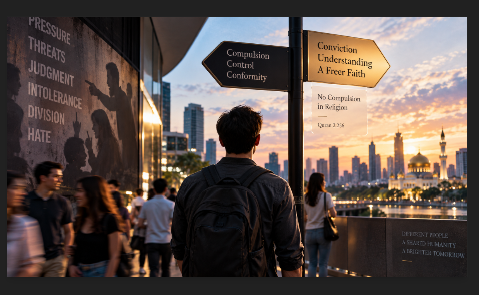
Quran 2:256 is one of Islam’s most quoted verses. But what is it actually saying?
You may have seen the sentence on posters, social media posts and interfaith presentations:
“Let there be no compulsion in religion.”
Quran 2:256
It sounds straightforward.
A person should not be forced to become Muslim.
But then difficult questions begin.
Does this mean Islam regards every religious belief as equally true?
Does it mean Muslims should never invite another person towards Islam?
What about verses where the Quran strongly distinguishes truth from falsehood?
And if Islam believes its message is true, why should people be free to reject it?
These questions matter, particularly for Muslims living in a religiously diverse society such as Singapore.
But before turning Quran 2:256 into either a slogan for religious pluralism or an argument about Islamic law, we should read what the verse actually says.
Read Quran 2:256 and the available tafsir →
Read the whole verse
Quran 2:256 does not stop after the famous opening words.
It continues:
“Let there be no compulsion in religion, for the truth stands out clearly from falsehood.”
Quran 2:256
The rest of the verse speaks about rejecting false gods, believing in Allah and grasping the firmest handhold.
That creates an interesting combination.
The verse rejects compulsion.
But it does not say that truth and falsehood are indistinguishable.
In fact, the verse says almost the opposite.
It says that the right way has become distinct from error.
So two ideas appear together:
Islam makes a truth claim.
And:
Faith should not be produced through coercion.
Those ideas are not necessarily contradictory.
Perhaps they tell us something important about what faith actually is.
What did classical tafsir say?
We should not decide the meaning of such an important verse from its English translation alone.
Ibn Kathir’s commentary on Quran 2:256 begins with a remarkably direct explanation.
He understands “There is no compulsion in religion” as an instruction not to force someone to enter Islam. He argues that Islam’s proofs are clear and that coercion cannot produce the kind of genuine acceptance that guidance requires.
Read Ibn Kathir on Quran 2:256 →
Ibn Kathir also records reports concerning the circumstances surrounding the verse.
One report attributed to Ibn Abbas concerns families among the Ansar whose children had been raised among Jewish families. When Banu Nadir were expelled from Madinah, some Muslim parents wanted to prevent those children from leaving with them.
The verse was revealed in that context according to the report cited by Ibn Kathir.
That historical background makes the verse considerably more concrete.
This was not merely an abstract philosophical statement about freedom.
It arose within a real community in which religious identity, family relationships and communal boundaries had become complicated.
Al Tabari also preserves extensive discussion around Quran 2:256 and the interpretations transmitted by earlier scholars.
Read Al Tabari on Quran 2:256 →
The classical discussion contains details and legal questions that cannot responsibly be reduced to a single sentence.
But the basic prohibition against forcing someone into belief is plainly present in the classical tafsir tradition.
Another Quranic verse makes the question even sharper
Surah Yunus asks Prophet Muhammad ﷺ:
“Had your Lord willed, all those on earth would have believed. Would you then compel people to become believers?”
Quran 10:99
This is a striking question.
Allah could have created a world in which everyone believed.
Yet that is not the world we inhabit.
People believe.
People disbelieve.
People search.
People resist.
People change.
And the Prophet himself is asked whether he would compel people until they became believers.
But doesn’t Islam still claim to be true?
Yes.
And this is where Quran 2:256 becomes more interesting than the way it is sometimes quoted.
“No compulsion in religion” does not mean:
“Every religious claim is equally true.”
The same verse says:
“The truth stands out clearly from falsehood.”
The Quran makes strong theological claims.
It calls people towards belief in Allah.
It challenges other beliefs.
It warns about rejecting God.
It describes consequences in the Hereafter.
None of that disappears because Quran 2:256 rejects compulsion.
Consider Quran 18:29:
“The truth is from your Lord. Whoever wills, let them believe, and whoever wills, let them disbelieve.”
The verse does not say belief and disbelief have identical consequences.
In fact, it immediately warns about the consequences of wrongdoing and rejection.
But a distinction remains between declaring something true and forcing another person to accept it.
Conviction and coercion are not the same thing
Imagine someone being threatened until they say:
“I believe.”
What exactly has been achieved?
Their mouth may have produced the sentence.
Their heart may believe something entirely different.
That distinction matters enormously in religion.
Faith is not merely a sound produced by the tongue.
It involves conviction.
That may help us understand why coercion is such a strange instrument for producing genuine belief.
You can force behaviour.
You can sometimes force silence.
You can pressure someone into conformity.
But can you actually force conviction?
This is a contemporary reflection rather than a legal ruling.
Yet it helps illuminate why Quran 2:256 places the absence of compulsion immediately beside the clarity of truth.
Truth does not become more true because somebody was frightened into repeating it.
Invitation is not the same as compulsion
There is another distinction worth making.
Rejecting religious coercion does not mean Muslims must never speak about Islam.
The Quran itself calls people towards God.
It presents arguments.
It tells stories.
It asks questions.
It challenges assumptions.
It asks people to observe the world.
It asks them to think.
There is therefore an enormous difference between saying:
“Here is what I believe. Here is why I believe it. Think about it.”
and:
“You must say that you believe this whether you are convinced or not.”
One is invitation.
The other is coercion.
A confident faith should understand the difference.
This matters in Singapore
Singapore gives this discussion a very practical dimension.
A Muslim may work beside a Christian, Buddhist, Hindu, Taoist, atheist or someone who does not think very much about religion at all.
Our children study together.
We share neighbourhoods.
We eat together.
We work together.
We may become close friends while holding fundamentally different beliefs about God, revelation and the meaning of life.
Living peacefully together does not require Muslims to pretend those differences do not exist.
Respect does not require theological agreement.
And conviction does not require hostility.
A Muslim can believe deeply that the Quran is revelation while recognising that another human being must make their own response to that claim.
Perhaps that is one reason Quran 2:256 remains so relevant.
There is also a lesson for Muslim families
Religious pressure does not exist only between different religions.
Sometimes it exists inside Muslim homes.
A parent desperately wants a child to pray.
A spouse wants their partner to become more religious.
Someone wants a sibling to dress differently.
The intention may come from genuine concern.
But concern can gradually become pressure.
Pressure can become humiliation.
And humiliation can sometimes create outward compliance while producing inward resentment.
This does not mean parents have no responsibility to teach Islam.
It does not mean Muslim families should become indifferent to religious practice.
And Quran 2:256 should not casually be transformed into a ruling about every question of parenting, family responsibility or Islamic law.
Those matters require their own evidence and qualified scholarship.
But the verse should at least make us ask:
What kind of faith are we trying to nurture?
One performed only because somebody is watching?
Or one understood and eventually owned by the person themselves?
There is a difference between freedom and indifference
“No compulsion” should not become:
“Nothing matters.”
The Quran clearly thinks truth matters.
Belief matters.
Moral choices matter.
What we worship matters.
How we live matters.
Quran 2:256 itself moves immediately from rejecting compulsion to talking about rejecting falsehood and believing in Allah.
So perhaps the verse offers something more demanding than either extreme.
Not forced religion.
Not indifferent religion.
But conviction.
A faith that can explain itself.
A faith willing to invite.
A faith confident enough to allow another person to think.
The deeper question
Perhaps we have been asking the wrong question.
Instead of asking only:
“Does Islam allow people to choose their religion?”
Quran 2:256 may push us towards another question:
“What kind of belief does Islam actually want?”
If the answer were merely outward conformity, coercion might accomplish something.
But if faith involves recognition, conviction and a willing response to what someone believes to be true, then force has a fundamental limitation.
It can control behaviour.
It cannot manufacture certainty inside another person’s heart.
That may be why the verse does something so striking.
It places two ideas beside one another:
There is no compulsion in religion.
And:
Truth has become distinct from error.
Islam does not have to abandon its claim to truth in order to reject forced belief.
Perhaps genuine conviction requires precisely that distinction.
Sources & Further Reading
Quran 2:256
The principal verse discussed in this article. The page also provides access to several tafsir works.
Read Quran 2:256 and tafsir
Tafsir Ibn Kathir on Quran 2:256
Discusses the prohibition against forcing people into Islam and records reports concerning the circumstances associated with the revelation of the verse.
Read Tafsir Ibn Kathir
Tafsir Al Tabari on Quran 2:256
Contains early transmitted interpretations and discussion surrounding the verse.
Read Tafsir Al Tabari
Quran 10:99
Asks whether people should be compelled until they become believers.
Read Quran 10:99
Quran 18:29
Places the Quran’s truth claim alongside the human response of belief or disbelief, while also describing moral consequences.
Read Quran 18:29
Continue Reading Quranic Thoughts
Why Does Allah Seal Some Hearts?
If Allah seals a person’s heart, where does human responsibility begin? Explore rejection, divine guidance and what repeated choices can do to the heart.
[Read the article →](INSERT ARTICLE 1 URL HERE)
Why Does the Quran Keep Asking Us to Think?
The Quran repeatedly asks human beings to observe, reason and reflect. What kind of thinking is it asking from us?
Coming next
What Does the Quran Actually Mean by Kafir?
A familiar Quranic word carries more context than its everyday use sometimes suggests.
Coming soon
About Quranic Thoughts
Quranic Thoughts is a Rethinking Islam series for reflection and learning.
Our approach is simple: Quran first, recognised scholarship before personal interpretation, and contemporary reflection after that.
Where recognised scholars have legitimately differed, we aim to acknowledge that disagreement rather than present one interpretation as though no others exist.
These articles encourage thoughtful engagement with the Quran. They do not replace qualified religious guidance where a formal religious ruling is required.
