

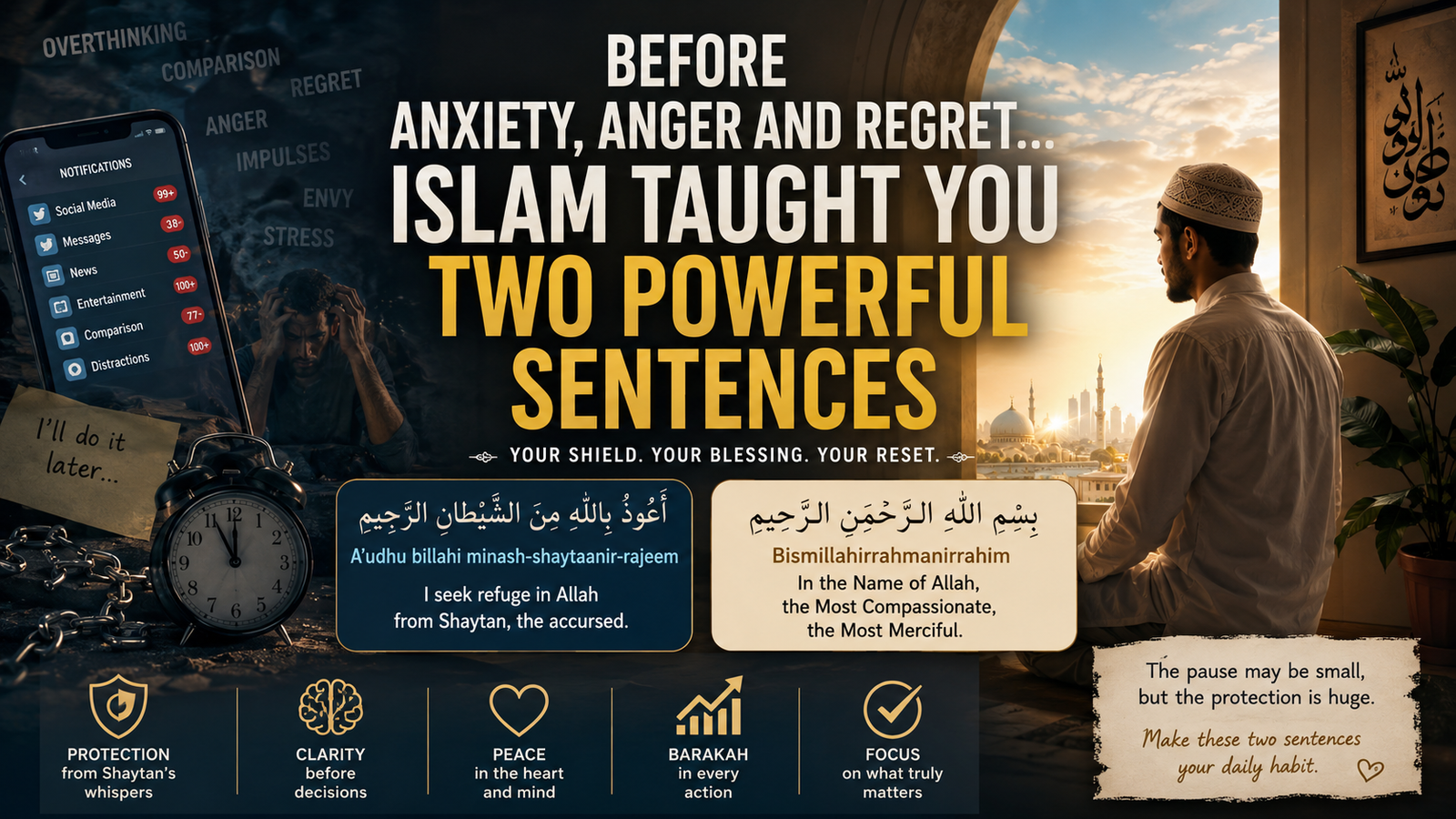
Long before modern mindfulness apps and wellness trends, Islam taught believers short forms of remembrance that can interrupt a rushed reaction and return attention to ALLAH.
Not as magic spells.
Not as empty rituals.
They are acts of remembrance and reliance, not a substitute for mental health care. They can also create a useful pause before anger, impulsiveness or a decision we may later regret.
Most Muslims know these phrases:
أَعُوذُ بِاللَّهِ مِنَ الشَّيْطَانِ الرَّجِيمِ – “A’udhu billahi minash shaytaanir rajeem”
(I seek refuge in Allah from Shaytan, the accursed)
بِسْمِ اللَّهِ الرَّحْمَٰنِ الرَّحِيمِ – “Bismillahir Rahmanir Raheem”
(In the Name of Allah, the Most Compassionate, Most Merciful)
But somewhere between routine and repetition, many of us stopped asking a frightening question:
What were these phrases actually protecting us from?
Because if we are honest, modern life is no longer attacking only the body.
It is attacking attention.
Emotions.
Patience.
Desires.
Intentions.
Identity.
And perhaps that is exactly why Islam taught believers to pause before reacting, before speaking, before deciding, and even before following their own feelings.
The Modern Human Rarely Pauses Anymore
Today’s world rewards immediacy.
Reply instantly.
React instantly.
Buy instantly.
Desire instantly.
Cancel instantly.
Expose instantly.
The slower a person thinks, the more “outdated” they appear.
Yet many regrets today were born from moments that lacked pause.
A single angry WhatsApp message.
A late night emotional decision.
An impulsive relationship.
A reckless financial commitment.
A moment of ego.
A private sin normalised repeatedly until the soul no longer feels disturbed.
The modern world trains humans to react immediately.
Islam trained believers to pause first.
And this is where Ta’awwudh and Basmala become more relevant than ever.
Before the Quran Was Read, Allah Told You to Seek Protection
Allah says:
“When you recite the Quran, seek refuge with Allah from Satan, the accursed.”
Notice something remarkable.
Allah commanded protection before Qur’an recitation.
Not after.
Why?
Because even guidance gets resisted internally.
How many times have we:
• intended to pray but suddenly felt lazy?
• opened the Quran but became distracted within minutes?
• wanted to repent but postponed it?
• planned something beneficial but mysteriously lost motivation?
Shaytan does not always attack through obvious evil.
Sometimes he simply interrupts transformation.
And in today’s world, distractions are endless.
A person opens social media for “five minutes” and walks out emotionally drained, insecure, angry, envious or spiritually numb.
A smartphone can provide endless distraction, temptation and comparison. We do not need to claim that every unhealthy digital habit is directly caused by Shaytan in order to take the problem seriously.
The Most Dangerous Whispers No Longer Sound Evil
Many people imagine Shaytan whispering dramatic invitations toward major sins.
But modern whispers are often much softer.
“You deserve this.”
“Just this once.”
“You suffered enough.”
“Everyone else is doing it.”
“Allah understands.”
“You can repent later.”
These whispers are dangerous precisely because they sound reasonable.
That is why Ta’awwudh is deeper than many realise.
It is not merely:
“Protect me from demons.”
It is also:
“Protect me from the version of myself I slowly become when desires, ego and emotions take control.”
Because the frightening reality is this:
A person can drift very far while still believing they are spiritually safe.
Bismillah Was Never Just About Food
Most people associate “Bismillah” with eating.
But Islam taught believers to say it before actions because it creates something modern life is rapidly losing:
Consciousness.
Pause for a moment and think carefully.
Can someone comfortably say:
“Bismillahir Rahmanir Raheem”
before gossiping?
Before humiliating someone online?
Before cheating?
Before opening something haram privately?
Before lying?
The tongue hesitates.
Why?
Because deep inside, the soul recognises contradiction.
Bismillah was never only about beginning actions.
It was also about questioning intentions.
That is profoundly relevant today.
Because modern society constantly encourages people to follow feelings without examining them.
Islam does not teach blind obedience to emotions.
Islam teaches awareness before action.
Anger Is One Place the Sunnah Explicitly Teaches Taawwudh
This may be one of the most practical lessons for modern Muslims.
Many destructive decisions today are not made logically.
They are made emotionally.
People decide while angry.
While lonely.
While insecure.
While jealous.
While emotionally exhausted.
While craving validation.
Then later comes regret.
Families break.
Friendships collapse.
Financial mistakes happen.
Private matters become public.
Trust disappears.
And many times, the person later says:
“I don’t know what came over me.”
Islam inserted spiritual pauses before emotional damage occurs.
“A’udhu billahi minash shaytaanir rajeem.”
Slow down.
“Bismillahir Rahmanir Raheem.”
Think again.
That pause cannot guarantee an outcome, but it can create enough space to reconsider words or actions before they cause avoidable harm.
The Prophet ﷺ once saw a man overwhelmed by anger and said that if he sought refuge in Allah from Shaytan, his anger would leave him.
Read Sahih al Bukhari 3282 on anger and seeking refuge in ALLAH
Today that anger may appear through:
• road rage
• passive aggressive texting
• online arguments
• public shaming
• family conflicts
• workplace hostility
The Sunnah suddenly becomes frighteningly modern.
Sometimes the Greatest Danger Is Ourselves
One uncomfortable truth many people avoid is this:
Not every harm in life comes from external evil.
Sometimes we cooperate with our own destruction.
We feed envy through endless comparison.
We feed arrogance through attention seeking.
We feed dissatisfaction through obsession with lifestyles online.
We feed ego while calling it “self respect.”
We justify desires using emotional language.
And slowly, the soul changes.
Not dramatically.
Quietly.
This is why these two phrases matter so much.
They interrupt self deception.
Spiritual distraction can be dangerous because it often feels ordinary. The Quran and Sunnah warn about Shaytan, while also holding human beings responsible for their own habits, choices and repentance.
Not Every Harm Is Physical
Modern people are surrounded by convenience yet emotionally exhausted.
Beautiful homes.
Expensive gadgets.
Entertainment everywhere.
Yet many hearts feel heavy.
Some homes have comfort but no tranquillity.
Some families live together but barely connect.
Some people laugh publicly yet feel internally empty.
The Prophet ﷺ taught that when Allah is remembered upon entering the home and before eating, Shaytan says there is no place to stay and no dinner there.
Sahih Muslim Hadith on Entering the Home
This should not make Muslims paranoid.
Islam is not teaching superstition.
Islam is teaching awareness.
Remembering ALLAH in the home is an established Sunnah. But a household can struggle for many reasons, including health, money, conflict and stress. Dhikr should not be used to blame a family for every period of difficulty.
The Two Sentences Many Muslims Recite Without Reflecting
Perhaps the saddest thing is not that Muslims forgot these two phrases.
It is that many recite them mechanically without understanding why Allah taught them to humanity in the first place.
These phrases were never meant to be empty rituals.
They remind the believer to seek ALLAH’s protection and begin lawful actions in His name. As a practical reflection, they can also help us pause and examine intention before acting.
In a world obsessed with speed, distraction and desire, Islam quietly taught believers something revolutionary:
Pause before you react.
Pause before you desire.
Pause before you decide.
Pause before you become someone you no longer recognise.
And perhaps that pause may save far more in our lives than we realise.
Related Reading
You Think It Is Not Wrong. But Did ALLAH Say It Was Right?
Quiet Reflection for Today Community Space
