

At seventeen, Hafiz had plenty of people to talk to. His friends crowded around him after school. At home, his mother asked about his day, his siblings borrowed his things, and someone was always calling him to eat.
One afternoon, walking home with a packet of food still warm in his hand, he thought, Allah, thank You. I was hungry.
That was all. He went upstairs, ate, and argued with his brother about the television remote.
The next week, a friend seemed unusually quiet after something Hafiz had said. On the bus, Hafiz looked out at the passing blocks and thought, Allah, did I embarrass him? Help me put it right.
He apologised the following day.
At first, these thoughts came only now and then. He still prayed and fasted, but he had begun bringing Allah into the small minutes between one task and the next.
In his twenties, the minutes multiplied. Before meeting the woman who would become his wife, he whispered, “Allah, let me be honest with her.” After the wedding, when both families had finally gone home and the flat was quiet, he said, “Thank You for her. Help me look after this marriage.”
He spoke with his wife about money, plans and the burnt rice at the bottom of the pot. He laughed with cousins and stayed out too late with friends. He spoke to Allah while living among them.
Sometimes what he said was almost embarrassingly ordinary.
“Allah, I am going to eat. Thank You for this.”
An hour later: “I ate too much. My stomach hurts. I should have listened to my wife.”
Before going out one evening: “Allah, I think I will watch a movie. I feel a little uneasy about my choice. Help me be honest about it.” Afterwards, he could admit, “I enjoyed the story.”
He was learning that he could be truthful before his Lord about a whole day, including its small pleasures and foolish moments. He did not expect an answer in a voice. He could ask for guidance, then consider his choices and take responsibility for them.
Then the children arrived. He began thanking Allah for details he once might have walked past: a fever breaking, his daughter sleeping with her hand around his finger, his wife laughing despite a difficult week. Before a conversation at work, he would quietly ask for fairness. After losing his temper at home, he would ask forgiveness and go back to apologise.
By his forties, gratitude had become the reason he spoke more often. He had once brought Allah mostly his troubles. Now he noticed how many ordinary things deserved thanks.
The Quran describes people who remember Allah while standing, sitting and lying down. Hafiz thought of that verse while waiting for the MRT, carrying groceries and sitting beside his family on the sofa. Quran 3:191
He also returned to Allah’s words: “Remember Me; I will remember you.” Quran 2:152 A sacred hadith speaks of Allah remembering the servant who remembers Him privately. Sahih al Bukhari 7405
The thought humbled him. Allah was his Lord, the One who had given him the table, the food and the people around it. Somehow, that greatness made Hafiz more willing to bring Him the truth.
Night prayer came later. One morning he woke before Fajr and could not fall asleep again. He made wudu, prayed a little, and stayed seated afterwards. He thanked Allah for his family. He admitted a worry about his ageing mother. He asked to be a better son while there was still time.
He did not manage Tahajjud every night. Some mornings the alarm won. But when he did rise, the quiet let him linger over words he had already been saying in daylight. The Prophet ﷺ described prayer during the night as the best prayer after the obligatory prayers. Sahih Muslim 1163a
Years passed. His children grew up. Family dinners had to be arranged in the group chat and rearranged twice before everyone could come. Hafiz passed sixty. His hair thinned, his knees protested on the stairs, and still, before leaving the flat, he might say softly, “Allah, I am going out. Help me be patient today.”
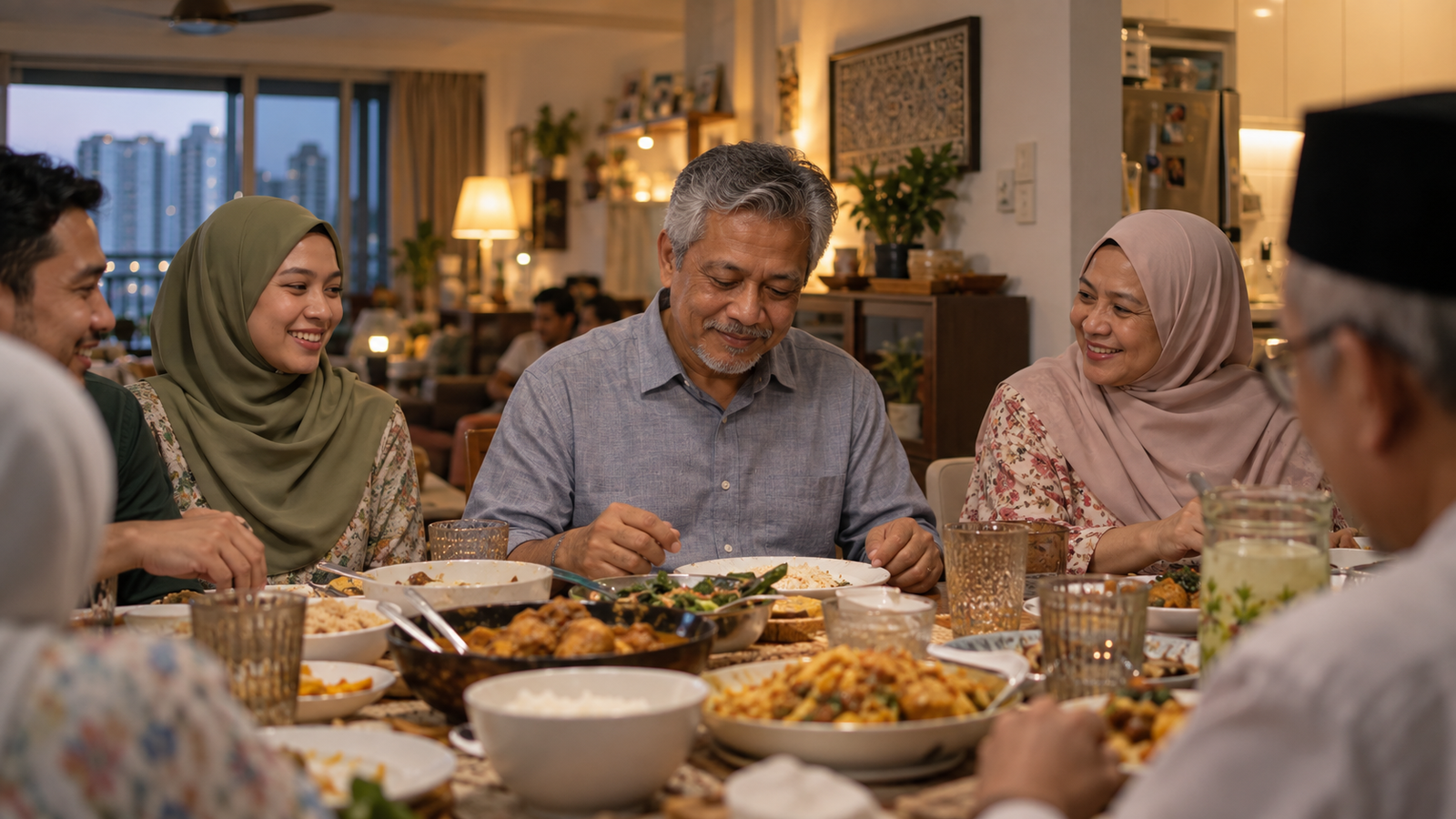
One Sunday, everyone came for dinner. His daughter brought a dish she had made herself. A younger relative was telling a long story, and three people interrupted to correct the ending. His wife caught Hafiz looking at the crowded table and smiled.
He reached for his food, then paused.
“Allah,” he said so quietly that only he could hear it, “thank You for letting me sit here with them.”
For a moment he remembered the boy carrying warm food home after school. He had never planned to become a man who spoke to Allah before doing almost anything. There had been no single day when it happened. There had been thousands of small days in which he found another reason to say thank You.
His wife asked him to pass the water. He did, then joined the conversation.
He knew the Quran’s promise that Allah is near and responds when His servants call upon Him. Quran 2:186 Hafiz left the manner of that response to Allah. He kept praying, reading the Quran, making zikr and trying to do right by the people at his table.
And when an ordinary thought rose in his heart, he spoke to Allah about that too.
Some years after that Sunday dinner, Hafiz became ill. His family took turns sitting with him. His wife kept his hand in hers. His daughter adjusted his pillow, though he insisted it was already comfortable.
On his last morning, he opened his eyes and looked at the people around his bed. He seemed to be counting them, the way he used to count chairs before a family meal.
“Everyone is here,” his wife told him.
He gave a small smile.
His lips moved once more. She heard him say, “Allah.” The rest was too soft for anyone in the room to make out. He closed his eyes with that faint smile still on his face.
At his Janazah, people remembered different parts of his life. A cousin recalled how easily he laughed. His daughter remembered the apologies he was never too proud to make. His wife remembered the quiet pauses before meals and before he left the house.
At the burial, his loved ones stood close together. Some cried softly. Others had no words yet. A light drizzle began, cooling the air after a warm morning. Somewhere beyond the cemetery, birds called to one another and lifted above the trees.
His daughter looked at the fresh earth. She wished she could hear him say one more ordinary thing. Then she remembered that, for years, he had said those things to Allah as well.
She raised her hands and made dua for her father.
The drizzle continued as the family walked back together.
References
- Quran 3:191: Remembering Allah while standing, sitting and lying down.
- Quran 2:152: Remember Allah and He will remember you.
- Sahih al Bukhari 7405: Allah remembers the servant who remembers Him privately.
- Sahih Muslim 1163a: The virtue of prayer during the night after obligatory prayer.
- Quran 2:186: Allah’s nearness and response to those who call upon Him.
- Sahih Muslim 373: The Prophet ﷺ remembered Allah at all moments.
- Sahih al Bukhari 6502: Nearness through obligatory and additional deeds.
