
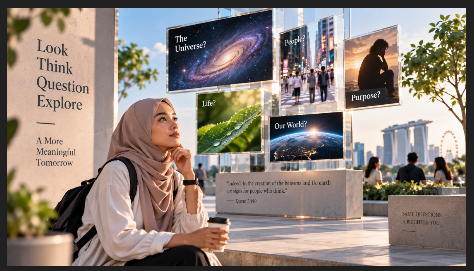
If faith is about believing, why does the Quran repeatedly ask us to observe, question, reason and reflect?
There is something interesting about the way the Quran speaks to its reader.
It does not simply say:
Believe.
Again and again, it asks us to look.
To listen.
To consider.
To remember.
To reason.
And, remarkably, to think deeply about the Quran itself.
One of the clearest examples appears in Surah Muhammad:
“Do they not then reflect on the Quran? Or are there locks upon their hearts?”
Quran 47:24
Read Quran 47:24 and its tafsir
That is a striking question.
The Quran does not criticise these people because they are thinking too much.
It asks whether they are thinking deeply enough.
So what kind of thinking is the Quran asking from us?
And does this mean every personal interpretation of the Quran is equally valid?
The answer to the second question is no.
But understanding why takes us somewhere important.
The Quran Points Beyond the Page
Consider another passage:
“Indeed, in the creation of the heavens and the earth and the alternation of the night and day are signs for people of understanding.”
Quran 3:190
The following verse describes these people as remembering Allah while standing, sitting and lying down, and reflecting on the creation of the heavens and the earth.
Notice what is happening.
The believer is not being told to shut out the physical world in order to become religious.
The physical world itself becomes something to contemplate.
Sky.
Earth.
Night.
Day.
Creation.
Order.
Existence.
The Quran points at the world and effectively tells its reader:
Look again.
Ibn Kathir, commenting on these verses, discusses the heavens, earth and the extraordinary variety within creation as signs for people of understanding.
Read Ibn Kathir on Quran 3:190
That makes Quranic reflection much broader than simply reading words on a page.
Even Rain, Clouds and Ships Become Things to Think About
Surah Al Baqarah gives an extraordinary list:
the heavens and earth,
night and day,
ships crossing the sea,
rain falling from the sky,
dead earth becoming alive,
living creatures spreading across it,
winds,
and clouds.
Then the verse describes these as signs for people who use reason.
Quran 2:164
The verse does not present reason as the enemy of revelation.
Reason is part of the human response to the signs revelation is pointing towards.
But What Does It Mean to “Reflect” on the Quran?
This is where we need an important distinction.
Quran 47:24 asks:
“Do they not then reflect on the Quran?”
Ibn Kathir’s commentary treats the verse as a call to reflect upon and understand the Quran, together with a warning against turning away from it.
Read Ibn Kathir on Quran 47:24
But reflection does not mean:
“I read one English translation, this is what the verse means to me, therefore this must be what Allah means.”
Those are two very different things.
There is tafsir, the disciplined interpretation of the Quran grounded in Arabic, Quranic context, Prophetic tradition and recognised scholarship.
And there is tadabbur, our reflection upon what the Quran is telling us and what it demands from our lives.
The second should not casually replace the first.
That distinction matters enormously for this Quranic Thoughts series.
We want Muslims to think about the Quran.
But we do not want to pretend that thinking about a verse for twenty minutes makes any of us a mufassir.
Thinking Is Not the Same as Inventing
Suppose someone reads:
“Do they not then reflect on the Quran?”
and concludes:
“Excellent. I can interpret the Quran however I want.”
That would defeat the purpose.
Serious thinking requires humility.
Sometimes thinking means discovering that our first interpretation was wrong.
Sometimes it means checking the Arabic.
Sometimes it means reading what scholars said.
Sometimes it means discovering that scholars themselves disagreed.
And sometimes the intellectually responsible conclusion is simply:
I do not know enough yet.
That too is thinking.
The Quran’s Questions Can Be Uncomfortable
The Quran does not only ask comfortable questions.
It asks human beings to consider creation.
It asks them to examine history.
It asks them to consider what happened to earlier peoples.
It challenges assumptions inherited from previous generations.
It asks people to consider their own behaviour.
And sometimes its questions seem almost deliberately unsettling.
Will they not reflect?
Will they not reason?
Will they not remember?
The purpose is not intellectual entertainment.
The questions are supposed to do something to us.
That may be why Quran 47:24 connects failure to reflect with something much deeper:
locked hearts.
The problem is no longer merely lack of information.
It is receptiveness.
We Live in an Age With Almost Unlimited Information
This creates an interesting modern problem.
A Muslim in Singapore today can reach more Islamic information in ten minutes than previous generations might have encountered in months.
Open your phone.
A Quran translation appears.
Another tap gives you tafsir.
Then a lecture.
Then a TikTok clip.
Then an Instagram reel.
Then a podcast.
Then an AI explanation.
Then somebody arguing against that explanation.
We are drowning in information.
But information and understanding are not identical.
And neither are information and wisdom.
The modern challenge may therefore be strangely Quranic:
Are we actually thinking about what we consume?
Or are we simply consuming more?
This is contemporary reflection, not classical tafsir.
But Quran 47:24 gives us a powerful question with which to examine our digital habits.
Even Religious Content Can Become Scrolling
This should make us slightly uncomfortable.
Imagine watching twenty Islamic videos in one evening.
One about marriage.
One about the signs of the Last Day.
One about halal investing.
One about Palestine.
One about jinn.
One about a controversial preacher.
One about a miracle supposedly discovered by science.
We swipe.
We like.
We share.
And five minutes later we barely remember what we watched.
Was that Islamic learning?
Maybe sometimes.
But perhaps not always.
There is a difference between being exposed to religious content and actually reflecting upon revelation.
The Quran’s repeated invitations to think suggest that attention itself matters.
What About Science?
Quran 3:190 to 191 is particularly interesting here.
The Quran directs attention towards the heavens and earth.
That does not mean every scientific discovery needs to be turned into a supposed Quranic miracle.
We should be careful about forcing modern scientific theories into verses that classical scholarship never understood that way.
Science changes as evidence develops.
The Quran should not become dependent upon whichever scientific headline happens to be fashionable this year.
But there is another possibility.
Studying the universe can deepen the questions the Quran asks us to consider.
Why is there something rather than nothing?
Why does nature exhibit order?
What does human consciousness mean?
What kind of creatures are we?
What responsibilities come with knowledge?
Science can investigate how extraordinary parts of our universe work.
The Quran asks us also to consider what those signs mean.
Those are related conversations, but they are not identical.
Thinking and Remembering Belong Together
There is another beautiful detail in Quran 3:191.
The people being praised do two things.
They remember Allah.
And they reflect upon creation.
The Quran does not force us to choose between a thinking mind and a remembering heart.
It brings them together.
That balance is important.
Reason without humility can become arrogance.
Religious enthusiasm without careful thought can become gullibility.
The Quranic picture is richer.
Remember.
Observe.
Reflect.
Recognise.
Respond.
This Also Changes How We Deal With Difficult Questions
Sometimes Muslims become nervous when someone asks a difficult religious question.
Why does Allah allow suffering?
How do we understand evolution?
Why are certain Quranic laws different from modern assumptions?
What happens to people who never encountered Islam properly?
How should we understand verses that appear difficult today?
There are responsible and irresponsible ways of asking these questions.
But the existence of the question itself should not automatically frighten us.
The Quran itself repeatedly places questions before its readers.
A difficult question can become a doorway to deeper learning.
The danger is not always the question.
Sometimes the danger is deciding that we already know enough to stop asking.
There Is a Difference Between Questioning and Refusing
Sincere questioning asks:
What does this mean?
What is the evidence?
How have scholars understood this?
Am I misunderstanding something?
What else do I need to learn?
That is very different from deciding beforehand:
Nothing could ever change my mind.
Thinking requires the possibility that we ourselves may need correcting.
That applies to believers and sceptics alike.
Perhaps Faith Should Make Us More Curious
If Muslims believe that Allah created the universe, then investigating creation should not automatically threaten faith.
If Muslims believe the Quran comes from Allah, then carefully studying its language, history and interpretation should not automatically threaten faith either.
There will be difficult questions.
There will be disagreements.
There will be things we do not understand immediately.
But intellectual humility works in both directions.
We should not pretend to possess answers we do not have.
And we should not assume that an unanswered question is therefore unanswerable.
Sometimes the most honest sentence in religious learning is:
I need to study this properly.
The Quran May Be Asking for More Than Intelligence
Perhaps this is the deeper point.
Quran 47:24 does not ask whether people lack brains.
It asks whether they will reflect, then speaks about hearts being locked.
Quranic thinking therefore appears to involve more than raw intelligence.
A brilliant person can still be arrogant.
An educated person can still refuse evidence they dislike.
A religious person can still read only what confirms what they already believe.
Thinking requires something moral as well as intellectual.
Patience.
Humility.
Honesty.
The willingness to discover that we were wrong.
So Why Does the Quran Keep Asking Us to Think?
Perhaps because Islam is not asking human beings merely to accumulate religious information.
It is asking them to see.
To look at revelation.
To look at creation.
To look at history.
To look at themselves.
And then to respond.
The Quran does not seem frightened by sincere thought.
Perhaps we should not be either.
Sources & Further Reading
Quran 47:24
The Quran asks whether people reflect upon the Quran and speaks of locks upon hearts.
Read Quran 47:24
Tafsir Ibn Kathir on Quran 47:24
Classical commentary on reflection and understanding of the Quran.
Read Ibn Kathir
Quran 3:190 to 191
The creation of the heavens and earth and the alternation of night and day are presented as signs for people of understanding.
Read Quran 3:190 to 191
Tafsir Ibn Kathir on Quran 3:190
Classical commentary concerning contemplation of creation.
Read Ibn Kathir
Quran 2:164
The Quran points to natural phenomena and human experience as signs for people who reason.
Read Quran 2:164
Continue Reading Quranic Thoughts
Why Does Allah Seal Some Hearts?
A closer look at rejection, human choice, divine guidance and what repeated decisions can do to the heart.
Does the Quran Really Say There Is No Compulsion in Religion?
What Quran 2:256 tells us about truth, conviction and coercion.
What Does the Quran Actually Mean by Kafir?
One familiar Quranic word, several contexts, and a meaning that deserves more care.
Coming next.
About Quranic Thoughts
Quranic Thoughts is a Rethinking Islam series for reflection and learning.
Our approach is simple: Quran first, recognised scholarship before personal interpretation, and contemporary reflection after that.
Where recognised scholars have legitimately differed, we aim to acknowledge that disagreement rather than present one interpretation as though no others exist.
These articles encourage thoughtful engagement with the Quran. They do not replace qualified religious guidance where a formal religious ruling is required.
