


Habib Noh Al-Habshi: A Pillar of Islamic Knowledge and Spirituality
https://www.hjmuhdsalleh.org.sg/st-24dec-habib-noh/
Let’s explore the life, teachings, and contributions of Habib Noh Al-Habshi, a revered Muslim spiritual figure and guide in Singapore’s early community. Drawing upon reliable sources such as the official website of Habib Noh Al-Habshi’s organization, the aim is to provide an in-depth understanding of his impactful role within the Islamic community. Additionally, I shall highlight the significance of his teachings in contemporary society. Furthermore, it will discuss three other influential individuals who share similar qualities and have made notable contributions to Islamic knowledge and spirituality.
- Introduction: Habib Noh Al-Habshi is remembered as a deeply respected spiritual figure. Accounts of his generosity, religious devotion and counsel have inspired generations of people seeking guidance and enlightenment. The purpose of this topic is to shed light on his life, teachings, and the impact he has made within the Muslim community.
- Biography of Habib Noh Al-Habshi: According to Masjid Haji Muhammad Salleh’s biography, Habib Noh was born in 1788 (1202H) aboard a ship travelling from Palembang towards Penang, not in Singapore. He arrived in Singapore around 1819, aged about 31, and passed away on 27 July 1866. While he is revered for his spirituality, the historical sources I consulted speak particularly of his compassion for poor families and children. Claims that he formally mastered specific scholarly disciplines or founded educational institutions would require further documentary evidence.
- Teachings and Contributions: Habib Noh Al-Habshi’s teachings encompass a wide range of topics, including the importance of seeking knowledge, nurturing spiritual growth, and upholding moral values. His emphasis on the purification of the heart and the cultivation of a strong relationship with Allah (SWT) has resonated with many. Habib Noh Al-Habshi’s teachings are documented on his official website [1], providing a valuable resource for those seeking spiritual guidance.
- Impact on Contemporary Society: The impact of Habib Noh Al-Habshi’s teachings can be observed through his numerous followers and students who have benefitted from his wisdom and guidance. Through his personal interactions, he has inspired individuals to lead lives that are deeply rooted in Islamic principles. The impact extends beyond Singapore, as Habib Noh Al-Habshi’s teachings have reached a global audience, fostering a sense of unity and connection among Muslims.
Numerous accounts highlight the extraordinary miracles attributed to Habib Nuh. His remarkable ability to seemingly vanish and reappear at distant locations left many in awe. Witnesses reported instances where he appeared to be praying in the Grand Mosque of Mecca, despite not physically making the journey there. Astonishingly, he once predicted a meeting with a departing Haj pilgrim and then greeted the person upon their arrival in Mecca.
Habib Nuh’s reputation as a healer, particularly for children, was widely recognized. According to one widely circulated account, he miraculously healed a child’s injured leg by placing his hands over the wound and reciting prayers. Within moments, the child was able to run as if the injury had never occurred. The child’s grateful father expressed his joy by donating money to Habib Nuh, who selflessly distributed it to the needy. Habib Nuh demonstrated his unwavering dedication to helping sick children, even braving thunderstorms. He walked through heavy rain from his home to Paya Lebar to attend to a sick child, leaving the child’s astonished parents astounded by the fact that Habib Nuh remained completely dry upon his arrival.
In another touching incident, Habib Nuh responded to the cries of his impoverished neighbor’s child. Realizing the family’s inability to afford food, he was moved to tears. In an act of divine intervention, Habib Nuh took a coconut kernel, poured water into it, and recited prayers. As the story is recounted, the water miraculously transformed into milk, providing nourishment for the hungry child.
These accounts of Habib Nuh’s miracles serve as a testament to his extraordinary spiritual abilities and his unwavering dedication to helping others.
Alright! These are the insights of such an Individual. An excerpt from this website explains:
(Habib Nuh al-Habsyi ق , the Grand Saint of Singapore (D.1866) (shadhiliyyah.sg) During World War II, the shrine of Habib Nuh miraculously remained unharmed despite bombs being dropped in its vicinity. Concerns arose about the shrine being eroded by rising sea levels, but those fears were dispelled during land reclamation in 1962. In the 1980s, plans for the East Coast Parkway expressway posed a threat to the shrine’s existence as it would cut through the area. However, when bulldozers approached the shrine, they inexplicably failed to operate, and the expressway had to be diverted around the sacred site, as can be seen on Google Maps. Despite the change in plans, laying the foundations of the expressway proved challenging. Reportedly, the construction company sought prayers from the shrine’s trustees and poured water from the shrine over the foundation grounds. Following this ritual, the construction proceeded smoothly. Although the highway nearly led to the demolition of Habib Nuh’s shrine, it ultimately served as a protective covering for those who now visit the revered Awliya of Allah in later years.
You see, what astonished me were the accurate accounts of his demise and the Singapore government’s efforts to relocate his resting place (grave), which failed in several attempts. I was able to verify these incidents with a couple of “authorized” personnel, and they appeared to be true. The efforts to relocate the resting place failed several times, leading the government to divert its expressway works. It also makes sense when you view it on Google Maps, as the expressway had to create a “roundabout” around the Haji Muhammad Salleh Mosque. (Haji Muhammad Salleh Mosque – Google Maps)

The above image shows the Haji Muhammad Salleh Mosque, where the Habib Noh shrine is located. The red dotted line indicates the probable expressway (Keppel Viaduct) that could have been constructed to reduce costs and travel time. It seems logical that the red dotted line would have saved construction money and travel time. However, due to the presence of the shrine, it was not possible to proceed with that plan. This information was confirmed by the personnels I spoke to. This news surprised me, and I wanted further evidence to support the existence of such an individual in my country, which is not typically known for Islamic phenomena. It is also a fact that the government’s priority was to relocate mosques, temples, and places of worship to support economic growth. Nonetheless, the local community supported this decision as long as there were adequate relocation options for these places of worship to accommodate the citizens. This is an appreciative matter for us.
NEW RESEARCH | OCTOBER 2026
My red dotted line is a hypothetical illustration, not an official engineering plan. However, the remarkable curve is real. In an NLB interview published on 23 October 2026, architectural historian Dr Imran Tajudeen explains that a more direct road alignment would have crossed both the mosque and the shrine. He also discusses the accounts of stalled bulldozers, noting that researchers are continuing to investigate eyewitness testimony. That makes the question I asked in 2023 even more intriguing, while the supernatural explanation remains an unverified account.
I approached pious men and mosque’s caretakers, who also acknowledged the aforementioned miracles. Additionally, one of the reasons for his shrine’s elevated location was his premonition regarding Singapore’s future vulnerability to flooding and being submerged underwater. This revelation troubled me, and I found it challenging to fully comprehend or believe in such extraordinary occurrences. Consequently, I decided to discontinue my research on him, as I struggled to accept the rationale behind constructing his shrine at a higher elevation primarily due to Singapore’s projected future as a submerged region.
Just as a thunder strike near someone can generate an awe-inspiring feeling, the news from Singapore’s government in early 2020 startled me. The reports and official sources below describe plans for Singapore’s coastal defences, including seawalls and other flood protection measures. They should not be read as saying that one complete wall has already been built around the island:
The last piece of the jigsaw puzzle came into my hand. Indeed, what I had heard about the higher burial ground seemed justifiable. The government’s main concern appeared to be flooding and how to prevent the island from sinking. What an eye-opener! How many “coincidences” happen without a reason? Even my ‘Teacher’ told us a couple of times that Singapore would submerge when the time came. Oh, my Almighty, I felt that we knew nothing about the unseen, but in some manner, we would be made aware of certain phenomena through pious individuals, commonly known as “Awliyas”. The concept of Awliyas is also a debated issue in modern Islamic thinking. But that will be a topic for another time!
What happened and why such a defensive mode against natural disasters?
Singapore, known for its forward-thinking approach, is proactively taking steps to safeguard our island nation from the impacts of sea-level rise. In this blog post, I will delve into the initiatives being implemented and the importance of these sea defenses in securing our future.
- Understanding the Challenge: Climate change poses a grave threat to Singapore, particularly due to its low-lying topography. Rising sea levels have the potential to erode our coastline, flood low-lying areas, and compromise the integrity of our infrastructure. Recognizing this challenge, the Singapore government has prioritized the development of robust sea defenses to protect our shores and safeguard our communities.
- Investing in Advanced Coastal Protection Systems: Singapore is leveraging cutting-edge technology and engineering prowess to construct state-of-the-art coastal protection systems. Examples include seawalls, dykes and coastal barriers, with different solutions proposed for different shorelines. PUB explains these approaches in its coastal protection measures guide. The proposed Long Island project is another major long term option under study.
- Reclaiming Land and Enhancing Resilience: Our nation’s land reclamation efforts have proven invaluable in expanding our territorial boundaries and creating additional space to accommodate Singapore’s growing population. Going forward, land reclamation projects will be strategically planned to incorporate climate resilience measures. By considering rising sea levels and storm surges during the reclamation process, we can build up our coastal defenses and bolster our resilience against climate-induced threats.
- Green Infrastructure and Natural Barriers: The Singapore government recognizes the importance of adopting nature-based solutions to mitigate the impact of climate change. Emphasizing the integration of green infrastructure, we are implementing measures such as coastal mangrove restoration and the preservation of natural barriers. Mangroves, with their intricate root systems, provide protection against erosion and act as a buffer against storm surges, enhancing our coastal resilience in the face of climate change.
- Public Awareness and Community Engagement: Building sea defenses is not solely the responsibility of the government; it requires the collective effort of every Singaporean. The government is actively engaging with communities, raising awareness about climate change, and encouraging individual actions to reduce carbon emissions. By instilling a sense of environmental consciousness and promoting sustainable practices, we can work together to mitigate the effects of climate change and ensure the long-term well-being of our nation.
As Singapore raises its sea defenses against the tide of climate change, we stand united in our commitment to protect our city-state and secure a sustainable future for generations to come. The government’s proactive approach, investment in advanced technology, and emphasis on nature-based solutions highlight our determination to combat the challenges posed by rising sea levels.
https://www.youtube.com/watch?v=uUex4L9T6_Mhttps://www.youtube.com/watch?v=QoJAI1ijun4
The above video is in Malay language. You can use the ‘cc’ option in YouTube to translate to English or other language. Quite an insightfully explanation, but it is also subjective.
References:
- Official website of Habib Noh Al-Habshi: “Biography.” Retrieved from: https://www.hjmuhdsalleh.org.sg/st-24dec-habib-noh/
- Decoding the 73 Sects in Islam with a Twist!
2026 Update: New Research and a Restored Maqam Habib Noh
I wrote the original article above in 2023. I have deliberately retained my original narrative, including my conversations, map, interpretations and reflections. The information below is a later addition informed by new research, not a rewrite of what I wrote then.
A remarkable new NLB interview
On 23 October 2026, the National Library Board published The 160 Year Old Tomb of Holy Man Habib Noh, a BiblioAsia podcast featuring architectural historian Dr Imran Tajudeen.
I was particularly drawn to his discussion of the expressway. Dr Imran describes how a more direct alignment past the site would have crossed both the mosque and the maqam, and how the existing viaduct swerves around them. He also talks about the familiar account of bulldozers reportedly failing. Researchers, he explains, are still trying to establish and record the eyewitness evidence. These historical observations echo the questions that prompted my original map and investigation, though they do not amount to confirmation of the supernatural explanation.
Dr Imran also describes the former settlement of Kampong Sambau and the hillock associated with Habib Noh’s spiritual retreats. He distinguishes this hillock from nearby Mount Palmer. His research therefore offers a historical reason for the site’s elevated location, alongside the oral accounts shared with me.
A SURPRISING PIECE OF SINGAPORE HISTORY
According to the accounts discussed by Dr Imran, Habib Noh also enjoyed watching Chinese opera. Kampong Sambau was home to a Hakka temple as well as its Malay community. I find this a fascinating reminder that Singapore’s early religious and cultural lives were more intertwined than we sometimes imagine.
Listen to the National Library interview and explore its transcript
The 2026 rejuvenation and reopening
PHOTOGRAPHED AFTER THE RESTORATION | 20 MARCH 2026
These are actual photographs taken two months after the maqam reopened. The exterior shows its position on the hill, while the interior reveals the newly restored dome.
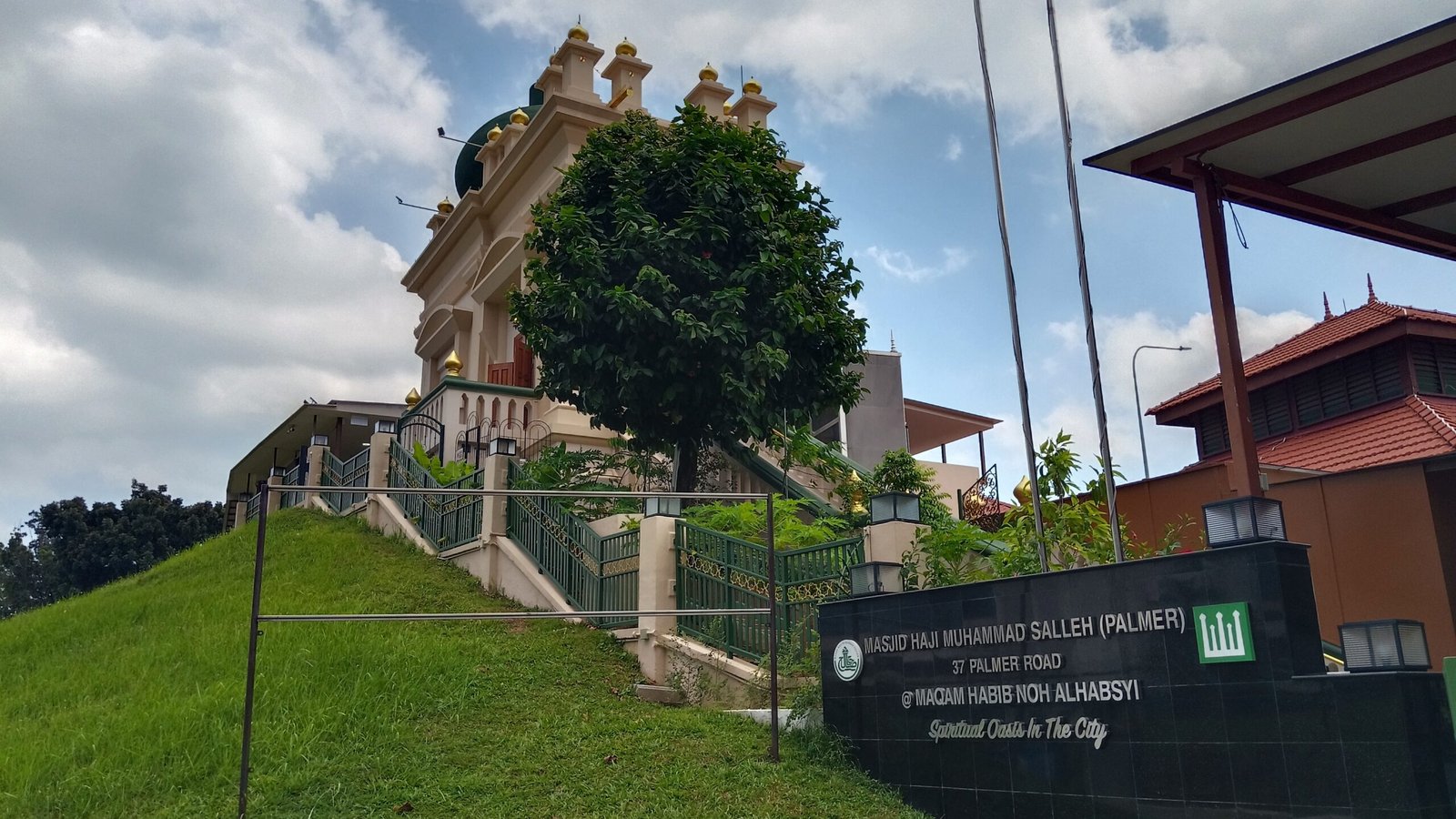

After approximately 18 months of major conservation work, Maqam Habib Noh fully reopened to visitors on 12 January 2026. The roughly SGD 2 million restoration included a replacement dome, structural reinforcement of the historic staircase, repairs to the façades and a new waterproofing system, according to The Straits Times’ January 2026 report. At the completion ceremony on 11 January, the Islamic Religious Council of Singapore (MUIS) recognised the donors, mosque leadership and community members who helped preserve this heritage site. Read the official MUIS statement here.
The NLB interview also describes work to reinforce the structure and replace the deteriorating dome. Dr Imran discusses vibrations from the nearby elevated road as a possible contributing factor to maintenance challenges. Quite an irony: the road that bends around this historic place is also part of the physical environment in which it must survive.
And Singapore’s rising seas?
Singapore’s coastal protection programme has progressed since the time of my original writing. The National Climate Change Secretariat says around 30 per cent of Singapore’s land lies less than five metres above mean sea level, while mean sea level could rise by up to 1.15 metres by 2100. Long Island is among the planned responses. That is a measurable climate risk, not a scientific prediction that all of Singapore will be submerged.
A historical clarification has now been made directly in the biography above. According to the mosque’s published account, Habib Noh was born in 1788 aboard a ship travelling from Palembang towards Penang. He arrived in Singapore around 1819 and died on 27 July 1866. This correction does not change my original personal reflections.
My reflection remains: The old stories of Habib Noh, the raised burial ground and that curious bend in the expressway continue to fascinate me. Newly researched history can deepen our understanding of these accounts without requiring us to treat every recollection as a proven fact.
New references added on 26 October 2026
- National Library Board, BiblioAsia: The 160 Year Old Tomb of Holy Man Habib Noh, published 23 October 2026, including podcast transcript.
- MUIS: Completion of Maqam Habib Noh’s rejuvenation works, 11 January 2026.
- National Climate Change Secretariat: Coastal Protection, updated July 2026.
- Urban Redevelopment Authority: Long Island, planning information.
