
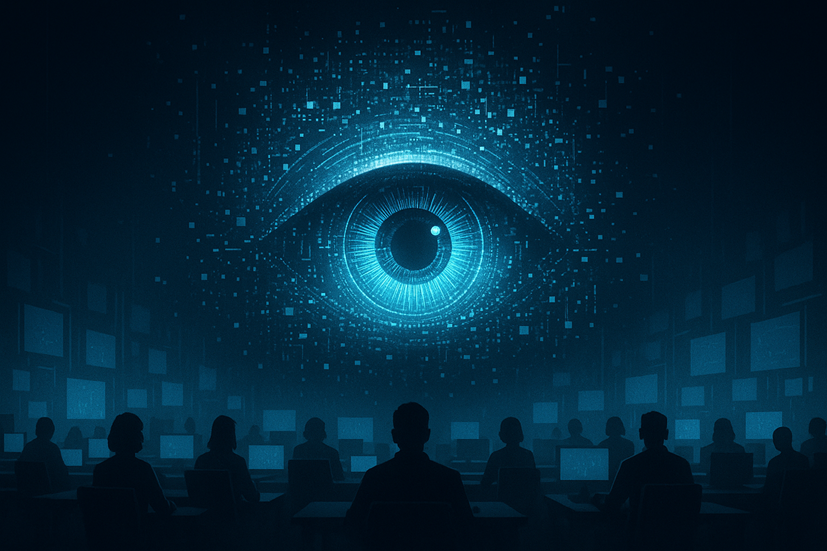
Artificial intelligence is powerful enough to raise serious questions about deception, persuasion and trust. That makes it tempting to connect AI directly with the Islamic descriptions of al Masih al Dajjal.
But similarity in language, such as joking that “AI” sounds like “a eye”, is not evidence. Authentic hadith describe Dajjal as one eyed and warn of an extraordinary future fitnah. They do not identify artificial intelligence, computers or algorithms as his system.
Now picture the world we’re in: chatbots can mimic voices, deepfakes can fabricate convincing scenes, and algorithms can personalise what people see. Could technologies like these help us imagine how large scale deception might be amplified in a future fitnah? Perhaps. But that is a thought experiment, not an Islamic teaching or a claim that AI is the Dajjal system. The Quran and authentic hadith do not identify artificial intelligence as Dajjal or as his technology.
Hadith Secrets: The Pull of Dajjal
The Prophet ﷺ said:
“There has been no fitnah on the face of the earth since Allah created Adam greater than the fitnah of the Dajjal.” (Muslim)
That means this isn’t just another tyrant. This is the ultimate trial.
The strongest authenticated reports are already enough to establish the seriousness of Dajjal’s fitnah. Sahih Muslim describes no greater trial between the creation of Adam and the Last Hour, while Sunan Abi Dawud 4319 warns that a person may approach Dajjal thinking himself a believer and then follow him because of the doubts and confusion raised.
Now layer this with today’s AI.
A Thought Experiment: AI, Deception and the Dajjal
- Spectacle on demand
Imagine Dajjal using A.I. to conjure “miracles” live on every screen. Water gushing where there was none, fire falling from the sky, videos of scholars endorsing him. Deepfake? More like fitnah-fake. - Personalised persuasion
A.I. does not merely broadcast; it can tailor content. That makes personalised persuasion a useful modern example when reflecting on deception, but it does not establish that Dajjal will use an AI system. - Erosion of trust
AI generated voices, images and videos make verification more difficult. That is a real present day problem. It can be used as an analogy when thinking about deception, but it does not prove a technological connection to Dajjal. - Dependence and control
Modern societies increasingly depend on interconnected digital systems for essential services. That dependence raises genuine ethical questions about power and resilience. It should not, however, be presented as fulfilment of the hadith about Dajjal’s extraordinary trials.
The Singapore Angle
We like to think we’re safe in our little island. High literacy, high tech, stable society. But that’s exactly why A.I. is seductive here. It already writes school essays, plans our shopping, navigates our streets. Imagine a future where it also resolves disputes, counsels families, even gives “Islamic guidance” smooth, fast, authoritative.
Would we even question it? Or would we, like so many others, hand over our second eye, the eye of conscience because it’s more efficient to trust the machine?
Singapore’s dependence on technology also gives us a practical question worth asking: how do we preserve independent judgment when convenience, security and authority increasingly arrive through digital systems? That is a present day ethical question, not evidence that a Dajjal system is operating in Singapore.
The One-Eye Symbolism
Why did the Prophet ﷺ emphasize the eye? Scholars say: because it marks imperfection. Allah is perfect. The false messiah is flawed.
AI can calculate and recognise patterns without possessing revelation, moral responsibility or knowledge of the unseen. Calling it “one eyed” can work as a literary metaphor for partial vision, but it should not be confused with the physical descriptions of Dajjal found in hadith.
A Warning Against Overreading the Narration
Digital platforms can target different groups with highly personalised content, but that modern reality should not be projected back into the hadith as though the Prophet ﷺ was describing social media or artificial intelligence. The narration belongs to its own eschatological context.
It would therefore be too speculative to say that modern influencer systems fulfil this narration, or that the report predicts a particular digital vulnerability among women. What can reasonably be carried into the present is the general discipline of verification and the need to resist persuasive falsehood, regardless of who is being targeted.
The descriptions of Dajjal belong to the Islamic eschatological sources themselves. Applying them to a modern technology as a symbol can be a literary exercise, but it should never be presented as tafsir or prophecy without evidence.
The Unsettling Takeaway
This is not an argument for rejecting technology. The practical danger is surrendering judgment to systems we do not critically examine. Verification, conscience and intellectual humility matter whether or not any particular technology has a role in future eschatological events.
The Prophetic warnings about Dajjal teach believers not to be overconfident in the face of extraordinary deception. That lesson can encourage intellectual humility today without claiming that every powerful technology fulfils an end times sign.
Final Reflection
The present day concern is not that AI is secretly the Dajjal. It is that people can become overdependent on systems that generate convincing answers without revelation, moral responsibility or guaranteed truth. That is a reason for verification and restraint, not an eschatological diagnosis.
The useful reflection is simpler: powerful technology can produce convincing appearances, while Islam repeatedly asks believers to care about truth rather than spectacle.
The Prophet ﷺ warned us:
Read that again. Even the confident believer can slip. Even the skeptical journalist can be dazzled. Even the protective father may find his household drifting.
The practical lesson is about us: whether we verify claims, protect our judgment and refuse to treat technological confidence as a substitute for truth.
The warning is therefore not that we have identified a hidden Dajjal system being built around us. We have not. The more grounded question is whether constant exposure to convincing digital manipulation could weaken the habits Islam asks us to protect: verification, humility, moral judgment and resistance to spectacle.
More Reads
