

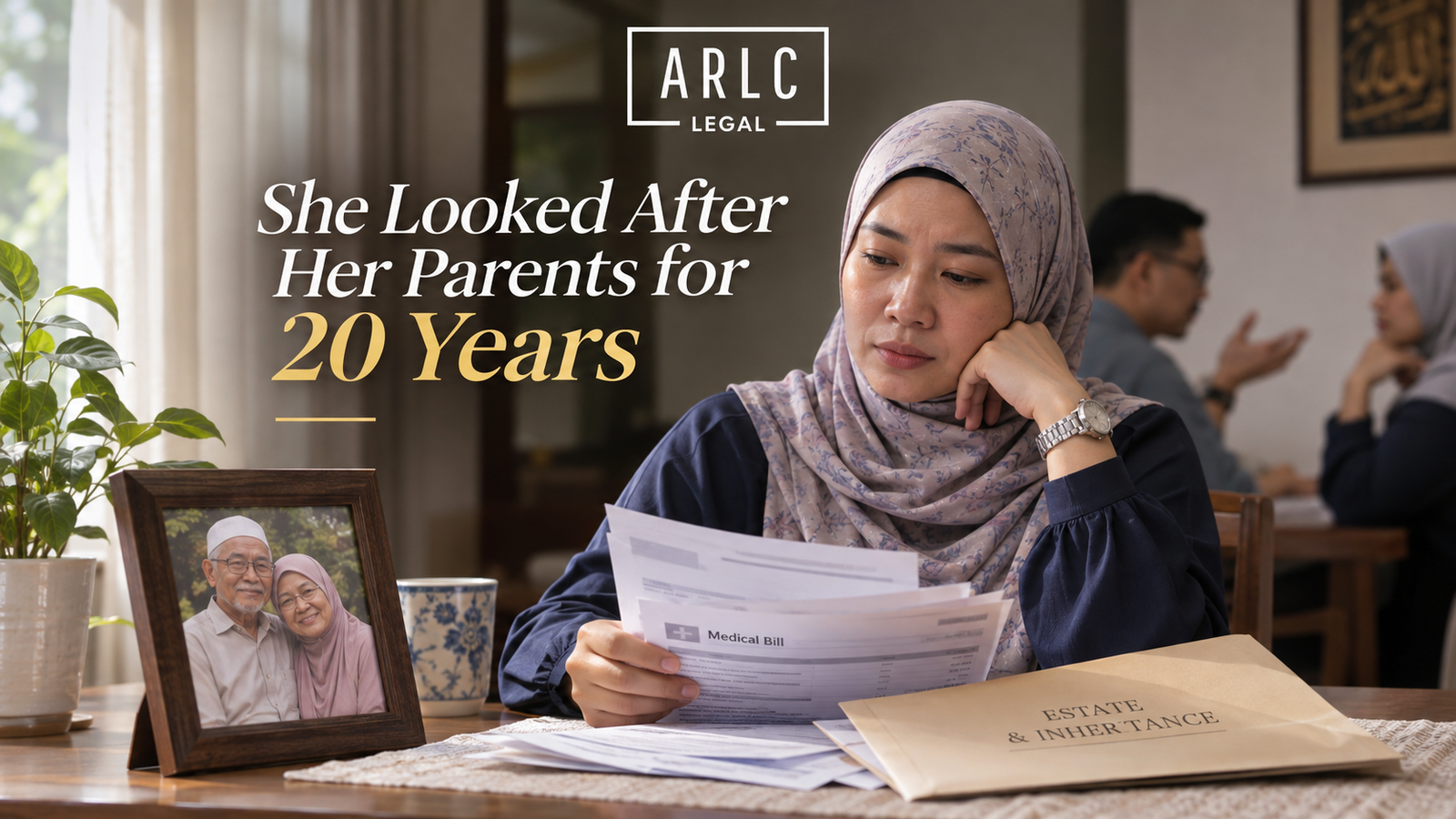
When Muslim families remember their inheritance rights but conveniently forget their family responsibilities.
By A.L. Said | Approximately 7 minutes | Sponsored legal awareness series with ARLC
The Daughter Everyone Depended On
For twenty years, she was the daughter everyone could rely on. When her father needed medical attention, she took leave. When her mother became less mobile, she rearranged her working hours. When hospital bills arrived, she paid them.
Her brothers had careers, families and commitments. Somehow, everyone assumed their sister had fewer commitments of her own. She rarely complained. These were her parents, after all.
Then came the day her last surviving parent passed away. Suddenly, everyone became interested in family matters. How much was in the bank? What was the HDB flat worth? When would the inheritance be distributed?
And suddenly, everyone remembered Faraid. In their particular family circumstances, each brother was entitled to twice her individual share. She understood the ruling. But one question remained.
Where were all these discussions about Islamic responsibilities when her parents were still alive?
This imagined scenario reflects a dilemma that some Singapore Muslim families may recognise. A question featured on Abdul Rahman Law Corporation’s Instagram raised a similar concern: should daughters who support their parents financially recover those expenses before inheritance is distributed? Two Singapore court decisions offer valuable lessons.
She Paid Her Mother’s Medical Bills. The Court Rejected Her Claim.
In Ong Wui Teck v Ong Wui Swoon and another [2019] SGCA 61, Singapore’s Court of Appeal considered a dispute over Madam Chew Chen Chin’s estate. Her daughter had paid medical expenses using her credit card and MediSave.
The High Court initially allowed a reimbursement claim of $13,597.10. On appeal, that award was overturned. The evidence established that she had incurred expenses, but did not establish the necessary intention to create a binding reimbursement arrangement.
Although this was not a Faraid case, its lesson matters to Muslim families too. Proving that you paid the money is not the same as proving that someone owes you the money. Receipts alone may not establish an enforceable debt.
Her Mother Intended to Give Her $2 Million. She Still Lost.
In February 2023, CNA reported that a mother wished to give her youngest daughter US$1.5 million, approximately S$2 million, after the daughter cared for her following a stroke. The intended gift was not completed before the mother died.
The daughter tried to establish that the amount was payable from the estate. Her appeal was dismissed in WDT v WDS [2023] SGHC(A) 7. The court’s decision illustrates why an intention to give money cannot simply be treated as a completed gift or an enforceable debt.
For Muslim parents contemplating Hibah, the warning is clear: good intentions need appropriate legal arrangements. A promise over dinner may not give your caregiver the protection you intended.
Singapore’s Invisible Caregivers
In May 2026, CNA’s On The Red Dot profiled four Singaporeans caring for loved ones largely on their own. Among them were Stacey Nonis, who supported her elderly parents, and Imran Wee, who cared for his mother with dementia.
Caregiving is not measured merely in hospital bills. It can mean declining promotions, using up annual leave, losing sleep and putting personal plans on hold. When one sibling becomes the default caregiver, everyone else may enjoy a freedom that person no longer has.
Apparently, being the available daughter can come with an unofficial appointment as the family’s care coordinator. No interview. No salary. No retirement benefits. And no automatic additional inheritance.
What Does MUIS Say?
The Islamic Religious Council of Singapore (MUIS) has addressed this precise question. Paying more towards a person’s healthcare or living expenses does not in itself entitle someone to a larger inheritance. MUIS also identifies valid CPF and insurance nominations as possible arrangements to recognise those who have supported a person.
Faraid determines the shares of eligible heirs. It is not a calculation of hospital visits, hours spent caregiving or sacrifices made. A separate, genuine debt may nevertheless need to be paid from the estate. That distinction matters.
Faraid Is Not the Problem. Selective Obedience Is.
Surah An Nisa, verse 11, establishes that when sons and daughters inherit together, each son receives twice each daughter’s share. This does not mean that women always inherit half the amount received by men. The distribution depends on the surviving heirs.
But Surah Al Isra, verses 23 and 24, also commands believers to honour their parents, especially in old age. Those instructions are not addressed exclusively to daughters.
Many Muslim sons make extraordinary sacrifices for their parents. This is not an accusation against all men. It is a challenge to those who insist on their religious entitlements while neglecting their responsibilities. A lawful inheritance does not disappear because someone was a disappointing child. Nor does receiving that inheritance prove that they fulfilled their duties before ALLAH.
What If the Daughter Spent $60,000?
Imagine a widowed mother leaves $300,000 available for distribution after other obligations. Her only entitled heirs are two sons and one daughter. There is no applicable Wasiat. The daughter previously spent $60,000 supporting her mother.
| Distribution | Voluntary support | Established debt |
|---|---|---|
| Debt repayment | $0 | $60,000 |
| Each son’s share | $120,000 | $96,000 |
| Daughter’s share | $60,000 | $48,000 |
| Total received by daughter | $60,000 | $108,000 |
If the contributions were voluntary, there is no automatic reimbursement. If they were an established, enforceable outstanding debt, the estate would generally settle it before distributing the remaining $240,000. The daughter’s additional money is debt repayment, not a change to her Faraid share.
MUIS guidance on estate obligations confirms that debts must be addressed before distribution. Families cannot retrospectively turn voluntary support into loans simply because the inheritance seems unfair.
What Families Can Do Before It Is Too Late
Singapore’s Maintenance of Parents Act allows eligible parents who cannot adequately support themselves to seek maintenance from children capable of supporting them, subject to legal conditions. It applies to sons and daughters. It does not create an automatic reimbursement claim for a caregiver after a parent’s death.
Share responsibilities. Discuss hospital appointments, expenses and respite care. A sibling who cannot contribute time may be able to contribute financially.
Document genuine debts. Keep receipts and written agreements if payments are intended to be reimbursed. Surah Al Baqarah, verse 282, reminds believers to document debts. Do this while the parties can still explain what they agreed.
Plan while parents have capacity. Consider properly executed Hibah, valid CPF and appropriate insurance nominations. Preserve enough for the parents’ own healthcare and living needs.
Understand Wasiat. A Muslim will cannot ordinarily be used to freely override Faraid shares. Seek legal advice about restrictions and any consent requirements before attempting to provide extra benefits for an existing heir.
When Muslim Families Need Legal Guidance
Estate disputes can involve both civil legal obligations and Islamic inheritance principles. Abdul Rahman Law Corporation (ARLC) provides estate planning, probate and related legal services in Singapore.
Its founder, Abdul Rahman BMH, was profiled by the Singapore Academy of Law in 2022. The interview describes his research into Syariah practice and a successful custody appeal in which he secured custody for a father. This was a Muslim family law matter, not a caregiving reimbursement or inheritance case.
For families facing disputed parental expenses, a lawyer can review the available evidence, advise whether an enforceable claim exists, explain estate planning instruments and assess options for resolving disputes. Early advice can help clarify obligations before relationships deteriorate.
Abdul Rahman Law Corporation | ARLC Legal
Estate planning, probate and Muslim legal matters in Singapore.
Before You Ask How Much You Will Inherit
Perhaps the next family gathering should include a different conversation. Not about who will inherit the flat. Not about how much money is in the bank. But about who will accompany our parents to the hospital next Tuesday.
Who will answer their telephone calls at three in the morning? Who will support the sibling who has been doing all these things quietly for years?
The same Quran that teaches us how to distribute our parents’ wealth after their deaths also teaches us how to treat them while they are alive. We cannot embrace one teaching and conveniently forget the other.
Do not wait until your parents leave this world before becoming interested in what they leave behind.
This article is part of the ARLC sponsored Legal Awareness Series on Rethinking Islam, a Singapore Muslim digital magazine. The opening story and numerical example are illustrative. The cited court cases are independent of ARLC. This article provides general information, not individual legal advice.
