

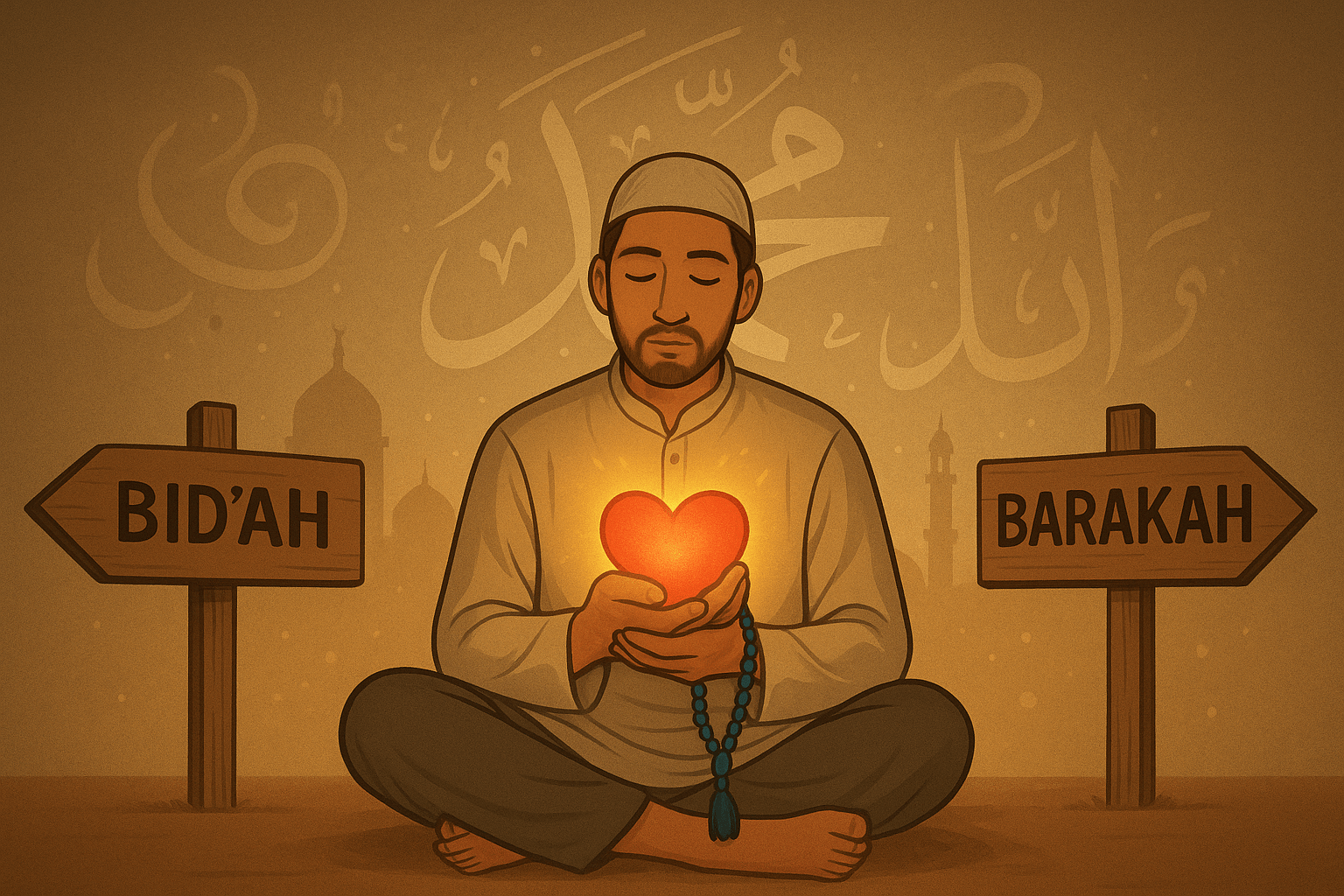
Recently, a sister reached out to me with a request to write a blog post about Mawlid. While she didn’t specify her reasons, I assumed that her curiosity stemmed from the prevalence of Mawlid congregation in her community and around the world, and with the discomfort some people feel about it. Additionally, she seemed interested in understanding why Mawlid is sometimes labeled as a Bid’ah (innovation).
Every year, as the 12th of Rabi’ al-Awwal approaches, Muslims around the world prepare for what’s commonly known as Mawlid—the celebration of the Prophet Muhammad’s ﷺ birthday. Streets light up, poems are recited, children dress up religiously, and masjids echo with praises. But just as hearts warm with reverence, debates heat up too.
“Bid’ah!” some declare, “It’s a blameworthy innovation.”
Others respond: “It’s love. How can remembering the Prophet ﷺ ever be wrong?”
So is Mawlid a blameworthy religious innovation or a permissible commemoration built from individually lawful acts such as seerah, salawat, charity and teaching?
Recognised Sunni scholars have answered that question differently. This article should explain both arguments rather than decide the dispute by rhetoric.
A Quick History Lesson
The earliest known public congregation of Mawlid trace back to the Fatimid dynasty in the 10th century CE (Shia rulers of Egypt). Later, Sunni rulers—like Sultan Al-Muzaffar in 12th-century Iraq—organized engaging events, including food distribution, poetry, and lectures. But here’s the twist: the Companions, Tābiʿīn, and early generations never celebrated the Prophet’s birthday as a religious event.
So does that automatically make it wrong?
Let’s not jump the gun.
Innovation: The Scary Word
Muslim scholars do not all use the word bidah in exactly the same technical way. Some use broader classifications that distinguish praiseworthy and blameworthy innovations. Others reserve religious bidah for acts introduced into worship without sufficient basis. That difference in methodology sits behind much of the Mawlid debate.
The Prophet ﷺ said:
“Whoever introduces into this matter of ours (Islam) that which is not from it, it is rejected.”
(Sahih Bukhari, Sahih Muslim)
Now here’s the nuance: Scholars like Imam al-Shafi‘i made a distinction between “good innovations” (bid’ah ḥasanah) and “bad innovations” (bid’ah sayyi’ah). He famously said:
“Anything that contradicts the Qur’an, Sunnah, or Ijma‘ is a reprehensible innovation. But if it aligns with them, it is not blameworthy.”
Examples such as compiling the Quran into a single codex, building minarets or organising congregational Taraweeh are often used in wider discussions about innovation. But they do not by themselves settle Mawlid, because scholars disagree over whether these examples are new means serving an established practice or new religious observances in their own right.
So Where Does Mawlid Fall?
Let’s be honest: Mawlid was not congregated by the Prophet ﷺ, his Companions, or the early scholars. That’s a historical fact.
But ask yourself: Why do people congregate it today?
Is it to imitate Christian Christmas?
To introduce a new ritual into Islam?
To claim the Prophet was divine?
Supporters usually understand Mawlid as an organised opportunity to remember the Prophet ﷺ through seerah, salawat, Quran, charity and teaching rather than as a new obligatory act.
Egypt’s Dar al Ifta is one clear example of the permissive position and describes commemorating the Prophet’s birth as permissible and meritorious when expressed through lawful acts.
Restrictive scholars answer that good intentions and individually lawful activities do not automatically justify fixing them to an annual religious commemoration that the Prophet ﷺ and his Companions did not establish.
Read a restrictive position on Mawlid
Real Talk: Can Love Go Wrong?
Imagine it’s your mother’s birthday. You give her a gift, not because she asked, but because you love her. You write her a poem, not because it’s in the will, but because your heart overflows.
Now someone says, “This wasn’t done before. It’s not part of the family manual!”
Would you stop? Of course not.
Love expresses itself in different ways across time. And as long as that expression doesn’t violate core values, it can even enhance the bond.
Same goes for Mawlid.
If it inspires people to learn about the Prophet ﷺ, hear his seerah, send salawat, and increase love—how is that blameworthy?
But… Let’s Be Fair
Even scholars who permit Mawlid would not justify fabricated stories, beliefs that exaggerate the Prophet ﷺ beyond Islamic limits, wasteful extravagance or other prohibited conduct. And scholars who reject Mawlid generally still encourage seerah, salawat, charity and teaching throughout the year.
Scholars like Ibn Taymiyyah, often cited in opposition to Mawlid, said:
“Some people make the Prophet’s birthday a festival… and reward for this may be granted due to good intention, but not because of the innovation itself.”
That’s a surprisingly nuanced take.
Let’s analyze the process of Mawlid in Europe, US, Singapore, and Malaysia as examples. Click here to watch this clip to understand the process, first.
| Process | Description |
| 1. Recitation of Quranic Verses | The celebration often begins with the recitation of Quranic verses that praise the Prophet Muhammad (peace be upon him) and emphasize his significance in Islam. |
| 2. Dhikr (Remembrance) | Attendees engage in dhikr, which involves the repeated remembrance of Allah and the Prophet through phrases and prayers to seek blessings and express love and devotion. |
| 3. Poetry and Nasheeds | Poetry and nasheeds (Islamic songs) are recited or sung, praising the life, character, and qualities of the Prophet Muhammad (peace be upon him). |
| 4. Lectures and Sermons | Scholars or religious leaders may deliver lectures and sermons that provide insights into the Prophet’s life, his teachings, and his impact on the Muslim Ummah. |
| 5. Reading of Seerah (Biography) | A portion of the Prophet’s biography (Seerah) may be read aloud, highlighting key events, teachings, and anecdotes from his life. |
| 6. Salawat and Salutations | Attendees send blessings and salutations (Salawat) upon the Prophet Muhammad (peace be upon him), often accompanied by raising hands and invoking peace and blessings upon him. |
| 7. Distribution of Food and Charity | It’s common to share meals or distribute food to attendees and give to charity as an expression of generosity and goodwill, following the example of the Prophet’s character. |
| 8. Community Gatherings | Mawlid celebrations often take place in mosques, community centers, or homes, where Muslims come together as a community to commemorate the occasion. |
| 9. Acts of Kindness and Good Deeds | Some individuals use the occasion to perform acts of kindness and good deeds in honor of the Prophet’s teachings of compassion and generosity. |
| 10. Cultural Expressions | In some regions, Mawlid is marked with cultural expressions, such as processions, decorations, and artistic displays to commemorate the Prophet’s birthday. |
| 11. Prayer and Supplication (Dua) | Attendees offer prayers and make supplications, seeking Allah’s blessings for themselves, their families, and the entire Muslim Ummah. |
| 12. Reflection and Renewal of Faith | Mawlid provides an opportunity for attendees to reflect on their faith, renew their commitment to Islam, and strive to follow the Prophet’s example in their lives. |
| 13. Interfaith and Community Outreach | In some cases, Mawlid celebrations may involve interfaith dialogues or community outreach activities to promote understanding and unity among diverse communities. |
Conclusion: A Recognised Scholarly Disagreement
Mawlid cannot accurately be labelled universally halal, universally haram or simply mubah without acknowledging the fiqh disagreement.
One recognised Sunni position permits or recommends lawful Mawlid commemorations because they gather already established acts of devotion and gratitude.
Another recognised Sunni position rejects the annual commemoration because the Prophet ﷺ, his Companions and the earliest generations did not establish it as a religious occasion.
A general reader can follow trusted scholarship on either side without turning Mawlid into a test of whether another Muslim loves the Prophet ﷺ.
Final Thought
If we spent half as much energy studying the life of the Prophet ﷺ as we do debating his birthday, we’d all be better Muslims.
Love for the Prophet ﷺ is not measured by whether someone attends or avoids Mawlid. It is measured more broadly through faith, obedience, salawat, learning his Sunnah and following his character.
References
- Celebrating the mawlid (birth) of the Prophet Muhammad (peace be upon him) in our community
- You Brought the Light – Muslim Kids Club – Sydney Mawlid 2018 – YouTube
- To Mawlid or Not to Mawlid? Bidah Explained

1 Comment
Pingback: Is It Really Prohibited to Recite Qur'an at the Grave? - Rethinking Islam