
For months, I found myself stuck on a single phrase we repeat often in salah:
“Subhana Rabbiyal Azeem” — Glory be to my Lord, the Most Great.
On the surface, it seems simple. But I kept wondering… what does “Subhana” actually mean?
Most translations say: “Glory be to Allah” or “Exalted is Allah.” But the Arabic root of “Subhana” — from س-ب-ح (sīn-bā-ḥā’) — literally means to declare someone free from any flaw, weakness, or imperfection.
It does not mean “perfect” in the way we describe a dish, a holiday, or a person.
It means flawless, pure, and completely untouched by any deficiency.
That made me pause.
Because in almost every dhikr and tasbih, we keep saying:
Subhan Allah – Allah is free from all imperfection.
Subhana Rabbiyal Azeem – My Great Lord is free from all flaws.
Subhana Rabbiyal A‘la – My Most High Lord is completely pure.
But nowhere do we say “Allah is perfect” in Arabic — at least not in the way we use the word in English.
So I searched. I read Qur’an translations, hadith collections, tafsir explanations, and even asked Uncle Google. And what I noticed shocked me.
👉 The Qur’an and Sunnah do not emphasize “perfection” as a divine attribute.
👉 Instead, they constantly highlight that Allah has no imperfection.
We often say Allah is “Perfect.” But if we pause and think deeper, is “perfect” really the best word to describe Him?
Take Rasulullah ﷺ as an example. He was sent as the perfect role model for humanity — the best in character, speech, and action. But even he, the most honoured of creation, experienced human moments. He got tired, he forgot, he waited for revelation, and was even corrected by Allah in the Qur’an. None of this makes him any less beloved — it simply shows that his “perfection” was within the bounds of being human.
So if we call a human “perfect,” while still knowing they have limits, then how can we use that same word — without any filter — to describe Allah?
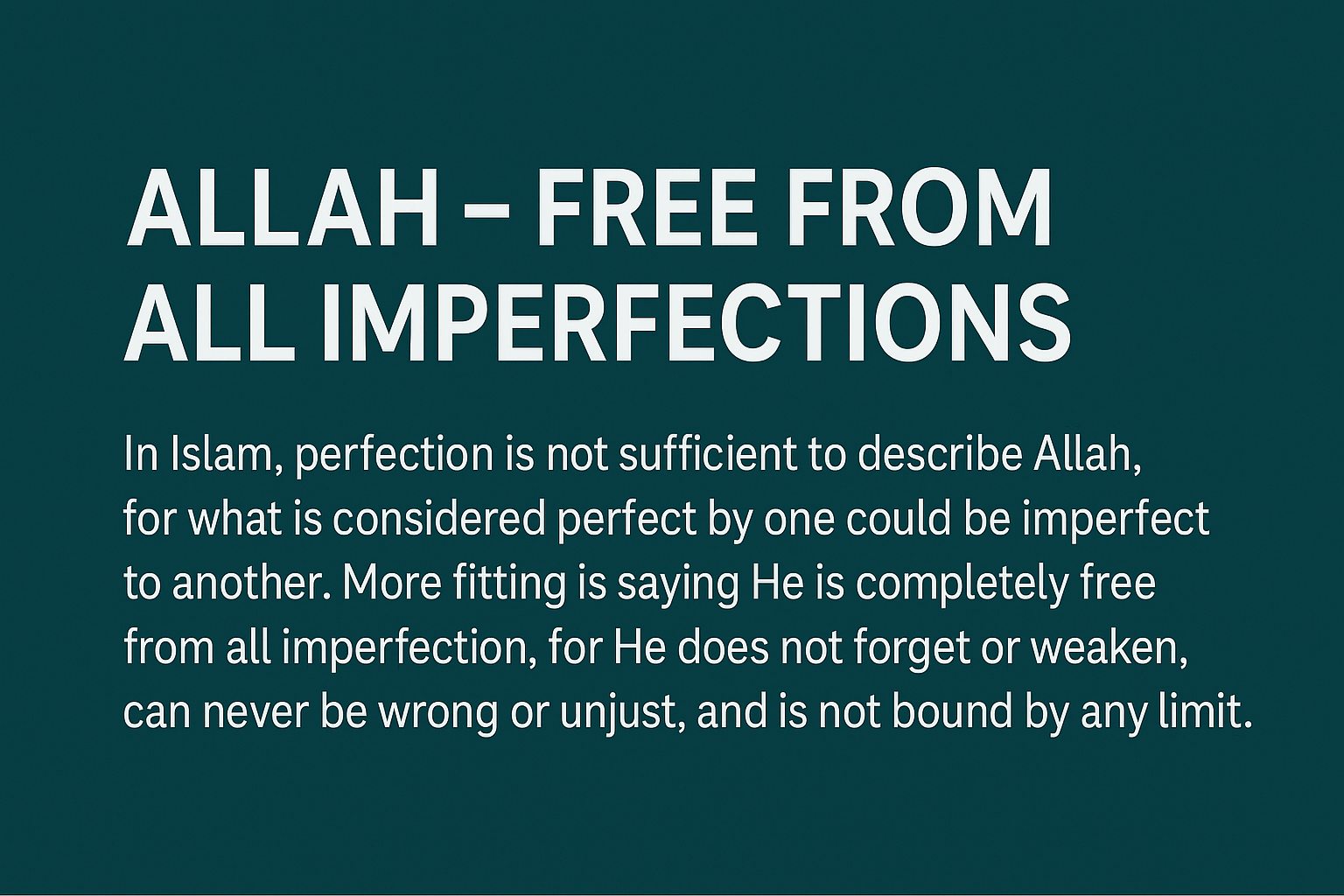
The word “perfect” is subjective. What’s perfect for one person or situation might not be perfect for another. But when it comes to Allah, the reality is far greater than human words. It’s not just that He is perfect — it’s that He is completely free from all imperfection. He does not forget, He is not limited, He does not change, He has no weakness.
That’s not just human perfection — that’s divine flawlessness.
Why “Perfect” is Not the Perfect Word for Allah
We often hear that Rasulullah ﷺ was sent as a “perfect example”. And that’s true — Allah Himself says:
“Indeed, in the Messenger of Allah you have a beautiful example (uswatun hasanah)…”
(Surah Al-Ahzab 33:21)
But here’s the key point:
👉 “Perfect example” doesn’t mean the Prophet ﷺ was literally flawless like Allah.
He was human — the most noble and best of humans — but still a servant of Allah. He experienced:
- Fatigue
- Sadness
- Wounds in battle
- Moments of forgetting
- Needing guidance through revelation
For example:
- He once frowned at a blind man (Surah Abasa 80:1–2), and Allah gently corrected him.
- In some matters, he waited for revelation to clarify his decisions.
That’s not to say he did anything wrong in a sinful way — he was protected from major errors in religion — but it shows that his “perfection” is not like Allah’s. It’s relative to human nature, not absolute.
Allah Is Not Just “Perfect” — He Is Free from Imperfection
When we call Allah “perfect,” we must be careful — because the word “perfect” in our human language is flexible, relative, and often used loosely.
Think about it:
- A student gets full marks — “Perfect!”
- A cake is baked just right — “Perfect!”
- Someone says the right thing at the right time — “That was perfect!”
But all of these are perfect for a moment, or in a limited context.
And most importantly: they still come with flaws.
That’s why the Qur’an and Sunnah don’t usually describe Allah as “perfect” the way we use it for creation. Instead, they describe Him as:
- Free from flaws
- Pure from any weakness
- Not like His creation in any way
- Complete in every attribute
Final Thought
So yes, the Prophet ﷺ was a perfect example for us, meaning he showed us the best way a human could live in obedience to Allah.
But he was still human — he ate, slept, was injured, and waited for revelation. That’s not a flaw — it’s part of his mission.
In contrast, Allah has no needs, no weakness, no waiting, no mistakes, and no change.
He is not just “perfect” in the way we understand the word —
He is beyond it. He is completely free from every kind of imperfection.
“Glory be to your Lord, the Lord of Honour and Power! (He is) free from what they attribute to Him!”
(Qur’an 37:180)
Conclusion
So after months of reflection, research, and restless thinking… I came to this:
It’s not that Allah is “perfect” in the way we understand the word.
It’s that He is absolutely free from all imperfection — and that’s far greater, far more precise, and far more majestic.
“Glorify the name of your Lord, the Most High.”
(Surah Al-A‘la, 87:1)
And that’s exactly what we do when we say:
“Subhana Rabbiyal Azeem” — My Lord is free from every flaw, every limit, every imperfection. And He alone deserves my awe and praise.
