
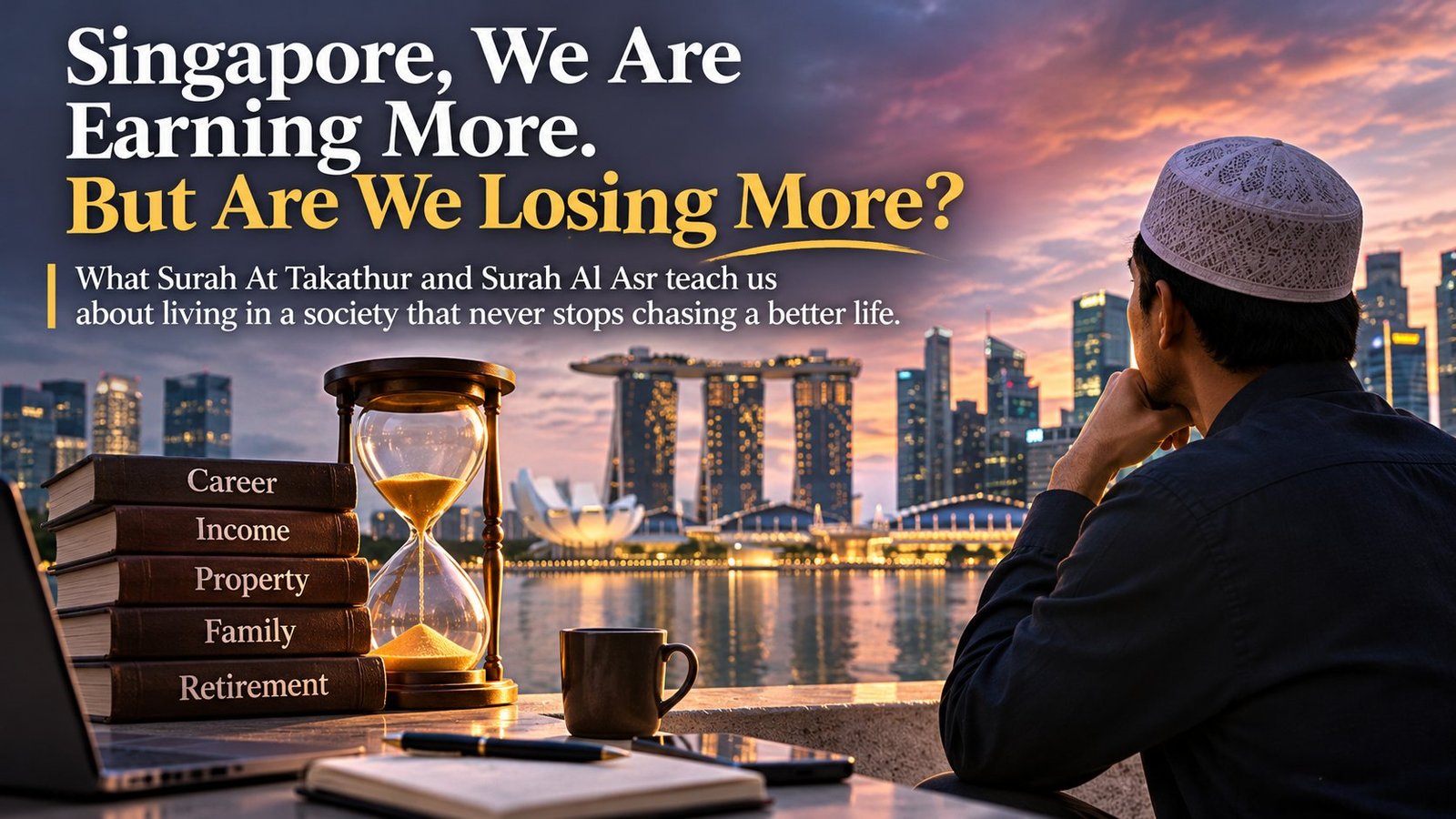
I was reading the Quran when two consecutive Surahs made me uncomfortable.
Not because I disagreed with them, but because I recognised so much of myself in them.
Surah At Takathur begins:
أَلْهَاكُمُ التَّكَاثُرُ حَتَّىٰ زُرْتُمُ الْمَقَابِرَ
Competition in worldly increase diverts you, until you visit the graveyards.
(Quran 102:1 and 2)
Immediately after comes Surah Al Asr:
وَالْعَصْرِ إِنَّ الْإِنسَانَ لَفِي خُسْرٍ
By time. Indeed, mankind is in loss.
(Quran 103:1 and 2)
One warns us about our obsession with accumulating more. The other warns us about the loss we face as time passes.
Together, they raise an uncomfortable question.
Are we spending something we can never recover to accumulate things we can never keep?
Singapore Taught Us to Survive
Let us be fair. Singapore did not become prosperous because people sat around waiting for good fortune.
Our parents worked tirelessly to provide opportunities that they themselves never enjoyed.
Today, we worry about housing loans, children’s education, ageing parents, medical expenses and retirement.
Even buying a car in Singapore requires financial planning that resembles a national budget exercise.
In 2025, CNA reported that approximately two in three Singapore residents surveyed by CIMB aspired to achieve financial independence between the ages of 40 and 60. More than half believed they needed over S$1 million to achieve it.
These concerns are understandable. Nobody wants to become a financial burden to their children.
But somewhere between survival and prosperity, have our needs quietly transformed into an endless list of wants?
When Enough Is Never Enough
We work first for survival, then for security, then for comfort and sometimes, eventually, for status.
The traditional Singaporean dream of the 5Cs reflected this aspiration. Cash, car, credit card, condominium and country club membership.
CNA reported in 2023 that Singaporeans were increasingly seeking purpose and fulfilment beyond these traditional material achievements.
Yet the culture of comparison remains familiar.
Our neighbour renovates his home. Our colleague upgrades his car. Our friends visit Switzerland. Suddenly, our own perfectly comfortable lives begin to feel inadequate.
Nobody may actually be competing with us, yet somehow we feel we are losing.
This is where Surah At Takathur becomes particularly relevant.
The Arabic word Alhakum refers to being distracted, while Takathur conveys rivalry in accumulating more.
The warning is not simply about possessing wealth. It is about allowing the pursuit of wealth and worldly achievements to distract us from what ultimately matters.
In 2024, CNA featured research by NUS Business School academics examining declining personal wellbeing despite rising household incomes in Singapore.
Apparently, earning more and feeling that we have enough are two very different things.
The Weightage Has Changed
I am not writing this to pinpoint anyone’s faults. I am examining my own.
I have ambitions, business plans and financial commitments. I want my children to succeed and my family to enjoy a comfortable life.
ALLAH remains in my thoughts. But has the weightage I give to Him in my everyday decisions changed?
We may spend hours researching investments but struggle to dedicate ten minutes to understanding the Quran.
We carefully arrange our schedules around business meetings but sometimes treat our prayers as appointments that can be accommodated later.
We become deeply concerned when our financial progress stagnates, but are we equally concerned when our spiritual progress stagnates?
We convince ourselves that everything we do is for our families and ultimately for ALLAH.
That intention can be sincere. Providing for our families through lawful means can itself be worship.
But surely that intention must also be reflected in the choices we make.
When worldly opportunities conflict with the commands of ALLAH, which one consistently wins?
We Are Spending Our Most Valuable Currency
Surah Al Asr begins with ALLAH swearing by time.
Singaporeans are exceptionally skilled at managing time. We have calendars, productivity applications, deadlines and retirement projections.
But are we managing our time or merely filling it?
Consider the father who works tirelessly to give his children a comfortable childhood, only to realise that he barely experienced their childhood himself.
Or the husband who promises his wife more quality time after his next promotion, only to discover that the promotion comes with even more responsibilities.
We keep postponing life in order to prepare for life.
We know when our housing loans will end. We know when our insurance policies will mature. We know when we intend to retire.
But we do not know when our time will end.
The Prophet Muhammad ﷺ reminded us that two blessings many people fail to appreciate are health and free time.
(Sahih Al Bukhari 6412)
Lost money can sometimes be recovered. Lost time cannot.
Have We Forgotten the Taqdir of ALLAH?
Singapore has taught us to plan for almost everything.
Planning is responsible. Believing that our plans guarantee our future is another matter.
We can invest heavily in our children’s education but cannot guarantee their success.
We can purchase insurance but cannot guarantee our health.
We can prepare for retirement at 65 without knowing whether we will live until 60.
Tawakkul does not mean abandoning effort. It means making every reasonable effort while recognising that the outcome belongs to ALLAH.
Surah At Talaq, verse 3, reminds us that whoever places their trust in ALLAH will find Him sufficient.
Work hard. Save money. Build businesses. Protect your family.
But never confuse the means ALLAH has provided with the One who ultimately determines our affairs.
Our bank balance is a resource, not our ultimate protector.
Four Conditions for Genuine Success
Surah Al Asr does not leave humanity without hope. Its final verse provides four conditions for escaping loss.
إِلَّا الَّذِينَ آمَنُوا وَعَمِلُوا الصَّالِحَاتِ وَتَوَاصَوْا بِالْحَقِّ وَتَوَاصَوْا بِالصَّبْرِ
Faith. Righteous deeds. Encouraging truth. Encouraging patience.
(Quran 103:3)
What would these look like in Singapore?
Faith: Allowing the commands of ALLAH to guide our professional and personal decisions.
Righteous deeds: Earning honestly, protecting our prayers, caring for our parents and using our prosperity to benefit others.
Truth: Teaching our children that integrity matters more than examination results, salaries or professional titles.
Patience: Accepting that our journeys differ and refusing to compromise our principles simply because others appear to be progressing faster.
These are not barriers to success. They are part of what genuine success looks like.
Islam does not ask us to become poor. Surah Al Qasas, verse 77, reminds us to pursue the Hereafter through what ALLAH has granted us without neglecting our legitimate share of worldly life.
Become wealthy if you can. But let your wealth serve your faith, rather than your faith accommodate your wealth.
Our Final Performance Review
Surah At Takathur ends with a powerful reminder:
ثُمَّ لَتُسْأَلُنَّ يَوْمَئِذٍ عَنِ النَّعِيمِ
Then, on that Day, you will be questioned about the blessings.
(Quran 102:8)
Perhaps we should occasionally conduct a spiritual audit alongside our financial planning.
Has our increasing income made us more generous? Has our knowledge made us more humble? Has our success brought us closer to ALLAH?
One day, our CPF statements will no longer concern us. Our property valuations will become someone else’s responsibility. Our professional titles will lose their relevance.
Our time will have expired.
I am not writing this because I have achieved the balance I am advocating. I am writing because I am still struggling to achieve it.
Perhaps the greatest challenge for Singaporean Muslims is not learning how to work harder. We already know how to do that.
It is learning how to place ALLAH at the centre of everything we work so hard for.
May ALLAH grant us barakah in our earnings, contentment in our hearts and wisdom in how we spend our remaining time.
In Sha ALLAH.
Let us not become so successful at preparing for tomorrow that we forget to prepare for eternity.
References and Further Reading
- CNA, Financial Independence Among Singapore Residents, 2025. https://www.channelnewsasia.com/singapore/financial-independence-cimb-survey-singapore-residents-5065041
- CNA, A Reboot of the 5Cs, 2023. https://www.channelnewsasia.com/singapore/5cs-new-singapore-dream-cash-condo-car-credit-card-country-club-forward-sg-3909151
- CNA, Why Is Wellbeing Declining Despite Rising Income Levels?, 2024. https://www.channelnewsasia.com/commentary/singapore-happiness-ranking-un-report-income-quality-life-survey-4260796
- Surah At Takathur. https://quran.com/102
- Surah Al Asr. https://quran.com/103
- Surah At Talaq, verse 3. https://quran.com/65/3
- Surah Al Qasas, verse 77. https://quran.com/28/77
- Sahih Al Bukhari 6412. https://sunnah.com/bukhari:6412
