

Muslim estate planning in Singapore
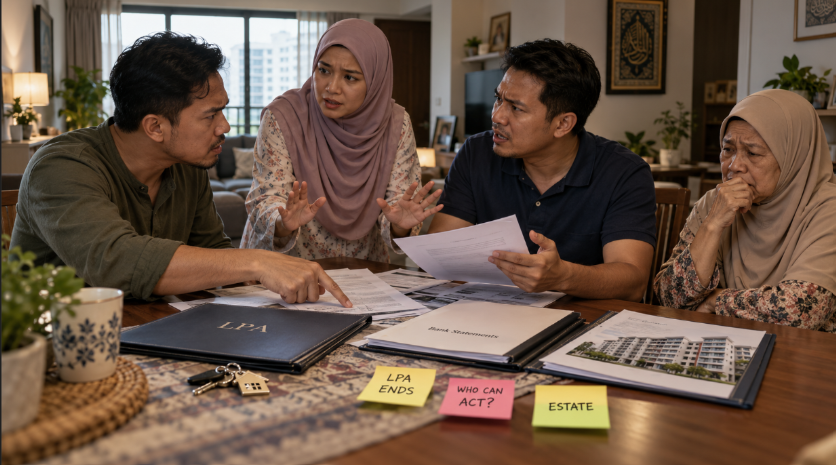
Your LPA protects you while you are alive. It ends when you die.
An LPA protects decision making during incapacity. It does not appoint anyone to administer the estate after death.
The document the family thought would solve everything
Imagine a Muslim father in Singapore who completes a Lasting Power of Attorney and appoints his daughter as his donee. The family feels relieved. If he loses mental capacity, someone trusted can step in.
Years later, he dies. His daughter approaches the bank and assumes the LPA still gives her authority to manage the account. The family also needs to decide what happens to the HDB flat.
At the bank, she learns the simple truth: the LPA ended when her father died.
The Office of the Public Guardian explains that a donee acts while the donor is alive but lacks mental capacity. A Will serves a different purpose after death. The father did something responsible. He simply prepared for incapacity, not for what must happen after death.
Planning cannot remove grief. It can make the authority, assets and written intentions clearer.
Singapore in context
Registered LPAs among citizens aged 50 and above after the campaign period.
Total deaths recorded in Singapore in 2025. This figure is not specific to Muslim estates.
Four planning tools with four different jobs
Who may act during incapacity?
It allows a donee to act while the donor is alive but lacks mental capacity. It ends when the donor dies.
Who should carry out lawful instructions?
A Muslim Will may appoint an executor and record instructions after death, subject to Singapore law and applicable Muslim law.
Can a lifetime gift achieve an intention?
The transfer must satisfy the legal requirements governing the particular asset. The label alone is not enough.
Who are the beneficiaries?
It identifies beneficiaries and their shares. It does not appoint an administrator or resolve every asset issue.
A Wasiat does not simply cancel Faraid
A Muslim cannot write any distribution into a Wasiat and simply replace Faraid. Section 111 of the Administration of Muslim Law Act states that a Muslim domiciled in Singapore may dispose of property by Will only in accordance with restrictions imposed by the school of Muslim law professed by that person.
The position becomes sensitive when someone wishes to benefit a person outside the usual Faraid beneficiaries, provide for a vulnerable relative, appoint guardians or combine several planning instruments.
Read the Administration of Muslim Law Act ↗Singapore High Court 2004
A detailed Will still failed in important respects
In Mohamed Ismail bin Ibrahim and another v Mohammad Taha bin Ibrahim, the Court examined a Will involving nuzriah, charitable gifts and Faraid.
The judgment discussed the restriction on disposing of more than one third of the remaining estate where legal heirs exist, unless they consent. Parts of the arrangement were inconsistent with the governing rules.
The lesson is not that planning is pointless. A document can contain detailed percentages, religious language and sincere intentions, yet still produce uncertainty when its legal structure is wrong.
Open the full judgment ↗Singapore High Court 2017
The Hibah of an HDB flat was void
In Haja Maideen son of Mohd Ali Maricar v Roshan Begum Md Ali M, a mother used a deed signed in India to give her solely owned HDB flat to her daughter.
The High Court held that the transfer was void because prior written HDB consent had not been obtained. The flat remained part of the deceased estate.
Religious language, detailed percentages or an overseas deed cannot repair a structure that fails under the law governing the estate or the asset.
Open the full judgment ↗When does a lawyer add real value?
Not every family needs an elaborate structure. Legal advice becomes more valuable when these risks appear.
Property ownership is unclear
Joint tenancy, tenancy in common and sole ownership can lead to different outcomes.
Documents point in different directions
The LPA, Wasiat, Hibah, nominations and property title should be reviewed together.
A proposed gift may not transfer the asset
HDB rules, title records and required approvals can determine whether the plan works.
Family circumstances are complex
Young children, vulnerable dependants, earlier marriages and likely disagreement increase risk.
The plan is no longer current
Marriage, divorce, death or a property purchase may make an older document unsuitable.
A coordinated review
Who may act during incapacity, and what powers were granted?
Who is the executor, and are the instructions legally workable?
What exact asset is involved, and were all requirements satisfied?
How are the home, accounts and investments legally held?
Do the beneficiaries and circumstances still match the plan?
If death occurred tomorrow, would the family know who has authority and which assets form the estate?
A clearer plan is a kindness to the people left to carry it out
The purpose is not to predict every disagreement. It is to reduce avoidable questions. Who may act? Which assets belong to the estate? Who should administer them? Do the written instructions work under Singapore law?
Those questions are easier to answer while the family can still sit together and discuss them calmly.
Legal services information
When a coordinated legal review may help
Abdul Rahman Law Corporation lists Wasiat and Hibah, estate planning, Grant of Probate and Letters of Administration among its services. Families with unclear ownership, conflicting documents or complex circumstances may wish to obtain advice on their own situation.
