
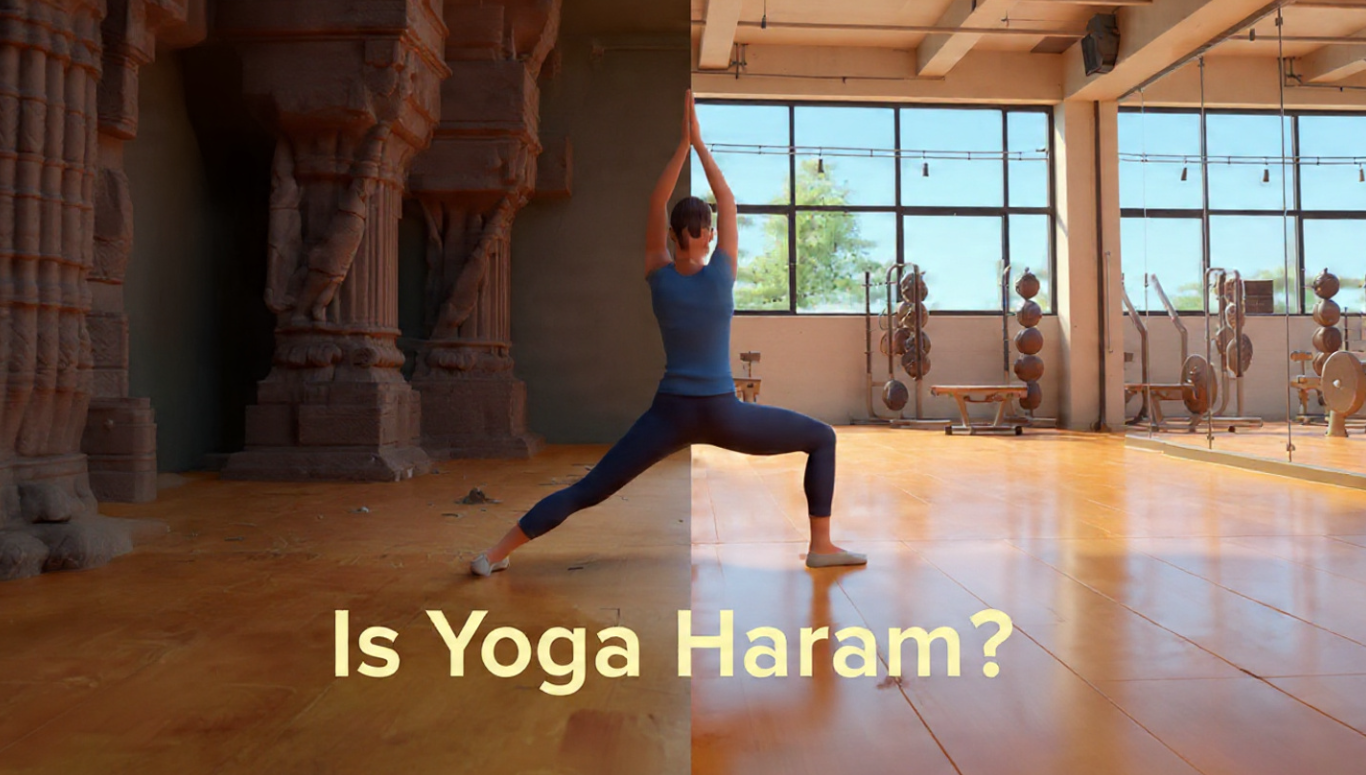
Let’s not pretend yoga began because someone was trying to fix lower back pain.
Yoga was not born out of physiotherapy or workplace wellness. It emerged centuries earlier as an intentional spiritual system.
How do we know this?
Because the earliest descriptions of yoga in sacred Hindu texts like the Yoga Sutras of Patanjali were explicitly about reaching spiritual liberation and divine union. You can read it yourself here:
https://archive.org/details/PatanjaliYogaSutra
And if you ever wondered whether yoga was originally physical exercise, the Bhagavad Gita spells it out clearly — yoga was a spiritual discipline designed to connect to God and purify the soul:
https://www.holy-bhagavad-gita.org/
That is the root. Not cardio. Not stretching. Not cute yoga pants.
So here is the real question for Muslims today:
Are we accidentally copying devotional postures meant for other deities while thinking it is just exercise?
Let’s break this down properly.
Yoga Did Not Begin as Exercise
Yoga’s early purpose was not health.
It was devotion.
Historical documentation shows yoga was created as a ritual system to:
- praise divine beings
- purify the worshipper
- induce altered spiritual states
- connect with unseen energies
- show surrender through the body
Do not take my word for it.
See Britannica’s explanation on yoga as a spiritual and philosophical practice:
https://www.britannica.com/topic/yoga
The Smithsonian Magazine also outlines how yoga grew from deeply religious roots, full of symbolism and sacred intention:
The Role of God in Yoga Philosophy
And the Hindu American Foundation openly states that yoga is a Hindu spiritual practice by origin, even if modern culture has secularised it:
Ashtanga Nilayam Singapore Writes The Divinity Of Yoga
So yes, yoga has been a literal devotional movement.
It is the equivalent of someone taking sujud and saying,
“Relax, this is just a nice spinal decompression pose.”
That is not how Islam works.
Imitating worship is still imitating worship, even if rebranded.
Were These Movements Influenced by the Unseen?
Let us be fair and accurate.
There is no direct historical evidence that jinn created yoga.
However, many early yogic practices involved:
- chanting mantras
- invoking unseen forces
- altering consciousness
- awakening spiritual “energy portals”
- entering trancelike states
Academic research demonstrates how chanting mantras induces altered states of awareness:
https://www.ncbi.nlm.nih.gov/pmc/articles/PMC5455070/
In Islam, anything that attempts to access the unseen without revelation opens the door for misguidance.
The Quran says that humans who sought help from jinn ended up in deeper ruin:
https://quran.com/72/6
So while yoga is not “from jinn,” it was shaped by spiritual methods that Islam warns us to avoid.
Yoga is not just bending.
It could be a doorway, and Muslims must decide whether that doorway should be opened.
How Devotional Worship Became a Gym Stretch
Modern secular yoga did not erase its origins.
It simply repackaged them.
BBC explains this transformation clearly in its religious history of yoga:
The British Colonial Impact on Yoga: How Colonialism Reshaped Yoga in India | THE PATH OF LIGHT
The West removed the deities but kept the poses.
Removed the mantras but kept the flow.
Removed the purpose but kept the posture.
It is the spiritual equivalent of:
Taking out the Qur’an from salah but keeping the movements
and then selling it as “mindful body balance therapy.”
The shape still matters.
The intention behind the shape still matters.
And Islam cares about both movement and meaning.
Are We Knowledgeable Enough to Tell the Difference?
Here is the uncomfortable truth.
Most Muslims do not know which yoga poses were originally worship movements.
We also do not know:
- which postures imitate bowing to deities
- which positions symbolise surrender to divine energy
- which movements honour ancient gods
- which actions activate channels meant to invoke spiritual beings
And if we do not know the difference, then ask yourself:
Are we walking blindly into something that could lead to shirk?
If you say:
“It is safe because I do not know what it means.”
That is not safety.
That is choosing ignorance.
Would a Muslim perform a movement that looks exactly like worship in another religion just because everyone else is doing it?
Would you willingly enter a grey area that scholars have warned about simply because yoga is trending?
Choosing not to know is still a choice.
And if that choice leads to shirk, was it innocent or intentional?
Islam teaches us:
One does not enter fire by claiming not to see the flames.
Conclusion
And here we are.
After all the stretching, bending, twisting, inhaling, exhaling, and pretending your life is sorted, you now know the truth:
Yoga was never created to save your back.
It was created to bend your soul in a direction you did not sign up for.
So the next time someone says,
“Relax, it is only stretching,”
just remember this simple reality:
Shirk has never needed loud music, flashing lights, or a temple.
Sometimes all it needs is a quiet room, dimmed lights, a soft voice,
and one innocent Muslim doing a pose originally meant to honour a deity.
That is the part nobody warns you about. Because it is not dramatic.
It is subtle. It is silent. It is spiritual erosion dressed as fitness.
And if that does not make your spine chill and your hair stand,
then imagine standing before Allah one day and saying:
“I did not know the pose I copied was actually worship.”
Ignorance is a choice. Shirk is not an accident.
And trending does not make something safe.
Your soul is worth more than a yoga mat.
Stretch wisely!
Islamic Rulings on Yoga
Multiple scholars and fatwa councils have addressed yoga:
Malaysian National Fatwa Council
Declared yoga haram due to its religious roots and devotional practices.
https://www.e-fatwa.gov.my/fatwa-kebangsaan/hukum-yoga-dalam-islam
Islam Q and A
So, Is Yoga Haram?
With historical evidence, spiritual origins, devotional intention, and our own lack of knowledge considered, here is the honest conclusion:
Haram when:
- the pose imitates religious worship
- chanting or mantras are included
- energy awakening is discussed
- the posture was designed as devotion
- yoga becomes a spiritual activity
Discouraged when:
- you avoid chanting but still follow devotional shapes
- you imitate movements whose meanings you do not understand
- you choose ignorance out of convenience or acceptance
Only permissible:
- when stretching exercises are clearly separated from yoga
- when the movements are physiotherapy, pilates, or mobility
- when the practice carries no yogic identity or intention
In Islam:
Exercise is halal.
Imitating worship is not.
If a movement might have been created to bow to a deity, and you do not know whether it is or not, then why take that risk?
Why gamble your tawhid for the sake of fitting in?
Ignorance is not innocence when you choose it.
Related posts
Rethinking Islam
https://rethinkingislam.net/
Trailblazing Muslimahs
https://trailblazingmuslimahs.com/
