


Two children. A marriage breaking down. Allegations of harsh punishment serious enough to require medical attention. When a father questions the safety of his children, does anyone listen?
Based on Singapore reporting by Berita Harian and official legal guidance. The individuals in the reported example were given pseudonyms. This article does not claim a final custody ruling that was never reported.
Imagine reaching the point where your marriage cannot be repaired. You and your spouse disagree over who should care for your children. Every conversation becomes an argument, and you begin to worry that the children are caught in something much worse than a disagreement between adults.
For one Muslim couple in Singapore, that concern was far from theoretical.
On 31 July 2026, Berita Harian reported on a case discussed at the Syariah Court Practice Forum involving a father identified as Danial, his estranged wife Nurul and their two children, Adam and Aliya, aged 10 and eight. Those were not their real names.
The parents disagreed about custody. The Court’s professionals identified significant risks, including a history of violence between the adults and harsh punishment by the mother which had caused injuries requiring medical treatment.
This was a case presented to explain the value of joint mediation involving both legal and therapeutic professionals. The report did not reveal a final judgment awarding custody to either parent.
The most important question was not whether the father or mother should win. It was whether the children were safe.
When a mother is accused of harming a child, should the father’s concerns carry weight?
Yes. The sex of a parent does not decide whether a safeguarding concern deserves investigation. Nor should allegations be treated as proven merely because one parent makes them.
Berita Harian explained that the joint mediation process helped the Syariah Court’s therapeutic specialists identify safety concerns, parental conflict and the children’s needs. Relevant child protection and social service agencies were involved in navigating the case.
The lesson for a Muslim husband is important: a custody dispute is not decided by who can shout the loudest, who earns more, or who assumes mothers always come first. It requires evidence, an assessment of risk, and a focus on the children’s welfare.
For the mother, the same principle applies. Allegations must be handled fairly and with proper professional assessment. A divorce should never become an excuse to weaponise children against the other parent.
What a Muslim father can actually ask for
In Singapore, a Muslim divorce falling within the Syariah Court’s jurisdiction may involve several different orders. They sound similar, but they are not interchangeable.
Custody concerns decision making on important matters in a child’s upbringing.
Care and control concerns the child’s primary daily living and care arrangements.
Access governs contact with the parent who does not have day to day care.
Interim orders can address urgent issues while proceedings continue, where the applicable requirements are met.
The Syariah Court’s published forms include an application for interim custody, care and control, and access, supported by an affidavit. The Court’s support programme guidance also explains that serious disputes or allegations may lead the Court to order a Custody Evaluation Report by an appointed psychologist.
A father can therefore seek an appropriate order. That is not a promise he will obtain the result he wants. The circumstances and the child’s welfare are central.
The uncomfortable part: what if the other parent plans to take the children overseas?
Now imagine another scenario. A Singaporean Muslim man marries someone from overseas. They have a child here. After the relationship breaks down, one parent plans to relocate abroad with that child. The other fears that ordinary weekend contact could become an international legal dispute.
This is a hypothetical scenario, not an allegation against a particular foreign wife. It raises a genuine issue highlighted by Singapore’s national news this month.
On 4 November 2026, Berita Harian reported that Singapore’s Syariah Court and ICA were discussing measures to prevent children involved in Muslim divorces from being improperly taken abroad, especially in urgent, high risk situations.
The report followed Parliament’s passage of amendments to the Administration of Muslim Law Act. The changes are intended to clarify the Court’s powers to permit or prevent a child’s overseas relocation, and to impose conditions designed to preserve the relationship with a parent who remains in Singapore.
Parliament passed the Bill on 4 November, as CNA also reported. But legislation being passed is not proof that every new provision was already in force on the day of publication. Anyone contemplating an urgent application must verify the provisions and procedures applicable at that time.
When a marriage involves two countries, the question is no longer only who gets the children. It may be whether a parent can continue to see them at all.
A parent worried about removal of a child should seek urgent legal advice, preserve relevant documents and discuss lawful protective steps. Threats, the seizure of passports without legal authority, or retaliatory conduct can worsen a dispute.
Does marrying a Singaporean automatically give the foreign spouse PR?
No. This is another misconception that can distort discussions about divorce. The Immigration & Checkpoints Authority has explained that PR applications involving foreign parents or spouses are individually assessed, including factors such as family circumstances, the marriage and financial support.
A foreign spouse’s PR or citizenship status does not establish that the marriage was a scheme. Nor does a failed marriage automatically prove that one spouse entered it in bad faith. Immigration and divorce are separate legal questions and should not be confused.
The stronger approach for a worried husband is not to speculate about motives. It is to understand property ownership, the child’s welfare, relevant court orders and what evidence is actually available.
The legal protection husbands overlook before divorce
The husband who waits until the first court date to collect documents may already have made matters much harder for himself. The most practical safeguards start earlier.
- Document caregiving, not only earnings. Keep factual records of school arrangements, health appointments and routine responsibilities.
- Preserve financial evidence. Mortgage records, CPF contributions, household payments and property documents may matter in matrimonial asset proceedings.
- Act promptly on genuine child safety concerns. Seek professional assistance and use lawful reporting channels rather than public accusations.
- Ask about interim arrangements. Appropriate applications may be available for care, access or protection while proceedings are ongoing.
- Check the international dimension. If another country, residency status or relocation is involved, obtain advice before relying on assumptions about immigration or parental authority.
- Respect existing orders. The proper answer to an unfair or unworkable arrangement is to seek legal advice about changing or enforcing it, not ignore it.
Why Berita Harian’s example matters beyond that one family
The most revealing part of the Danial and Nurul report was that the Court did not treat a family conflict as a simple two person legal battle. Therapeutic professionals looked at the children’s safety and the broader family circumstances. A companion Berita Harian report explained that joint mediation was being piloted for selected vulnerable Muslim families.
That should change the way fathers and mothers approach a divorce. Being heard does not mean being believed automatically. Being protected means there is a process that can examine credible evidence and respond to real risks.
A husband does not have to choose between accepting every demand and turning his divorce into a war. He can seek informed legal advice, preserve evidence and pursue appropriate court procedures. A wife is entitled to the same fair process.
A Muslim divorce ends a marriage. It should not end a father’s responsibility, a mother’s rights, or a child’s right to safety.
A legal practitioner familiar with Muslim family disputes
For readers who need professional advice concerning Syariah divorce, custody, access, matrimonial assets or cross border complications, Abdul Rahman Law Corporation lists Muslim family law among its areas of practice. Its Managing Director is Abdul Rahman Bin Mohd Hanipah, professionally also known as Abdul Rahman BMH. He was admitted to the Singapore Bar in May 2009 and his published profile describes experience in Syariah family law.
Abdul Rahman BMH
Managing Director, Abdul Rahman Law Corporation
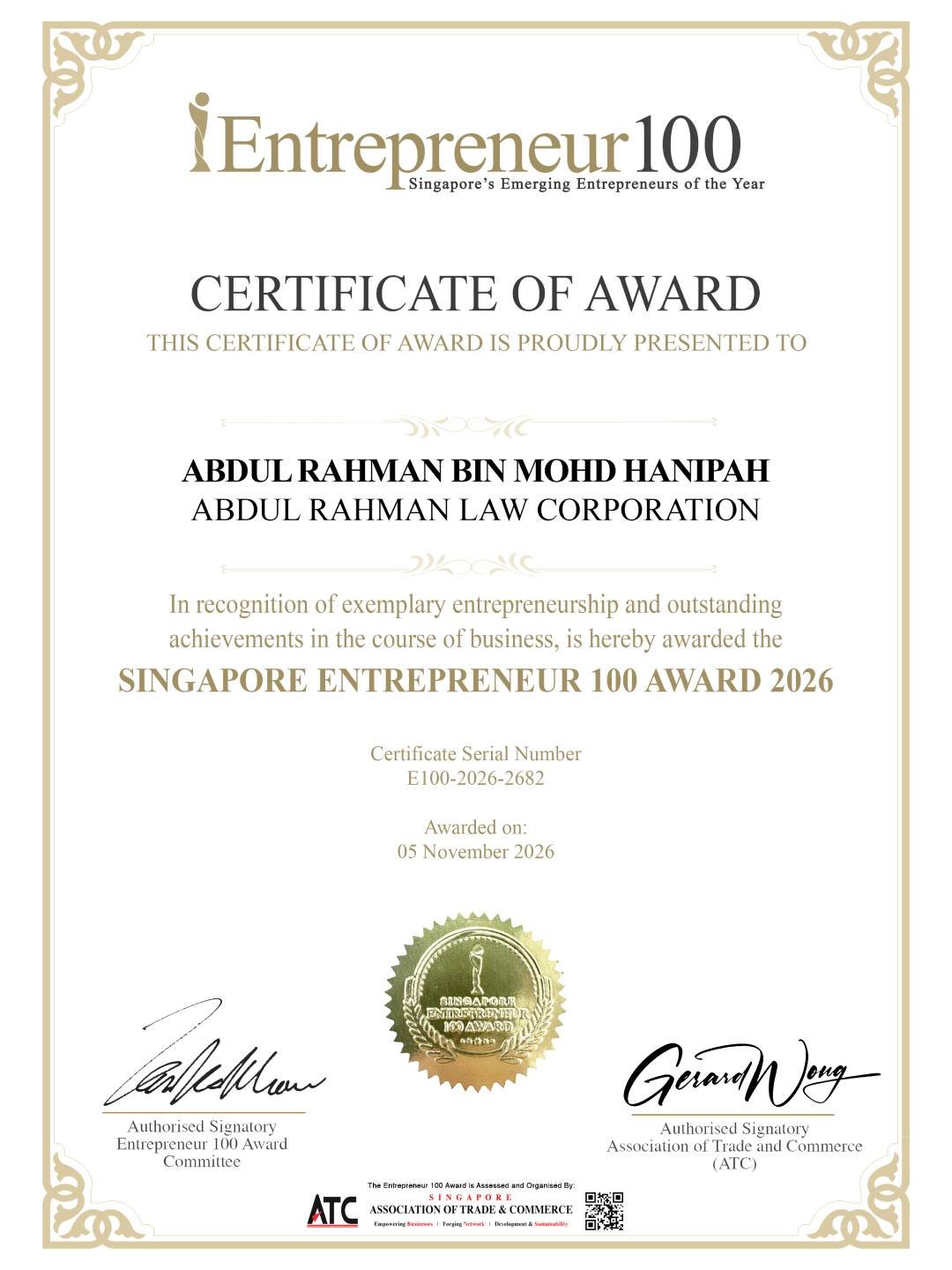
On 5 November 2026, ARLC announced through its official Instagram account that its Managing Director had received the Entrepreneur 100 Award 2026, presented by the Association of Trade and Commerce.
This is recognition in entrepreneurship and leadership, not a certification of specialist legal skill. The image alongside was taken from ARLC’s own 2026 award announcement, not an unrelated older award.
Source: ARLC’s award announcement on Instagram, 5 November 2026.
Sponsorship disclosure: ARLC is a sponsored legal partner of Rethinking Islam. Its video appears above as advertising. Neither of the families in the reported cases is claimed to have been represented by ARLC. This article is independent editorial commentary and general information, not legal advice.
Read the other Singapore Muslim legal stories
Explore practical discussions on divorce, estate planning, inheritance, LPA, child maintenance and Faraid.
Browse the complete legal hub →References and original reporting
- Berita Harian Singapore, 31 July 2026: Joint mediation custody case
- Berita Harian Singapore, 4 November 2026: Syariah Court and ICA discussions on child removal
- Berita Harian Singapore, 31 July 2026: Syariah Court joint mediation
- CNA, 4 November 2026: Parliament passes AMLA amendments
- Singapore Syariah Court: Support programmes and custody evaluation
- Singapore Syariah Court: Court forms
- ICA: Assessment of foreign spouses and parents for permanent residence
- ARLC official Instagram: Entrepreneur 100 Award 2026 announcement
