


We can research a new home, compare insurance plans and plan our children’s education. So why do some of us still freeze when it is time to put our own money to work?
Give a Singaporean woman a complicated problem and there is a good chance she will research it thoroughly. The school options, the mortgage package, the best insurance coverage, even which supermarket has the better promotion this weekend. We know how to compare, question and decide.
Yet when the conversation turns to investing, a familiar answer appears: “I will look into it when I know more.”
Sometimes that is sensible caution. Sometimes it becomes a comfortable place to stand still. Education is not always the missing ingredient. The courage to start responsibly may be.
We are informed. But are we confident?
In January 2026, CNA Women explored why conversations about money can still feel uncomfortable, even for accomplished women. Then, in March, CNA reported that investment platforms and learning resources are more accessible than ever, while emphasising the value of starting with discipline and realistic goals.
For Muslim women, there can be a second question alongside money and risk: Does this investment align with my faith? It is a question worth asking, not a reason to abandon the conversation.
A real Singapore Muslim woman’s experience
Azlinah Ismail’s experience challenges a familiar assumption. Berita Harian reported that the project administrator had spent around a decade investing in conventional products. She later described receiving competitive returns from investments structured around Shariah principles, alongside greater peace of mind.
Her story is not a promise that halal investments always perform better. It is a reminder that avoiding an entire category without examining the available options may mean overlooking choices that deserve proper research. Read the Berita Harian report.
Can investing help you afford a condo or a car?
Possibly, as one part of a much wider financial plan. But let us be careful with the success stories. A condominium requires a deposit, borrowing eligibility and room for ongoing payments. A car means additional recurring costs and a depreciating asset. Neither should be sold as the guaranteed reward for buying an investment product.
There is a useful Singapore example. CNA reported in January 2024 on Chen Min, a 23 year old woman who built up a reported S$200,000 condominium down payment by combining business income, multiple jobs and disciplined saving. She bought a one bedroom unit in Serangoon and rented it out. This was a property and business story, not evidence that Shariah screened stock investments financed her purchase.
The lesson is more useful than the glamour: she had a defined goal, made tradeoffs and tracked how her money moved. For a Muslim woman, the same discipline can be paired with careful Shariah screening when choosing investments.
What starting wisely actually looks like
Forget the idea that the first step must be buying a share. The first step is creating a plan that can survive real life.
- 1Give every dollar a purpose.Separate emergency money, a home deposit, a family goal and long term retirement savings. Money needed soon should not be exposed to risks you cannot afford.
- 2Build a safety cushion.Before taking market risk, cover everyday commitments, urgent debts and an emergency reserve. MoneySense recommends preparing emergency savings before investing.
- 3Learn what halal means for the actual product.Ask what businesses or assets are included, which screening standards are used, who checks them and how income is treated. A marketing label does not replace evidence.
- 4Consider a manageable monthly amount.For long term goals, regular contributions to suitable, diversified, Shariah screened investments may be easier to maintain than trying to predict markets. The amount must fit your budget; losses remain possible.
- 5Question the adviser, not just the product.Ask about risks, all fees, compensation, liquidity and Shariah oversight. Verify the financial institution and appointed representative through the MAS institution directory and representatives register.
Faith and financial intelligence belong in the same conversation
A financial adviser who understands modern portfolios but cannot explain the Islamic considerations leaves an important question unanswered. One who speaks only about permissibility but cannot explain volatility, fees or suitability leaves another question unanswered.
Muslim women deserve both conversations. You should be able to ask why a fund passes its screening, what could go wrong, and whether the investment fits your family responsibilities. You should also feel free to walk away when an answer is unclear.
There is no need to confuse every Singapore savings arrangement with an investment fund. For example, MUIS has a specific fatwa concerning interest credited to CPF accounts. That ruling should not be treated as a blanket approval for unrelated interest bearing products.
A better lifestyle starts with having options
A successful financial journey does not have to end in a penthouse or a luxury car. It might mean being able to change jobs without panic, care for an ageing parent, help a child with university fees, or buy a home when the timing is right.
Those goals require different decisions. Some call for cash. Some call for protection. Others may benefit from carefully selected long term investments. All require understanding.
So here is a modest challenge: this month, spend one evening listing your goals, what you already have, what you do not understand, and which professional or trusted source could help answer your questions. You may not invest a single dollar that night. But you will have moved from hesitation to preparation.
For Singapore’s Muslim women, that is the shore worth leaving. Not to chase someone else’s idea of wealth, but to build a future with more choice, more confidence and clearer values.
The Right Adviser Does More Than Explain Investments
Behind a confident financial decision is often a conversation with someone who takes the time to listen. For a Muslim woman balancing family responsibilities, savings and future ambitions, a capable financial adviser should make complex choices understandable. She should explain investment risks as clearly as potential returns, respect each client’s circumstances, and be able to discuss both modern financial planning and the questions that arise around Shariah screening.
That is how professional trust is earned: through patient guidance, transparent costs, verifiable credentials and support that helps clients make their own informed decisions. The real benefit is not a promise of wealth overnight. It is greater clarity and confidence about what to do with their money.
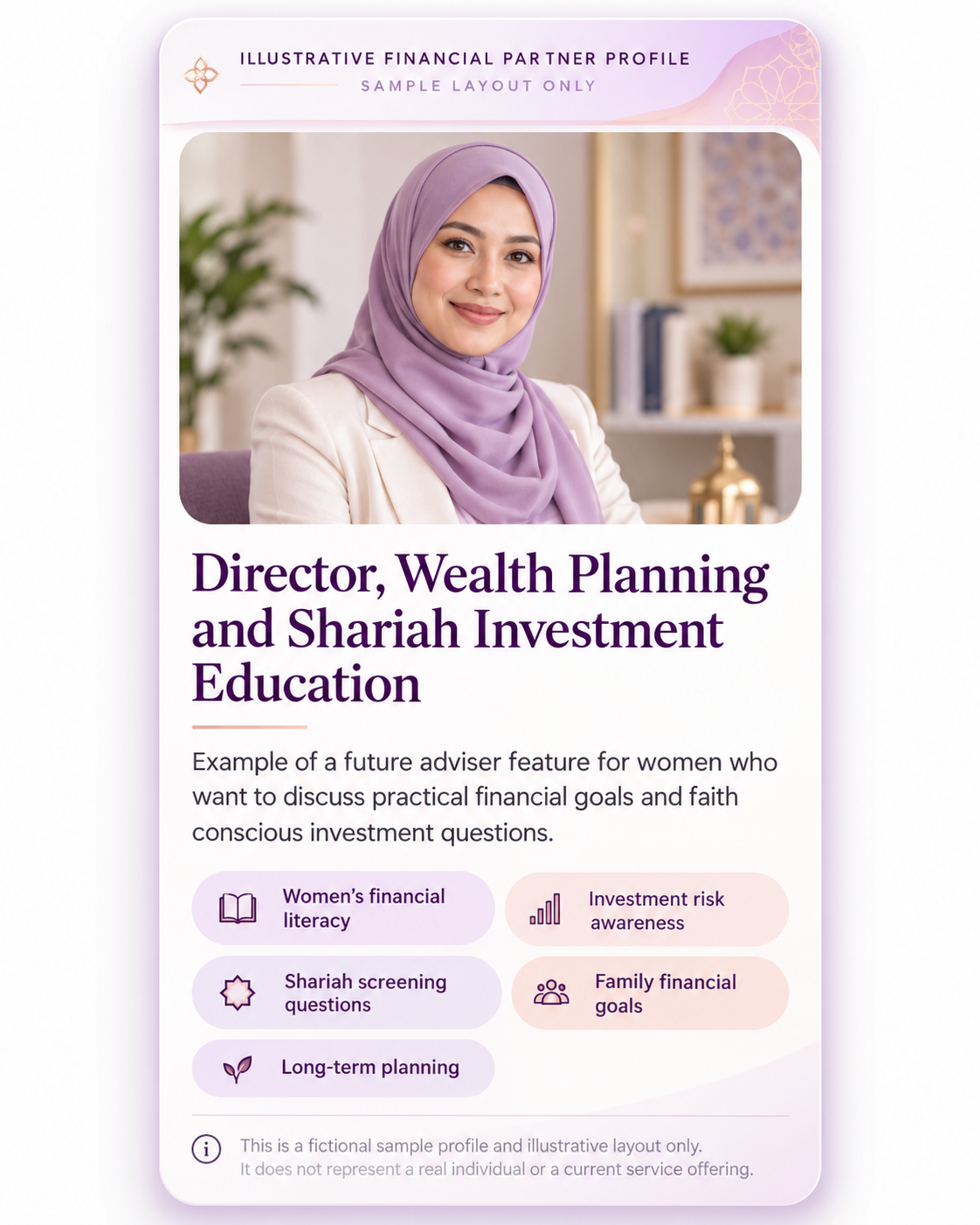
The director profile below illustrates the type of trusted educational partner we hope to feature. It is a fictional sample, not a real professional endorsement or evidence of client results. When an actual sponsor joins us, her confirmed appointment, qualifications and substantiated experience can be included here. Readers should independently check financial representatives through the MAS Representatives Register.
- CNA Women, January 2026: Why many women still find it hard to talk about money
- CNA Women, March 2026: Investing at every life stage
- Berita Harian, June 2017: Azlinah Ismail and Shariah investments
- CNA, January 2024: A young Singaporean woman’s condominium purchase
- MoneySense: What is investing?
- MoneySense: Building a portfolio
- MUIS: Fatwa on interest in CPF accounts
Reader notice: This feature offers general financial education and is not personal investment, legal or religious advice. All investing carries risk, including loss of capital. References to property or lifestyle are examples of goals, not promises of returns. Shariah conclusions may depend on the specific product and applicable screening approach. The sample adviser card above is fictional.
