
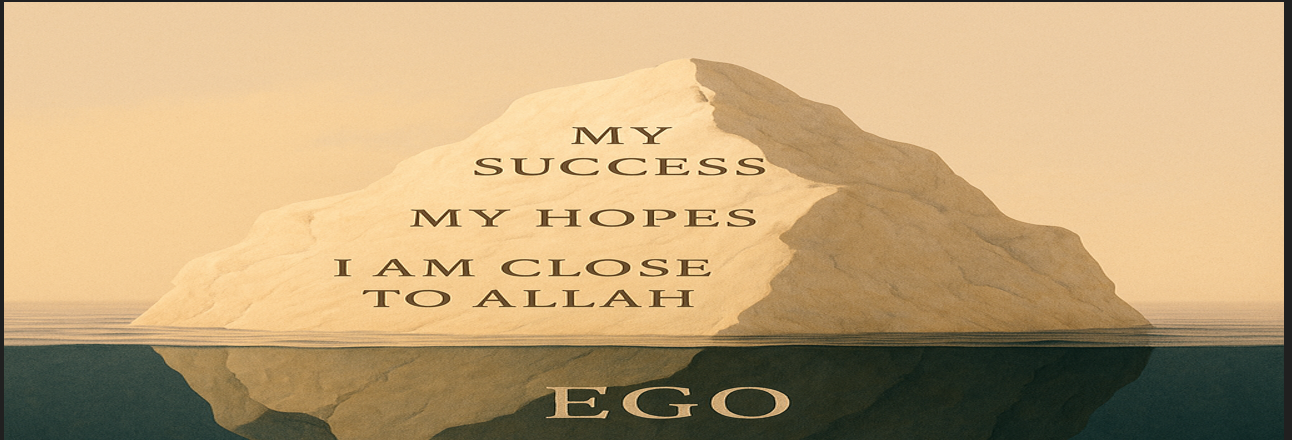
Most people think ego shows only in anger or arrogance. But sometimes it wears success like perfume, subtle, sweet and dangerous. You start believing you built everything with your own hands or your own dua blessed by the Almighty. You forget that your success could have come from your loved ones or well wishers.
It begins quietly. You work hard, earn well and gain respect. You tell yourself this is what barakah looks like. Then days pass where prayer becomes quick, remembrance becomes rare, and the heart feels strangely light, not peaceful but hollow. You are busy maintaining a life Allah once gave, but you stop maintaining your bond with Him.
Once, someone tried to recite verses from the Quran in their own way, just to feel closer to the words. But a religious person told them they were doing it wrong and even called them “stupid.” That single word hurt deeply. It was not the correction that wounded, but the way it was given. Sometimes, people who carry knowledge forget that guidance without kindness can turn into ego. The Quran teaches with mercy, not insult, and every sincere effort to learn should be met with patience, not pride.
When success turns into something we cannot stop talking about, ego has already found a quiet seat inside us. Most of the time, we do not mean to show off. We only want to share what made us happy a new job, a child’s achievement, a comfortable home. But somewhere in the excitement, words start sounding like proof of our worth. What began as gratitude slowly turns into display.
The Prophet ﷺ warned against doing deeds for reputation or display: “Whoever acts to be seen, ALLAH will expose him, and whoever acts to be heard, ALLAH will make him heard.” (Sahih Muslim 2987). The warning concerns intention. Simply posting or sharing something is not automatically riya. The question is why we are doing it and what effect it has on the heart.
Not every public blessing is showing off, and an unintended effect on someone else does not automatically make an act sinful. Still, sensitivity matters. Constant comparison, boasting or presenting a perfect life can hurt people who are already struggling, so gratitude should be paired with humility and awareness.
Gratitude can be private or public. The Quran itself speaks about mentioning the favour of your Lord, while sincerity still matters. The point is not to hide every blessing. It is to remember that the blessing came from ALLAH and not turn it into a measure of superiority over others.
Ego does not always show as pride in words. It often hides behind achievement, behind the smile of someone who looks calm but is quietly drifting from Allah. You tell yourself everything is fine. You pray, you give charity, you still believe. Yet little by little, worship starts to fade. You remember Allah only between tasks. You start to chase what you once avoided. You build a beautiful life, but your soul starts to feel tired.
Then hardship may come. It could be sickness, loss, disappointment or emptiness. Islam does not allow us to assume that every hardship is a punishment for pride or a personalised message from ALLAH. Trials can be tests, consequences, opportunities for growth or means of expiation. What we can say with confidence is that hardship often exposes how dependent we really are.
Other people’s duas may be among the means through which ALLAH brings good into our lives, and the prayers of parents or loved ones can be deeply meaningful. But we should not claim that a blessing collapses simply because another person becomes sad or stops making dua. That is knowledge of the unseen we do not possess.
Success and loss both occur within qadar. Our own choices, relationships and conduct can also have consequences, but we should not turn those consequences into secret spiritual formulas. Pride is dangerous because it distorts gratitude and responsibility, not because we can map every setback to a particular person’s hurt.
The truth is simple. Our achievements are borrowed. The health, the career, the peace at home, all on loan from Allah, all sustained by love around us. If He decides to take it back, no power, no title, no degree can stop Him.
So fear ALLAH with humility, not superstition. Do not wait for a crisis before practising gratitude, repairing relationships or returning to prayer. Hardship may teach us, but we should not claim to know the exact divine reason behind every loss.
Maybe that is the real test of ego. Not how loudly we defend our success, but how quietly we admit that none of it was ever ours.
That is why the hardest person to surrender to Allah is not anyone else. It is the self that thinks it is already close to Him.
More Reads!
- Sahih Muslim 2987 on acting for reputation and display
- On riya (showing off) being a form of minor shirk: “Verily, what I fear most for you after me is ostentation and hidden lusts” (Prophet ﷺ) abuaminaelias.com
- The notion that our deeds should be for Allah alone, and desires to be seen by others nullify them. quran.com+1
- When Faith Loses Wisdom: The Modern Crisis That Paves the Way for Imam Mahdi
- Waswasa in Islam: The Sinister Whispers That Destroy Marriages
